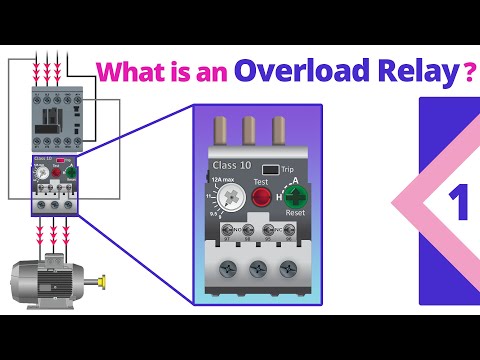
What is an Overload Relay? Connection & Working Principle

What is an Overload Relay? Connection & Working Principle

What is an Overload Relay and How Does It Work?

Introduction to Overload Relays

  • An overload relay is a device that protects motors from overheating due to excessive current draw.
  • It is essential for industrial automation, ensuring motors do not operate under harmful overload conditions.

Functionality of Overload Relays

  • The relay allows temporary harmless overloads (like inrush current) but trips during prolonged excessive current situations.
  • When an overload condition persists, the relay sends feedback to the contactor, which interrupts the motor's power supply.

Causes of Motor Overloading

  • Common causes include mechanical obstructions, improper shaft alignment, phase failures in three-phase systems, frequent starts/stops, high ambient temperatures, and damaged bearings.

Components of Overload Relays

  • Adjustable Current Setting: Allows setting the motor's rated Full Load Amps (FLA).
  • Auxiliary Contacts: Includes normally closed (NC) and normally open (NO) contacts that change state during an overload event.
  • Reset Button: Can toggle between manual and automatic reset modes after a trip occurs.
  • Test Trip Button: Simulates a trip to verify if the relay functions correctly.
  • Trip Indicator: Visually indicates when an overload condition has occurred by turning on.

Differences Between Overload Relays and Circuit Breakers

  • Circuit breakers protect against sudden high-current events like short circuits by opening instantly; they prevent immediate damage to motors.
  • In contrast, overload relays protect against gradual excessive current draw that can deteriorate winding insulation over time; they have a delayed trip characteristic based on their class rating.

Integration with Contactors

  • An overload relay must be paired with a contactor; it cannot operate a motor independently but provides critical protection within a motor starter setup.
  • Typically positioned beneath the contactor in wiring diagrams, it connects through prongs into load side terminals for effective operation.

Schematic Representation of Operation

  • Two symbols represent overload relays in wiring diagrams: NEMA standard uses opposing question marks while IEC standard uses digital pulse symbols for each phase.

Understanding Overload Relay Functionality

Overview of Overload Relay Operation

  • The overload relay plays a crucial role in protecting the motor by closing related contacts in the power circuit, allowing current to flow through the overload relay when operating normally without overload.
  • In case of an overload condition, the normally closed contact of the overload relay opens, which de-energizes the contactor’s coil and subsequently opens the primary contact in the power circuit, shutting off the motor.

Testing Overload Relay with Multimeter

  • To test an overload relay using a multimeter set to Continuity Beeper, ensure continuity between L1 and T1, L2 and T2, and L3 and T3 while in a non-tripped state.
  • When testing during a tripped situation, connections between L1 to T1, L2 to T2, and L3 to T3 remain intact; however, auxiliary normally closed contacts will show as open while normally open contacts will indicate continuity.

Upcoming Content

Video description

🎥 If you are curious to know what an overload relay is, what an overload relay consists of, how an overload relay is coupled into a contactor to protect a motor, what differences it has with a circuit breaker, and how to test an overload relay to check if it is functioning, watch this video until the end. By watching this video, you’ll get the answer to these questions: - What is a motor starter? - What is motor overload? - What is an overload relay? - How to test an overload relay? - How to wire an overload relay? - What causes overload current? - How does an overload relay work? - What are the components of an overload relay? - How to connect an overload relay to a contactor? - What is the difference between a circuit breaker and an overload relay? ====================================================== 💬 Video Summary: What is Motor Overload - If a motor draws too much current and generates too much heat, it indicates running in overload. So, to protect products in industrial automation, an overload relay is used to attach to a contactor to prevent motors from operating in overload. Overload Relay Operation - Once the overload relay detects an ongoing overload condition for a considerable time, it will trip and send feedback to the contactor, so the contactor breaks up the current flow and stops the motor. Motor Overload Causes - When a rotor gets jammed, and there is a mechanical obstruction. - When the process of aligning shafts with each other is not properly executed. - When the ambient temperature is high, and there is inadequate ventilation. - When a motor is undersized to handle a load which causes additional stress on a motor, and - When bearings, responsible for supporting the shaft inside a motor, have been damaged. Parts of an Overload Relay - Adjustable current setting: By using this dial, you can specify the amount of current the motor must draw to be considered overloaded. In other words, the motor's rated FLA or Full Load Amps can be set here. - Built-in auxiliary contacts: A pair numbered 95 to 96 is normally closed, whereas a pair numbered 97 to 98 is normally open. - Reset button: This design allows you to toggle between manual and automatic reset modes and functions as the reset button. - Test trip button: It may be utilized to simulate a trip off the overload relay to check if the overload relay is working correctly. - Trip indicator: provides the status of the overload relay visually. Meaning, when an overload condition happens, this indicator turns on. Difference between Overload Relay and Circuit Breaker - Using a circuit breaker, you can protect a motor from sudden high-current events caused by a short circuit. - On the other side, an overload relay protects a motor from the excessive current being drawn from the supply. Overload Relay and Contactor Connection An overload relay cannot be used to operate a motor on its own, so you need to pair it with a contactor. Typically, an overload relay is positioned beneath a contactor, often having three prongs extend outside its housing coupled into the contactor load side terminals. Overload Relay Testing Procedure Finally, we will show how to test the overload relay using a multimeter set to the Continuity Beeper. ====================================================== ⏰ TABLE OF CONTENTS ⏰ 00:00 Motor Overload Explained 00:52 Overload Relay Working Principle 01:22 Motor Overload Causes 02:02 Overload Relay Components 03:35 Overload Relay vs Circuit Breaker 04:34 Overload Relay Connection With Contactor 05:14 Overload Relay Wiring Diagram 06:46 Overload Relay Testing ====================================================== 🔥 Have you seen our recent popular videos? You can watch them here: DCS Explained: https://youtu.be/WyIRpfBQif4 PLC Explained: https://youtu.be/SbbxEzno3nU HMI Explained: https://youtu.be/M3RZKW38XA8 SCADA Explained: https://youtu.be/7kTJA69EzMc Photodiode Explained: https://youtu.be/rNoHLOumplk Capacitors Explained: https://youtu.be/E7_MBEhX8Ao Potentiometer Explained: https://youtu.be/sWbSeJmUFfw Solenoid Valves Explained: https://youtu.be/gWyGaqp_k1g PLC Hardware Components: https://youtu.be/wlCG8d2iQ5c IIoT | Industrial Internet of Things: https://youtu.be/GNiJwFCbTi4 2-Wire, 3-Wire, and 4-Wire Transmitter: https://youtu.be/XNBCSlQSh4A 2-Wire Transmitter Connection to PLC: https://youtu.be/LVU7252p25w 4-Wire Transmitter Connection to PLC: https://youtube.com/shorts/m7a-0XMVobE?feature=share ====================================================== 💡 If you enjoyed this video and want to follow our upcoming videos, subscribe to this YouTube channel and relax your mind: https://bit.ly/3CTjbUi ====================================================== #Automatedo #relay #overload