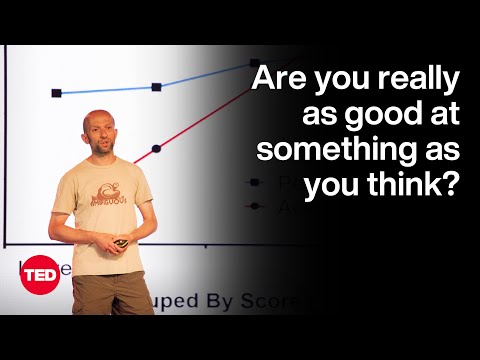
Are You Really As Good at Something As You Think? | Robin Kramer | TED
Introduction to Metacognition
The speaker discusses the concept of metacognition, which refers to our insight into our own thought processes and abilities. They mention that our self-assessment of skills may not always align with reality.
Understanding Metacognitive Insight
- Good metacognitive insight means that our perception of our abilities matches our actual performance.
- However, in reality, many people overestimate their skills in certain areas.
- The speaker gives an example of someone who thinks they are great at navigating maps but is actually not skilled in this area.
Better Than Average Effect
- The speaker asks the audience to rate themselves on their driving ability.
- Most people tend to rate themselves as above average, which is statistically impossible.
- This bias is known as the "better than average" effect and is one of several cognitive biases related to self-assessment.
The Dunning-Kruger Effect
The speaker introduces the Dunning-Kruger effect, a bias described by psychologists Dunning and Kruger in 1999. This effect explains how individuals with low ability often overestimate their performance due to a lack of metacognitive insight.
Graphical Representation
- People are divided into four groups based on their test scores.
- When comparing their actual scores with their self-assessments, a pattern emerges.
- The red line represents actual scores, while the blue line represents self-assessments.
- Weakest performers (green oval) significantly overestimate their performance.
Lack of Metacognitive Insight
- According to Dunning and Kruger, poor performance correlates with a lack of metacognitive insight.
- This pattern has been observed across various domains such as driving skill, exam-taking, and chess-playing.
Criticisms of the Dunning-Kruger Effect
The speaker discusses criticisms of the Dunning-Kruger effect and highlights reasons to doubt its validity.
Statistical Effect: Regression to the Mean
- The statistical effect known as regression to the mean can influence self-assessment.
- When two measures are related but not perfectly, there can be variations in rankings.
- The speaker uses the example of height and weight measurements to explain this concept.
Meaningless Data Produces Similar Pattern
- Shuffling or randomizing data still produces a similar pattern observed in the Dunning-Kruger effect.
- This suggests that the pattern may not be solely attributed to metacognitive insight.
Application in Face-Matching
The speaker expresses disappointment with the application of the Dunning-Kruger effect in their field of expertise, face-matching.
Face-Matching Task
- Face-matching involves determining whether two images show the same person or different individuals.
- The speaker mentions how we often rely on others' judgments when it comes to our ID photos.
Timestamps beyond this point were not provided.
New Section
In this section, the speaker presents four pairs of images and asks the audience to determine whether each pair is a match or a mismatch. The difficulty of this task is highlighted due to changes in facial expression, lighting, and time.
Insight and Ability in Image Matching
- The speaker focuses on individual decision making rather than overall scores and self-estimates.
- Participants were asked to rate their confidence in each decision.
- Good metacognitive insight would be reflected in higher confidence for correct responses and lower confidence for incorrect responses.
New Section
In this section, the speaker analyzes the participants' performance in image matching tasks based on their confidence levels.
Confidence Levels and Performance
- The red line represents confidence in incorrect responses, which remains consistent regardless of overall test performance.
- The blue line represents confidence in correct responses, showing that better performers are more confident compared to weaker performers.
- Weaker performers show poor metacognitive insight as they have similar levels of confidence for both correct and incorrect responses.
New Section
This section discusses the relationship between insight, ability, and the Dunning-Kruger effect.
Insight and the Dunning-Kruger Effect
- Weaker performers do not exhibit overconfidence as predicted by the Dunning-Kruger effect.
- However, weaker performers lack insight into their own abilities as they cannot differentiate between correct and incorrect responses.
- Insight does depend on ability but not exactly as described by the Dunning-Kruger effect.
New Section
In this final section, key takeaways from the talk are summarized.
Key Takeaways
- Science is always updating with new evidence that may contradict or disprove previous work.
- The Dunning-Kruger effect may not be as prevalent as believed, and insight depends on ability.
- Weaker performers lack insight and cannot differentiate between correct and incorrect responses.
- Confidence does not always indicate correctness; it is possible to be confident but have poor insight.
New Section Expertise and Confidence
In this section, the speaker discusses the relationship between expertise, confidence, and accuracy in one's field of knowledge.
The Importance of Confidence and Uncertainty
- If someone is an expert in their field, their level of confidence can be indicative of the accuracy of their statements.
- However, it is more sensible to rely on someone who is knowledgeable rather than simply confident, as confidence can sometimes be misplaced.
Key Takeaways
- Expertise combined with confidence is a good indicator of accurate information.
- It is important to consider both confidence and uncertainty when evaluating someone's knowledge.
- Relying solely on confidence without expertise can lead to misinformation.
New Section Additional Topic
Provide a brief overview or summary of the next topic discussed in the transcript.
Subtopic Title
- Use bullet points to provide a detailed description of key points and insights. Each bullet point is a link to the corresponding part of the video using timestamps.
Turn any video into a summary like this
YouTube links, meetings, lectures. With transcripts, search, and chat.