How to tell the difference between permutation and combination
Permutation vs Combination
In this video, the difference between permutation and combination is explained. Permutation is used when order matters, while combination is used when order does not matter.
Permutation
- Permutation is used when order matters.
- It counts things once and does not count them twice.
- In a permutation, the order of items being counted matters to the recipients.
- Example: Distributing prizes among 10 people with a $20 bill, a $10 bill, and a $5 bill.
Combination
- Combination is used when order does not matter.
- It counts things without considering their order.
- In a combination, all members have equal roles or jobs.
- Example: Distributing prizes among 10 people with 3 $5 prizes.
Calculation Methods
Permutation Formula
- The permutation formula is P(n,r) = n! / (n-r)!
- Example calculation for the previous scenario: P(10,3) = 10! / (10 - 3)! = 720
Combination Formula
- The combination formula is C(n,r) = n! / (r!(n-r)!)
- Example calculation for the previous scenario: C(10,3) = 10! / (3!(10 - 3)!) = 120
Solving Examples
Several examples are provided to demonstrate how to solve permutation and combination problems using formulas and calculators.
Example 1 - Distribution of Prizes
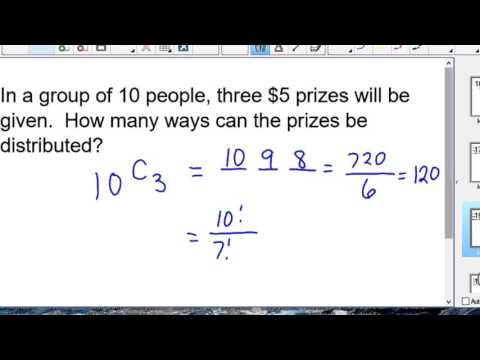
In a group of 10 people, three $5 prizes will be given out. How many ways can the prizes be distributed?
Solution:
- Since order does not matter in this case, it's a combination problem.
- Using the combination formula, C(10,3) = 10! / (3!(10 - 3)!) = 120.
Example 2 - Forming a Committee
A local school board with eight people needs to form a committee with three people. How many ways can this committee be formed?
Solution:
- Since order does not matter in forming the committee, it's a combination problem.
- Using the combination formula, C(8,3) = 8! / (3!(8 - 3)!) = 56.
Example 3 - Forming a Committee with Different Responsibilities
A local school board with eight people needs to form a committee with three different responsibilities. How many ways can this committee be formed?
Solution:
- Since order matters in assigning different responsibilities, it's a permutation problem.
- Using the permutation formula, P(8,3) = 8! / (8 - 3)! = 336.
Example 4 - Forming a Committee with Specific Gender Requirements
A local school board with eight people needs to form a committee of three members. Two must be girls and one must be a boy. How many ways can the committee be formed?
Solution:
- This is also a permutation problem since specific gender requirements are involved.
- The calculation would be: P(5,2) * P(3,1) = (5! / (5 - 2)!)(3! / (3 -1)!) = 60.
Conclusion
The video concludes by summarizing the concepts of permutation and combination and providing solutions to various examples.
Overall Summary:
- Permutation is used when order matters, while combination is used when order does not matter.
- Permutation formula: P(n,r) = n! / (n-r)!
- Combination formula: C(n,r) = n! / (r!(n-r)!)
- Examples were provided to demonstrate the application of these formulas.
- Calculators can also be used to solve permutation and combination problems.
Counting Boys and Girls
In this section, the speaker discusses counting boys and girls in a given scenario.
Counting Boys and Girls
- The scenario involves three boys and five other girls.
- To determine the number of possible combinations, we use the formula 5 choose 2 for selecting two girls from the group of five.
- We then multiply this by 3 to account for the three boys.
- Alternatively, we can calculate it using bins. We start with 5 options for the first girl, then 4 options for the second girl (since one has already been chosen). However, we need to divide by 2 to account for repeated combinations.
- The final result gives us the total number of combinations of boys and girls in this scenario.
Choosing One Girl
In this section, the speaker discusses choosing one girl from a group.
Choosing One Girl
- To choose one girl from a group of three, we use the formula "3 choose 1" or simply count all possible options.
- Another approach is to think in terms of bins. We start with 5 options for the first girl, then subtract out any repeated combinations (in this case, there are none).
- By applying these methods, we can determine how many ways we can choose one girl from a given group.
The language used in these notes is English as specified in the transcript.