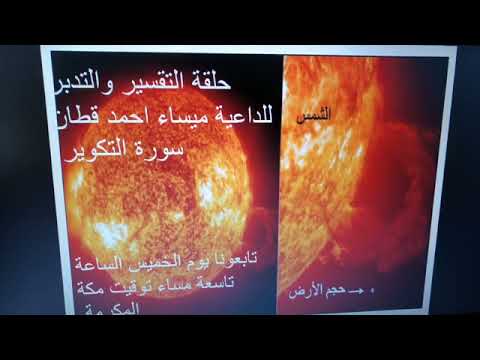
تدبر وتفسير سورة التكوير مع الداعية الإسلامية ميساء قطان
Introduction to the Tafsir of Surah At-Takwir
Opening Remarks
- The speaker begins with a prayer and greeting, emphasizing the importance of understanding the Quran.
- A quote from Abdullah ibn Mas'ud highlights that those seeking knowledge should reflect on the Quran, which contains wisdom for all generations.
Overview of Surah At-Takwir
- The discussion focuses on Surah At-Takwir, a significant chapter in the Quran that depicts events of the Day of Judgment.
- The Prophet Muhammad (peace be upon him) stated that reading this surah allows one to visualize the Day of Resurrection as if witnessing it firsthand.
Themes and Significance of Surah At-Takwir
Nature of Revelation
- This surah was revealed in Mecca before the Prophet's migration, aiming to correct misconceptions about existence and faith.
- It addresses fundamental beliefs about God, prophethood, and resurrection, reinforcing core Islamic tenets.
Cosmic Transformations
- The surah describes dramatic cosmic changes during the Day of Judgment: celestial bodies will alter their states dramatically (e.g., sun darkening).
- These transformations serve as reminders for humanity regarding accountability and divine power over creation.
Key Messages in Surah At-Takwir
Divine Will and Human Accountability
- Emphasizes God's ultimate control over all events; nothing occurs without His permission or decree.
- Humanity is reminded that they will face judgment based on their deeds; every soul must account for its actions.
Urgency for Reflection
- The speaker urges listeners to engage deeply with these verses rather than merely memorizing them; true understanding leads to spiritual awakening.
- There is an emphasis on feeling a profound sense of awe when contemplating God's might as depicted in this surah.
Imagery and Language in Surah At-Takwir
Poetic Expressions
- The use of conditional phrases like "if" indicates certainty about future events; these are not mere possibilities but assured occurrences.
- Vivid imagery illustrates cosmic upheaval—sun being wrapped up, stars falling dimmed—creating a powerful visual representation of impending doom.
Emotional Impact
- Readers are encouraged to feel fear and reverence towards God's omnipotence through evocative language describing celestial phenomena changing drastically at judgment day.
Scientific Insights Related to Surah At-Takwir
Discussion on Celestial Bodies
- Mentioned scientific aspects related to stars and their distances from Earth highlight both human insignificance and divine grandeur within creation narratives found in scripture.
Conclusion on Cosmic Scale
- Reflecting on vastness emphasizes how small Earth is compared to other celestial entities while also reminding believers about eventual destruction awaiting all creations except God’s essence alone as per Quranic teachings.
The End of the Universe and Day of Judgment
Signs of the End Times
- The universe will unravel, with strong mountains becoming like wool. Various signs are mentioned in the Quran regarding the end times, particularly concerning the first blowing of the trumpet (نفخة الصور).
- All creation will perish, followed by a second blowing that resurrects humanity for judgment before Allah.
The Reality of Resurrection
- Everyone will witness these events firsthand; thus, it is crucial to prepare for meeting Allah on Judgment Day.
- Significant cosmic changes will occur: the sun will be darkened, stars will fall, and even mighty mountains will lose their stability.
Transformation of Creation
- Mountains that once seemed immovable will become insignificant as they are flattened during this cataclysmic event.
- Scholars have differing opinions about specific signs preceding Judgment Day; however, chaos among people and nature is expected.
The Great Gathering
- On that day, all beings—humans and animals alike—will be terrified. The trumpet's sound will cause everyone to faint.
- Prophet Muhammad (peace be upon him) described how even mundane activities would cease as people succumb to fear at the sound of the trumpet.
Value Shift on Judgment Day
- Material possessions such as food or wealth will hold no value when resurrection occurs; individuals won't care for their belongings.
- After death, there is a transition to a second blowing which signifies resurrection for accountability before Allah.
Cosmic Disruption and Human Accountability
Cosmic Events Leading to Judgment
- Major disruptions in nature signify that earthly values diminish; everything created serves a purpose until its time ends.
- Wealthy items like camels (عشار), which were highly valued in ancient times, become worthless during this upheaval.
Loss of Material Value
- On Judgment Day, material wealth loses significance; only good deeds matter.
Human Behavior During Catastrophe
- People may abandon their homes and possessions during disasters similar to those experienced on Earth but magnified on Judgment Day.
Animals and Nature's Role in Judgement
Gathering of Creatures
- All creatures—including wild animals—will be gathered together. Humans' fears towards them transform into indifference due to overwhelming terror from divine judgment.
Nature’s Reaction
- Oceans and seas filled with life will undergo drastic changes; they too shall react violently during this period leading up to judgment.
Divine Power Over Creation
Transformation into Fire
- Seas may ignite due to divine command; scientists have discovered potential fire sources beneath oceans indicating God's power over creation.
Finality Before Resurrection
- As souls are gathered for judgment after experiencing these calamities, each individual stands accountable alongside their kind—believers with believers and disbelievers with disbelievers.
Division Among Souls
Grouping Based on Deeds
- Those who committed sins gather together while righteous individuals unite based on their faithfulness. This division emphasizes accountability based on one's actions in life.
Reflection on Personal Conduct
- Individuals should reflect upon their lives: Are they aligned with scholars or engaged in sinful behavior? It’s essential to evaluate one’s standing before God based on actions rather than mere words or intentions.
The Day of Judgment and Accountability
Understanding the Significance of Actions
- The speaker emphasizes the importance of preparing for the Day of Judgment, urging listeners to reflect on their actions and intentions in life.
- A reminder is given about the rewards for those who are charitable and sincere in their worship, highlighting that God will gather them under His shade on that day.
- The necessity of associating with righteous individuals and engaging in good deeds is stressed as a means to attain God's pleasure.
Reflection on Life Choices
- The concept of accountability is introduced through the metaphor of a buried girl (the "mo'ooda"), questioning her unjust death and emphasizing justice from God.
- It’s noted that many people live in fear due to societal pressures, which leads to wrongful actions; this serves as a warning against injustice.
Consequences of Actions
- The speaker discusses how everyone will be questioned by God regarding their deeds, stressing that faith should guide one's actions rather than mere rationalization.
- A stark contrast is drawn between worldly success and divine judgment; true worth lies not in status but in righteousness.
Youth Engagement with Faith
- Young people are encouraged to engage actively with religious teachings instead of wasting time on trivial pursuits like social media or entertainment.
- There’s an urgent call for youth to prioritize spiritual growth over distractions, reflecting on how they spend their time.
Spiritual Decline and Its Implications
- Concerns are raised about the gradual decline in adherence to religious principles among believers, particularly during celebrations where violations occur.
- Observations are made about prayer being performed without sincerity or focus, indicating a need for deeper connection with God.
Upholding Religious Values
- The importance of maintaining modesty and adhering strictly to Islamic guidelines is reiterated; any deviation can lead one away from God's favor.
- Men are reminded about lowering their gaze as part of moral conduct, reinforcing mutual respect between genders within Islamic teachings.
Accountability Before God
- Each individual will be held accountable for every action taken; this includes intentions behind teaching or sharing knowledge.
- Listeners are urged to renew their intentions when engaging with religious practices, ensuring they seek God's pleasure above all else.
Preparing for Divine Judgment
- Parents must consider how they raise their children spiritually; it’s crucial that homes reflect values aligned with Islam.
- On the Day of Judgment, personal records will be revealed openly; thus, living righteously now prepares one for accountability later.
Final Reflections on Life's Purpose
- Emphasis is placed on self-reflection regarding one's life choices—what has been done for oneself versus what has been done for others or God?
- Individuals should strive towards making meaningful contributions rather than superficial ones; true fulfillment comes from serving others and adhering closely to faith.
This structured summary captures key insights from the transcript while providing timestamps linked directly back to specific moments within the content.
Importance of Understanding the Quran
Engaging with the Quran
- Emphasizes the significance of dedicating time to understanding the Quran rather than engaging in activities that do not please Allah.
- Stresses that merely memorizing verses is insufficient; one must live and experience the teachings, especially regarding concepts like resurrection and judgment day.
Application of Knowledge
- Highlights that true believers should embody their faith in daily life, influencing their children positively by living for Allah.
- Encourages continuous learning and application of Quranic knowledge as a means to earn ongoing rewards even after death.
The Reality of Hellfire
Descriptions of Hell
- Provides vivid imagery about hellfire, including its immense size and terrifying nature, urging listeners to seek refuge from it through sincere prayers.
- Discusses how fear of worldly ailments pales in comparison to the fear of hellfire, emphasizing its eternal consequences.
The Path to Paradise
- Contrasts the fate of believers who will be shielded from hellfire with those who will face its horrors, reinforcing hope for paradise among the righteous.
Spreading Knowledge and Good Deeds
Impact on Others
- Encourages sharing knowledge gained from lectures or studies as a way to accumulate good deeds over time.
- Reflects on personal growth through learning Quranic recitation and prayer practices, highlighting transformative experiences.
Accountability Before God
- Urges self-reflection on one's actions towards others—whether they have contributed positively or negatively—and emphasizes accountability before God.
The Nature of Divine Revelation
Understanding God's Signs
- Discusses how divine signs are evident in creation and emphasizes recognizing them as part of God's communication with humanity.
The Role of Angels
- Introduces Gabriel's role as a messenger delivering revelations to Prophet Muhammad (PBUH), underscoring his importance within Islamic theology.
The Significance of Faithful Practice
Living by the Quran
- Stresses that mere reading without understanding or application is inadequate; true faith requires active engagement with scripture.
Overcoming Doubts
- Addresses skepticism faced by believers regarding prophetic messages, affirming their truth through divine validation.
Prophetic Experiences
Visionary Encounters
- Shares accounts where Prophet Muhammad (PBUH), witnessed angel Gabriel in his true form during significant moments like Isra and Mi'raj.
Recognition of Divine Majesty
- Concludes with reflections on God's grandeur revealed through these encounters, encouraging deeper appreciation for spiritual experiences.
What is the Message of the Quran?
The Importance of the Quran and Prophethood
- The speaker emphasizes that Prophet Muhammad (peace be upon him) is not stingy with his message, having conveyed it fully and faithfully.
- The Quran is affirmed as the word of God, dismissing claims that it could be influenced by evil forces; it is a divine revelation.
- The speaker urges listeners to reflect on their actions in light of the Day of Judgment, highlighting the transient nature of worldly life.
Divine Signs and Guidance
- God swears by celestial bodies and natural phenomena to illustrate His power, encouraging believers to seek enlightenment through the Quran.
- The guidance provided through the Quran is described as essential for leading a righteous life, emphasizing its role in correcting one's path.
Accountability and Self-reflection
- A reminder that after death, individuals will face either paradise or hell based on their earthly deeds; this serves as motivation for self-assessment.
- Questions are posed about human direction in life, urging introspection regarding one’s faith and practices.
Practical Application of Beliefs
- True belief must translate into action; mere acknowledgment without practice (like prayer or adherence to Islamic principles) is insufficient.
- Many claim faith yet do not act accordingly; this inconsistency highlights a need for genuine commitment to God's commands.
Living According to Divine Will
- Every aspect of life should align with pleasing God; from speech to behavior, all should reflect devotion.
- Social media and daily interactions should also serve as platforms for worship rather than distractions from it.
How Can One Achieve True Guidance?
Daily Accountability
- Regular self-evaluation is crucial; individuals should assess their prayers and actions daily rather than infrequently.
- Setting personal goals for spiritual growth can help maintain focus on religious duties throughout each day.
Community Influence
- Surrounding oneself with righteous company can significantly impact one's spiritual journey; accountability within community settings fosters growth.
Embracing Knowledge
- Knowledge gained from studying the Quran should be shared widely among family and friends as part of fulfilling one’s duty towards others.
The Role of Choice in Faith
Free Will vs. Divine Decree
- Individuals have free will in choosing their paths toward righteousness or sinfulness; God's guidance aligns with sincere intentions.
Seeking Support
- Those seeking guidance must actively pursue knowledge and supportive relationships that lead them closer to God’s pleasure.
Final Reflections on Prophethood
Affirmation of Truth
- The speaker concludes by reiterating that both the Quran's teachings and prophethood are vital truths meant for all humanity.
Understanding the Essence of Quranic Reflection
Introduction to Quranic Study
- The speaker emphasizes the importance of understanding and reflecting on the meanings of Quranic verses, hoping that it will lead to a deeper connection with God.
- Acknowledges various interpretations and opinions regarding the meanings of the verses but stresses that ultimately, they should enhance faith in meeting God and improving one's deeds.
Spiritual Aspirations
- The speaker expresses a desire for the Quran to be a source of comfort and guidance, referring to it as "the spring of our hearts" that alleviates worries and sorrows.
- Encourages participants to share their reflections on social media, highlighting the communal aspect of learning and spreading knowledge about the Quran.
Accountability and Reflection
- Discusses how people often live without acknowledging mortality, leading to a lack of adherence to God's commands. Urges listeners to seek forgiveness for their shortcomings.
- Stresses that good deeds will be recorded positively in one's book on Judgment Day, emphasizing the importance of inviting others towards righteousness.
Commitment to Learning
- Mentions upcoming opportunities for students to engage in further studies such as Tajweed (pronunciation rules) and Tafsir (interpretation), encouraging them to participate actively.
Closing Thoughts
- Conveys condolences for recent losses within the community while expressing love for all attendees. Ends with prayers for mercy upon those who have passed away.