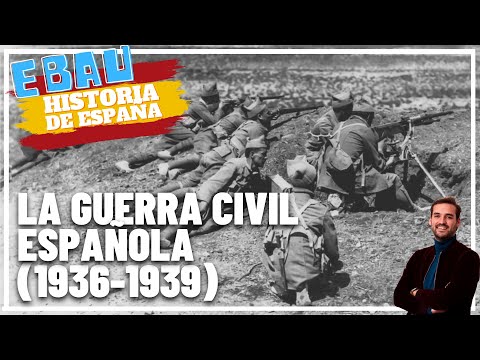
LA GUERRA CIVIL ESPAÑOLA (1936-1939) | Historia de España 🇪🇸
Spanish Civil War Overview
The Spanish Civil War is a significant historical event that continues to influence Spain, with deep-rooted divisions persisting in society and politics.
Causes of the Spanish Civil War
- The war was not just a conflict between two sides but a clash of multiple ideologies within Spain.
- Many battles from the civil war era still resonate in modern-day Spain, even if some younger generations seem to have forgotten them.
Initial Events and Movements
- After the radicalization post the 1936 elections, notable assassinations occurred on July 12th and 13th, fueling political tensions.
- The assassination of José Calvo Sotelo catalyzed military conspiracies against the Republic, leading to the failed uprising on July 17th, 1936.
Military Actions and Divisions
- Despite initial failures, Franco's forces gained control in certain regions like Morocco and parts of mainland Spain.
- The conflict divided Spain geographically based on agricultural versus industrial dominance, impacting each side's economic power.
International Involvement
- The conflict internationalized as foreign powers intervened or stayed neutral; Britain and France's non-intervention stance affected Republican forces.
Evolution of the Spanish Civil War
This section delves into the progression of the Spanish Civil War, highlighting key events, strategies, and outcomes that shaped the conflict.
Initial Phases of the Conflict
- The rebel faction received substantial support from Italy and Germany in terms of resources, particularly minerals crucial for German war industries.
- The rebels aimed to capture Madrid initially, with General Franco advancing from the south and General Mola from the north. The Battle of Madrid ensued but was prolonged due to Republican resistance in key battles like Ciudad Universitaria and Jarama.
Shifts in Strategies and Offensives
- Franco redirected his strategic focus towards conquering northern Spain after facing challenges in taking Madrid. This shift led to offensives in regions like Vizcaya, Santander, and Asturias.
- Both sides engaged in offensives to seize initiative; however, Franco's plans for a new offensive on Madrid were altered by Republican advances on Teruel. Subsequent counteroffensives reshaped territorial control.
Decisive Battles and Conclusion
- The Battle of Ebro marked a significant confrontation resulting in a decisive victory for Franco's forces. This battle symbolized the downfall of the Republic with substantial casualties on both sides.
- Following victories by Franco's troops, Catalonia fell swiftly without much resistance. President Azaña crossed into France as it became evident that the war was nearing its end.
Political Evolution on Both Sides
- In Republican Spain, political shifts within governing bodies influenced strategies and unity. Internal conflicts between factions like anarchists and communists impacted governance during critical phases.
New Section
This section discusses the establishment of a single party under Franco's leadership, merging two major ideologies that supported the rebel cause during the Spanish Civil War.
Franco's Unification Decree
- Franco promoted the unification of two key ideologies, Francoism and Carlism, through the Unification Decree in April 1937.
- The decree led to the formation of a single party named Falange Española Tradicionalista de las Juntas de Ofensiva Nacional Sindicalista under Franco's leadership.
New Section
This part highlights how Franco consolidated power after merging franquistas and carlistas under his leadership within a short period.
Consolidation of Power
- In a few months, Franco centralized all powers including those of the army, government, and the new single-party regime under his control.
- The consolidation process merged franquistas and carlistas under Franco's leadership.
New Section
The aftermath of the Spanish Civil War is discussed here, focusing on human losses and political consequences.
Human Losses and Exile
- Approximately half a million deaths occurred during the war due to various factors including warfare and repressive activities.
- Around 300,000 individuals became political exiles post-war with notable figures like poets, artists, and scientists fleeing Spain.
New Section
This segment delves into significant repercussions such as mass exiles and imprisonment following the Spanish Civil War.
Exiles and Imprisonment
- Over 250,000 people were imprisoned or sent to forced labor camps at the end of the conflict.
- A substantial number of individuals fled Spain as political exiles during this period.
New Section
Economic devastation and political outcomes post-Spanish Civil War are explored in this part.
Economic Devastation and Political Shift
- The war resulted in economic turmoil marked by loss of reserves, reduced workforce, infrastructure destruction, and decreased income levels for Spaniards.
Turn any video into a summary like this
YouTube links, meetings, lectures. With transcripts, search, and chat.