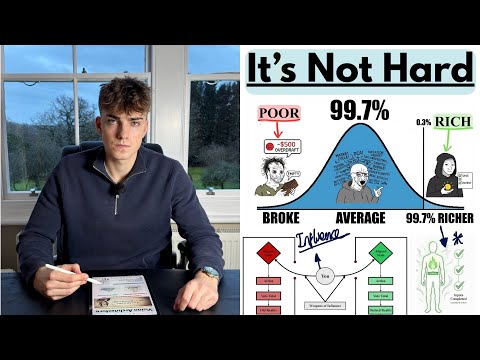
you’ll get richer than 99.7% of people if you watch this
Understanding Emotional Dependency and Financial Success
The Impact of Caring Too Much
- Individuals often remain poor due to excessive emotional attachment to outcomes, which creates barriers to success.
- The speaker shares personal experience, stating that detaching from outcomes led to significant financial success, earning over $100,000 in a month.
Detachment vs. Desire
- The concept of "detachment" is discussed; the speaker critiques the traditional law of detachment for suggesting complete elimination of desire.
- It is argued that humans require desire as an incentive for action; eliminating desire could lead to inaction.
- Emotional dependency on goals can hinder progress; people fail not because they want too much but because they need it too desperately.
Need Desire vs. Want Desire
- Need Desire: Characterized by total emotional dependency where individuals feel incomplete without their goals, leading to fear and inaction.
- Want Desire: Represents a healthier form of motivation where individuals desire goals but are not emotionally dependent on them, allowing for more balanced action.
The Goldilocks Zone
- The "Goldilocks zone" refers to an optimal level of emotional dependency—neither too high nor too low—that encourages effective action without overwhelming pressure.
- High dependency leads to fear-driven actions that can paralyze decision-making and create anxiety around performance (e.g., public speaking scenarios).
Action Dynamics
- Excessive need leads to analysis paralysis; individuals become hesitant due to viewing every action as critical for survival or success. This hinders decisive action-taking.
- In contrast, want desire allows for imperfect yet decisive actions driven by confidence rather than fear, fostering creativity and adaptability in problem-solving situations.
Shifting from Need Desire to Want Desire
Understanding Dependency and Certainty
- Dependency arises from uncertainty about achieving goals; this uncertainty fuels emotional attachment and neediness towards outcomes.
- To reduce dependency, one must cultivate certainty about achieving their goals through consistent actions rather than waiting for feelings of readiness or confidence first.
Engineering Certainty Through Action
- Certainty is described as a lagging indicator that follows consistent action; taking steps toward a goal builds confidence over time rather than the other way around.
- Breaking down goals into actionable steps helps clarify what needs to be done consistently—this clarity fosters certainty about eventual success.
Reverse Engineering Goals
- Reverse engineering involves identifying necessary inputs (e.g., daily tasks) required to achieve desired outputs (financial targets), emphasizing consistent effort over outcome fixation.
- Doubling input efforts ensures that even with conservative estimates, achieving the goal becomes highly probable if maintained consistently.
Focus Shift Towards Inputs
- By concentrating on daily inputs instead of expected outcomes, individuals can build momentum and celebrate small wins regularly while reducing anxiety related to results.
- This shift allows one to embrace certainty regarding their path forward while minimizing emotional dependencies tied directly to specific outcomes.
Achieving Financial Independence Through Mindset Change
Transitioning from Fear-Based Actions
- Moving from a state of confusion or overwhelm into one characterized by certainty enables individuals to take substantial actions toward their financial aspirations without being paralyzed by fear or doubt.
- Ultimately, cultivating want desire through understanding one's inputs leads not only towards financial independence but also personal growth beyond conventional limits.