Juicio Sumario: concepto, características, tramitación, incidentes y sustitución del procedimiento.
Introduction to Summary Procedure
In this section, the speaker introduces the summary procedure as a declarative process designed for cases requiring swift and effective resolution.
General Cases and Special Cases
- Two main categories of cases where summary procedure applies:
- General cases under Article 680 of the Civil Procedure Code.
- Special cases specified in the second paragraph of Article 680.
- General cases involve actions needing quick resolution due to their nature, while special cases are those mandated by legislation for mandatory summary proceedings.
Specific Instances of Summary Procedure
- Specific instances where summary procedure is applicable:
- Actions ordered to proceed summarily by law or similar forms (e.g., jactancy trial).
- Matters concerning natural or legal servitudes' establishment, exercise, modification, or extinction.
- Summary procedure also applies to:
- Fee collection procedures except for specific instances mentioned in Article 697 of the Civil Procedure Code.
Additional Instances and Scenarios
- Summary procedure is used in:
- Proceedings related to guardianship appointments and removals.
- Applicable in disputes between legal representatives and their wards, as well as in deposit-related lawsuits where deposits become necessary under certain circumstances.
Continuation of Summary Procedure Details
This section delves deeper into various scenarios where summary procedure is utilized for efficient legal processes.
Legal Actions Transformation
- Summary procedure is employed in actions that have transitioned from ordinary to executive actions per Article 2515 of the Civil Code.
- Notably, if an executive action has prescribed within three years but can still be pursued as an ordinary action within five years after prescription.
Declaration Pursuits
- The use of summary procedure is mandated when seeking a declaration required by law or contract without pursuing further claims beyond what's stipulated in Article 696.
Specific Legal Rights Pursuit
- Summary procedure applies when pursuing rights granted by former Article 945 of the Civil Code (now integrated into water laws).
Civil Actions from Criminal Offenses
Explanation of Article 680
In this section, the speaker explains the reference to civil indemnity action in Article 680 and discusses the competent court for restitution.
Understanding Civil Indemnity Action
- Article 680 refers to civil indemnity action.
- The competent court for restitution is the penal tribunal, specifically starting with the guarantee judge and then moving to the trial court judge.
Characteristics of Summary Procedure
This part delves into the specific conditions that make up a summary procedure and its key characteristics.
Key Characteristics of Summary Procedure
- Summary procedure is declarative, primarily aimed at declaring a right.
- It is a brief process compared to ordinary procedures.
- The procedure is concentrated, consolidating various steps into one hearing.
Concentration in Summary Procedure
Concentration within the summary procedure is discussed, highlighting how different processes are streamlined into a single session.
Concentration Aspects in Summary Procedure
- Different proceedings are consolidated in one hearing, such as response and conciliation.
- All exceptions must be raised during this combined session.
Verbal Nature of Summary Procedure
The verbal aspect of the summary procedure is explained along with its implications.
Verbal Nature of Proceedings
- Theoretically, it's a verbal process but allows written submissions per legal provisions.
- Despite being initially verbal, it often transitions into a written format during practice.
Substitution Provision in Summary Procedure
This segment covers the substitution provision within the context of summary procedures.
Substitution Provision Details
- Substitution provision applies generally but not to specific cases within summary procedures.
Provisional Concession and Appeals Competence
Discussing provisional concession and expanded competence for appeals courts in summary procedures.
Procedural Elements
- Provisional concession can lead to provisional res judicata.
Overview of Legal Proceedings
This section delves into the legal procedures that occur during court hearings, focusing on the actions and responsibilities of both plaintiffs and defendants.
Legal Procedures in Court Hearings
- The defendant is allowed by law to respond in writing, which often leads to written responses being the norm during court proceedings.
- Resolutions are typically not finalized during the initial hearing but rather in the definitive sentence. The court initiates conciliation discussions between parties, aiming to resolve conflicts amicably.
- If only the defendant appears at a conciliation and response hearing, they must present their defense and any necessary exceptions or incidents. These matters are usually resolved in the final sentence.
- When only the plaintiff attends a hearing, it is assumed that the defendant has physically responded to all allegations. The court then proceeds with evidence reception if substantial facts are disputed.
- In cases where only the plaintiff attends a conciliation and response hearing, they can request provisional acceptance of their claims if valid reasons are provided.
Provisional Acceptance of Claims
This segment explores scenarios where only one party attends a hearing and seeks temporary approval of their demands pending further proceedings.
Requesting Provisional Acceptance
- If solely the plaintiff is present at a hearing due to the defendant's absence, they may ask for provisional approval of their claims by presenting plausible justifications.
- The plaintiff's request for provisional acceptance allows five days for the absent defendant to oppose this decision upon notification. Opposition does not immediately halt provisional acceptance but triggers further legal steps.
- Should opposition arise from the absent party, it does not automatically suspend provisional acceptance but prompts formal contestation. A new conciliation hearing with both parties may be scheduled as a result.
Evidence Presentation and Trial Phase
This part outlines the trial phase following preliminary procedures such as conciliation attempts and response submissions.
Trial Phase Initiation
- After initial processes like conciliation meetings conclude, significant disputed facts lead to evidence reception by the court.
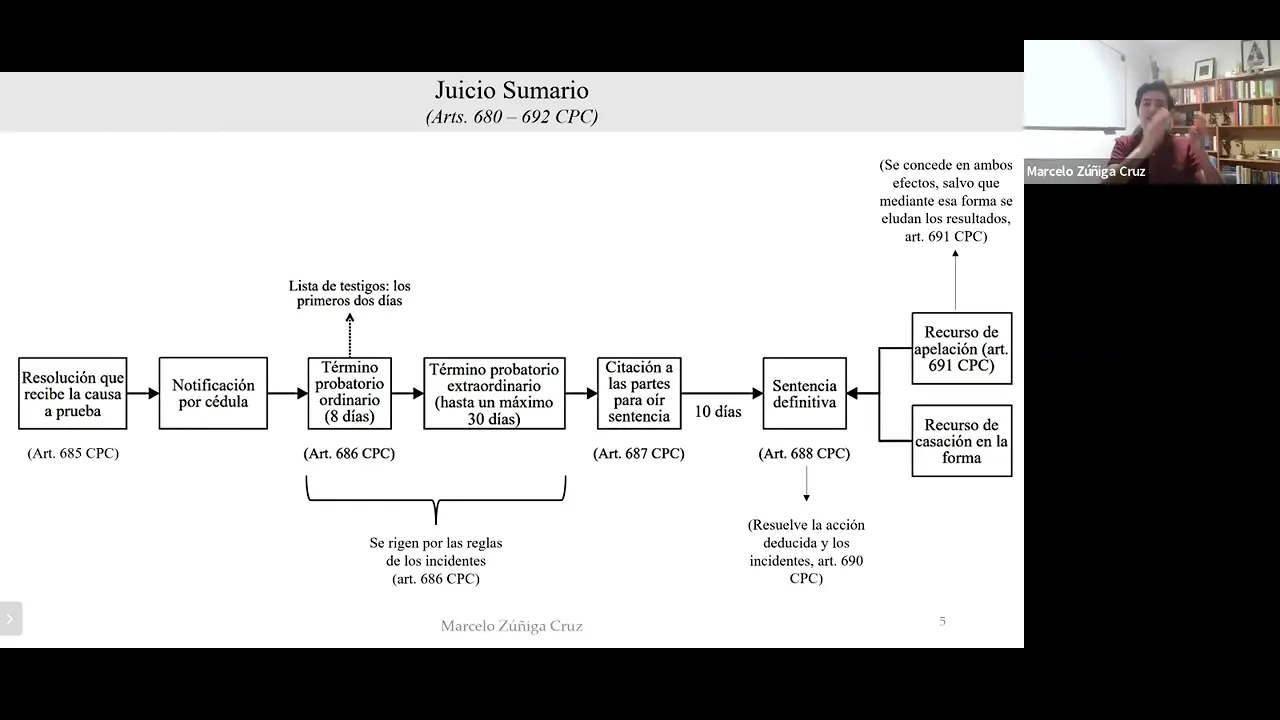
- Notification of evidence reception occurs through official channels like cedula delivery. If no substantial contested facts exist, parties are summoned for sentencing hearings instead.
Trial Conclusion and Sentencing
This section discusses how trials progress towards final judgments after evidence presentation concludes.
Final Judgment Process
- Following evidence submission deadlines (ordinary or extended), courts schedule sentencing hearings within ten days from notifying parties. This timeframe is legally binding for judicial action.
Explanation of Appeals and Cassation in Legal Proceedings
In this section, the speaker explains the process of appeals and cassation in legal proceedings, highlighting key differences and considerations.
Understanding Appeals and Cassation
- The final judgment in a summary trial allows for two types of appeals: appeal and cassation.
- There is a conflict between two norms regarding the effects of an appeal: one stating it is evolutive only, while the other allows for both effects.
- To resolve this conflict, appeals against final judgments are considered with both effects unless avoiding trial results, where only the evolutive effect applies.
Differentiating Appeals Based on Resolutions
- Appeals against resolutions converting ordinary trials to summary ones are allowed with both effects but can be limited to evolutive if trial results are to be avoided.
- Other resolutions in executive or summary trials allow appeals solely in an evolutive effect without suspending court proceedings.
Second Degree Competence in Appeals
- In summary trial appeals, second-degree competence grants appellate courts authority to address issues not ruled upon by lower courts but introduced and discussed during the initial trial.
- This contrasts with first-degree competence where appellate courts can only address issues previously ruled upon by lower courts. Third-degree competence further expands this scope.
New Section
In this section, the discussion revolves around the handling of incidents in summary trials, emphasizing their relationship with the main issue and how they do not halt the primary action due to the concentration of summary trials.
Handling of Incidents in Summary Trials
- Incidents in a summary trial should be processed together with the main issue without halting the primary action, showcasing the concentration characteristic of summary trials.
- The majority of incidents in a summary trial are not specific and require special pronouncements, except for instances like incompetence or procedural substitution.
- Decisions on incidents are typically made alongside the final judgment on the main case, except for specific exceptions such as tribunal incompetence or procedural substitution.
New Section
This segment delves into the concept and process of substituting procedures within a summary trial, highlighting its unique feature allowing transition between ordinary and summary proceedings based on certain criteria.
Substitution of Procedures in Summary Trials
- A distinctive aspect of a summary trial is its allowance for procedure substitution, enabling a shift from an ongoing trial to either an ordinary or summary proceeding depending on specific circumstances.
- Procedure substitution is applicable only to cases falling under general conditions specified in Article 680 of the Civil Procedure Code that necessitate swift processing for effectiveness.
New Section
Here, detailed insights are provided regarding two dimensions of procedure substitution: transitioning from an ordinary to a summary trial and vice versa, elucidating reasons behind each scenario.
Transitioning Between Ordinary and Summary Trials
- Procedure substitution can occur by moving from an ordinary trial to a summary one or vice versa based on distinct grounds.
Explanation of Appeal Process in Legal Proceedings
In this section, the speaker explains the appeal process in legal proceedings, specifically focusing on the appeal of a resolution regarding procedure substitution.
Appeal of Resolution on Procedure Substitution
- The appeal of a resolution concerning procedure substitution is permissible and granted with both effects - suspending the ongoing trial.
- Two resolutions typically granted with both effects in summary trials are appeals against a definitive sentence and appeals related to procedure substitution.
Types of Appeals and Court Decisions
This part delves into different types of appeals and court decisions within legal proceedings.
Types of Appeals
- Two main types of appeals discussed are appeals against definitive sentences and those related to procedure substitution.
- Both types of appeals are granted with devolutive and suspensive effects, while other resolutions usually have only devolutive effect.
Outcome Scenarios in Procedure Substitution Decision
This segment explores potential outcomes following a decision on procedure substitution in legal cases.
Possible Outcomes
- If the court approves procedure substitution, it applies only to future actions, leaving all prior steps unchanged without needing new claims or precautionary measures.
- Alternatively, if the court rejects procedure substitution, the trial continues following standard summary trial rules.
Conclusion and Recapitulation
The conclusion wraps up by summarizing key points discussed regarding summary trials and their procedures.
Summary Wrap-Up
- The review provides an overview of summary trials' key aspects, clarifying the implications of decisions on procedure substitutions for ongoing legal processes.