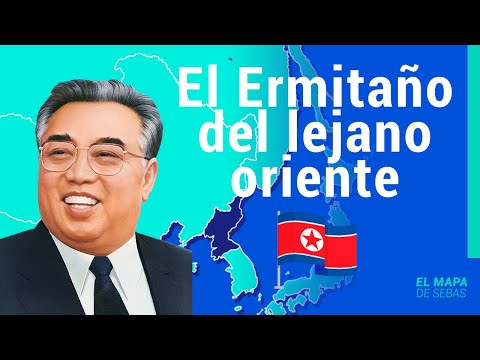
🇰🇵HISTORIA de COREA del NORTE en 11 minutos 🇰🇵 - El Mapa de Sebas
History of North Korea: A Brief Overview
Introduction to North Korea's Isolation
- No doubt that North Korea is the most secretive country in the world, with limited access and one of the least visited nations.
- The lack of press freedom means most information comes from testimonies of defectors and insiders.
- The video aims to explore North Korea's history, starting from its ancient roots.
Early History of the Korean Peninsula
- Documented history begins around 2303 BC with the Gojoseon dynasty, which lasted until 108 BC.
- Following Gojoseon's decline, three kingdoms emerged: Goguryeo (the largest), Silla, and Baekje.
- In 668 BC, Silla unified the peninsula after conquering Goguryeo and Baekje, establishing a period of relative stability.
Dynastic Changes and Cultural Influences
- Silla was followed by a long reign of Goguryeo until it fell under Mongol control in the 13th century. This led to its decline towards the end of the 14th century when it was succeeded by Joseon (or Choson) dynasty.
- The Joseon dynasty adopted Confucianism as its official ideology but faced invasions from Japan and Manchuria during its rule.
Transition to Modern Era
- By late 18th century, internal struggles weakened Joseon leading to its end in 1897; this marked a new era for Korea despite rulers being descendants from Joseon.
- The First Sino-Japanese War (1894) forced Korea out of isolationism; following China's defeat, Japan began exerting influence over Korea leading to formal annexation in 1910 amidst colonial expansion efforts post-Russo-Japanese War (1905).
Colonial Rule and Its Aftermath
- Under Japanese rule, Koreans lost autonomy while Japan exploited resources on the peninsula; industrialization occurred more rapidly in northern regions due to resource availability. Remember this detail for context later on!
Division Post World War II
- With Japan's surrender after WWII, Korea was divided at the 38th parallel into Soviet-controlled north and US-controlled south amid Cold War tensions.
- In August 1948, South Korea was established as a republic with Syngman Rhee as president; shortly after, North Korea became known as the Democratic People's Republic under Kim Il-sung’s leadership recognized by Soviets in September 1948.
Escalating Tensions Leading to War
- Both governments aimed for unification under their respective ideologies—North adopting an autocratic anti-capitalist regime while South suppressed pro-communist guerrillas leading up to war drums sounding across the peninsula.
Outbreak of Korean War
- On June 25, 1950, North invaded South Korea initiating conflict; within two months they captured almost all territory except Pusan perimeter due to industrial advancements made during Japanese occupation.( t =350 s )
International Intervention
- To counteract communist expansion during Cold War dynamics ,the United States intervened supported by UN coalition forces pushing back against North Korean advances .( t =374 s )
Consequences of Conflict
- The war resulted in significant casualties estimated between two to three million people ; an armistice was reached after three years but no peace treaty signed leaving both sides technically still at war .( t =398 s )
This structured overview captures key historical moments related to North Korea's development while providing timestamps for easy reference throughout your study or review process.
The Evolution of North Korea's Political Landscape
Kim Il-Sung and the Juche Ideology
- Kim Il-Sung maintained neutrality during the division of the communist world through diplomatic skills, shaping his own version of communism reflected in the Juche ideology.
- Juche combines socialism with extreme patriotism, anti-imperialism, defense of traditional Korean culture, and a policy of isolationism.
- The regime created a class-based society where families supporting communism during the Korean War enjoyed better living conditions in Pyongyang, while others faced oppression.
Economic Isolation and Crisis
- Following the Cold War and the dissolution of the Soviet Union, North Korea entered a state of autarky coinciding with Kim Il-Sung's death in 1994.
- His successor, Kim Jong Il, faced severe economic crises leading to widespread famine from 1995 to 1998; government estimates reported around 220,000 deaths but UN estimates suggest up to 2 million.
Diplomatic Relations Under Kim Jong Il
- During Bill Clinton's presidency, relations with the U.S. improved; however, they soured under George W. Bush who labeled North Korea part of an "axis of evil" due to its nuclear program.
- Despite famine challenges, military development continued unabated under Kim Jong Il’s leadership.
Tensions and Nuclear Developments
- In 2012, Kim Jong Un conducted nuclear tests as a response to international sanctions following UN Resolution 2087.
- The situation escalated into a crisis in 2013 when tensions peaked between North and South Korea but were eventually de-escalated through dialogue.
Recent Developments and Inter-Korean Relations
- In 2018, Kim Jong Un announced a suspension of nuclear programs amid ongoing military exercises by South Korea and the U.S., signaling potential thawing relations.