Capitulo III Generalidades video 1
Methods for Isolation and Purification of Biomolecules
Overview of Techniques
- This chapter discusses methods related to the isolation and purification of biomolecules, focusing on centrifugation, precipitation, filtration, chromatographic techniques, and electrophoresis.
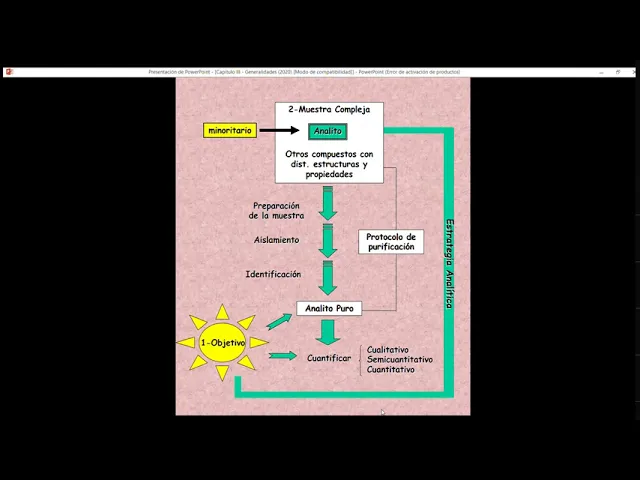
- Emphasizes the importance of identifying and quantifying biomolecules before their isolation to achieve satisfactory results. The analytical problem must be considered from start to finish.
Analytical Strategy
- Separation typically involves isolating one or more components from a mixture using various fractionation techniques categorized by differential solubility, centrifugation, chromatography, and electrophoretic methods.
- Initial separation steps often utilize high-capacity but low-resolution techniques (e.g., differential solubility), while later purification stages require higher resolution with lower capacity (e.g., HPLC and affinity chromatography).
Defining the Problem
- To apply an effective protocol, two main aspects must be considered: clearly establishing the objective (formulating the problem) and understanding the sample type.
- Key questions include identifying what needs to be found, determining analytes' concentrations, assessing matrix complexity, defining quantitative/qualitative outcomes, urgency for results, and available budget.
Case Studies in Problem Definition
- Example 1a illustrates a clear problem: quantifying free microcystin in river water.
- In contrast, Example 1b complicates matters by requiring total microcystin determination in reservoir water; this necessitates investigating how toxins are present in algae as well.
Sample Complexity Considerations
- Analyzing water samples for human consumption requires establishing which analytes to determine based on national or international standards regarding permissible levels.
- Example 1d highlights challenges in pesticide analysis due to numerous types; thus limiting analysis to specific pesticide groups is essential for feasibility.
Rancidity Analysis Challenges
- Determining oil rancidity presents complexities as it involves identifying degradation products of free fatty acids rather than straightforward analyte identification.
Purification Protocol Design
Objective-Based Protocol Development
- Example 2a focuses on determining fenitrothion (a phosphorated pesticide); a simple purification protocol suffices due to straightforward matrix characteristics.
- Conversely, analyzing fenitrothion in wastewater demands a more complex purification process because of differing sample characteristics affecting analytical strategy.
Active Ingredient Isolation
Analytical Strategy for Mycotoxin Detection in Cereals
Overview of Analytical Strategy
- The goal is to determine mycotoxins in cereals qualitatively or semi-quantitatively, focusing on rapid screening rather than extensive purification.
- Planning an analytical strategy requires a clear problem description that aligns with the sample type and analysis objectives.
Steps in Designing a Purification Protocol
- Key steps include defining the problem, selecting appropriate methods, obtaining representative samples, preparing samples for analysis without excessive chemical separation, conducting measurements, and reporting results.
- Characterization of the study object is crucial; it can range from specific elements like lead to functional groups such as alcohols or higher-order structures like mitochondria.
Importance of Sample Knowledge
- Understanding the matrix—compounds present in the sample that are not the target analyte—is essential for effective analysis.
- The concentration of the analyte affects isolation ease; higher concentrations facilitate easier extraction.
Sampling Considerations
- Ensuring that laboratory samples are representative of the entire lot is critical for valid results. Responsibility may vary between laboratories and clients.
- Proper sample preparation techniques are vital; this may involve dissolution or decomposition to make analytes accessible.
Extraction Techniques and Challenges
- For solid samples, initial steps often include dissolution or decomposition to free up target analytes for elemental analysis (e.g., heavy metals).
- When dealing with trace amounts of analytes, enrichment procedures may be necessary to enhance detection capabilities.
Critical Points in Extraction and Separation
- The choice of solvent during extraction is pivotal; poor selection can result in analytes remaining within the sample matrix instead of being extracted.
- Separation processes can vary significantly based on sample complexity; more complex matrices require additional steps and techniques.
Transformation and Combination Methods
- Sometimes transformation of analytes is needed to improve detectability or suitability for subsequent analyses (e.g., derivatizing amino acids).
- Combining different separation methods based on various principles (size, charge, etc.) enhances resolution and selectivity throughout purification protocols.
Final Evaluation and Reporting
- Results must be expressed clearly; this influences whether qualitative, semi-, or quantitative methods will be employed.
- Analyzing results includes assessing reliability through uncertainty measurement. Reports should detail method limitations alongside findings.
Documentation Responsibilities
- Analysts must ensure conclusions drawn from data align with actual findings. Reports should cater to intended audiences while maintaining clarity about methodologies used.
Optimization of Key Parameters in Chromatography
Fundamental Parameters in Chromatography
- Four fundamental parameters are optimized: resolution, speed, recovery, and capacity. These can be visualized as vertices of a pyramid, indicating their interrelated nature.
- Achieving an ideal balance among these factors is crucial; prioritizing one may negatively impact another. For instance, resolution becomes increasingly important as sample quantity decreases during separation.
Relationship Between Speed and Resolution
- Speed and resolution are inversely related; increasing speed in a defined chromatographic medium can lead to decreased resolution.
- Optimal recovery requires minimizing the number of separation steps while maintaining biocompatibility throughout the process.
Techniques for Sample Preparation
- The goal is to minimize purification time and steps. Each purification step should complement the next, ensuring that fractions containing target molecules provide suitable conditions for subsequent processes.
- A variety of starting materials are available in biochemistry, including microorganisms and animal tissues. The choice depends on the study's objectives.
Isolation Methods for Enzymes
- Bacteria can be cultured to produce large quantities of specific enzymes which may need to be isolated from cell-free culture media through centrifugation or filtration.
- If enzymes are intracellular, cell homogenization or lysis is necessary for extraction.
Techniques for Biological Sample Preparation
- Biological sample preparation often involves isolating cellular components like membranes or organelles (e.g., mitochondria, ribosomes).
- Various laboratory techniques such as lysis, tissue homogenization, filtration, centrifugation, chromatography, and precipitation by salts or organic solvents are employed based on the type of cells studied.
Challenges in Cell Lysis
- Different methods exist for cell lysis depending on cell type; animal cells are easier to break than plant cells due to their tougher cellulose walls.
- Vigorous methods like pressing or grinding can disrupt cellular integrity while milder techniques aim to preserve subcellular organelles intact.
Equipment Used in Extraction Processes
- Mechanical or manual homogenizers are used for various tissues during extraction. Osmotic lysis involves placing cells in hypotonic solutions to facilitate breakdown.
- Care must be taken during extraction to minimize chemical composition changes and ensure satisfactory recovery rates of target molecules.
Considerations for Solvent Use