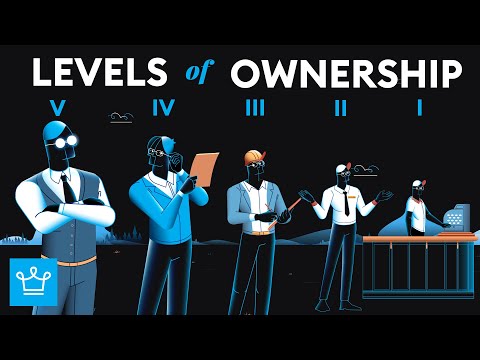
Levels of Ownership
Understanding Economic Layers
Introduction to Economic Layers
- The economy consists of multiple layers, with workers at the bottom and owners at the top.
- Most individuals remain unaware of these layers throughout their lives.
- This video will explore five layers of ownership, from the most basic to the most complex.
Level One: Labor Income
- At this level, individuals earn money by performing work directly; if they stop working, income ceases.
- Example: A pastry chef in a bakery earns wages for hours worked but does not own the products made.
- Workers trade time and effort for money but do not own what they produce; ownership lies with the business owner.
- Labor income is limited by time and energy; even skilled workers face constraints on earnings based on hours worked.
- Taxes are deducted immediately from labor income, making it challenging to save or invest later on.
Level Two: Business Ownership
- At this level, individuals transition from being paid for work to owning and running a business where work occurs.
- As a bakery owner, one earns money from overall business operations rather than just personal labor input.
- The owner decides operational aspects like product offerings and pricing while bearing all financial risks and rewards associated with profits after expenses are covered.
- Unlike level one, where pay comes first, here profits are retained after paying employees and costs—this introduces greater potential for income growth based on business performance rather than personal effort alone.
- Many owners struggle to detach themselves from daily operations; true success requires systems that allow businesses to function independently of their presence.
Understanding Business Ownership Levels
Level 1: Taxation and Control
- On a paycheck, individuals are taxed on business profits, which comes with more rules but also offers more options for financial management.
- Business owners can deduct costs, reinvest profits, and control the timing of money leaving the business, providing greater financial autonomy compared to labor-level income.
Level 2: Transitioning to Asset Ownership
- At this level, a bakery evolves from just a job into an asset that can grow in value and potentially be sold.
- Entrepreneurs can benefit from tools like the Alux app designed for networking and learning among peers on similar growth journeys.
Level 3: Owning the Building
- The third level involves owning not just the business but also the physical assets it relies on, such as the building where it operates.
- Income shifts from direct sales to rental income; rent is prioritized over profit, enhancing financial stability regardless of business performance.
- This ownership model separates income generation from operational success; even if one bakery fails, the building retains its value.
Stability Through Asset Ownership
- Owning real estate provides a stable source of income since good assets tend to last longer than businesses that may fail during downturns.
- A single property can serve multiple businesses over time, ensuring continued revenue generation despite individual failures.
Value Growth and Risk Management
- Unlike businesses that rely solely on daily sales for income, buildings generate monthly rent and appreciate in value over time.
- Asset ownership mitigates risk; while vacancies pause income temporarily, they do not eliminate asset value entirely.
Tax Advantages for Asset Owners
- Taxes favor asset owners by allowing deductions for maintenance and repairs while often taxing capital gains at lower rates compared to labor income.
Level 4: Building a Portfolio
- At this stage, ownership expands to multiple properties across various locations generating diverse streams of rental income.
- Diversification reduces risk; issues with one property have less impact when others continue generating revenue.
Evolving Role of Ownership
- As portfolio size increases, day-to-day management is typically delegated to professionals while strategic decisions about acquisitions or sales become paramount.
- Performance metrics shift focus towards overall portfolio health rather than individual property management.
This structured approach highlights key concepts related to different levels of business ownership while providing timestamps for easy reference.
Understanding Levels of Ownership in Asset Management
The Growth and Predictability of Portfolio Income
- A diversified portfolio allows for faster growth compared to a single asset, leading to more predictable income streams.
- While individual rents may fluctuate, the overall income tends to be smoother, facilitating easier financial planning.
- This structure reduces reliance on any single event or decision, enhancing stability in income generation.
Level Five: Owning the Owners
- At level five of ownership, individuals no longer own assets directly but instead control structures that manage those assets.
- Income is derived from control and allocation rather than direct management of properties or businesses.
The Role of Holding Companies
- In this model, one owns a holding company or fund that encompasses multiple portfolios of buildings managed by others.
- Decision-making regarding asset acquisition and management is delegated to other parties while the owner focuses on capital deployment.
Complexity and Scale in Asset Management
- Managing numerous assets can become complex; thus, ownership is structured to pool resources and spread risk effectively.
- The owner's role shifts from operational tasks (like tenant selection or building maintenance) to strategic oversight—setting rules and limits for investment.
Visibility and Legal Considerations
- As ownership becomes layered through various entities, it often becomes less visible; external observers see only the end products (e.g., bakeries), not the underlying structures.
- Different tax implications and legal treatments apply at this level due to the nature of holding structures designed for efficient capital movement.