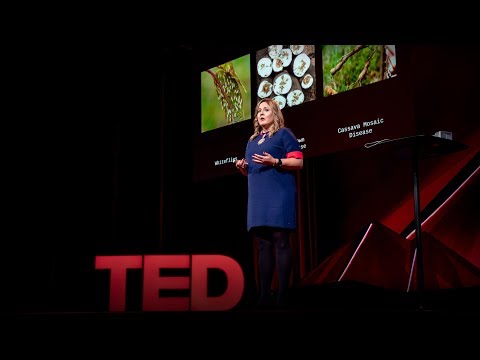
How we're using DNA tech to help farmers fight crop diseases | Laura Boykin
Why I Get Out of Bed: Addressing Food Insecurity
The Motivation Behind the Work
- The speaker emphasizes two main reasons for their work: addressing food insecurity among small-scale family farmers and promoting diversity in science to tackle global challenges.
- They highlight the importance of using advanced technology with diverse teams to help farmers increase food production.
Journey to Computational Biology
- The speaker shares their unconventional path to becoming a computational biologist, starting from a college basketball player needing a work-study job.
- Their first scientific role involved working in an herbarium, where they glued dried plants onto paper, leading them into the field of biology.
- A pivotal moment occurred at Los Alamos National Lab, where exposure to supercomputing revealed its potential for understanding complex biological issues like influenza and hepatitis C.
Focus on Cassava and Its Challenges
- In 2013, the speaker joined a team aiming to save cassava, a crucial crop feeding nearly one billion people globally, particularly in East Africa.
- They explain that cassava is under threat from pests like whiteflies and diseases that devastate crops, impacting food security and income for millions.
On-the-Ground Realities
- A trip to Tanzania highlighted the struggles faced by women farmers who plant cassava but often see no yield due to pest damage.
- The loss of crops leads to significant economic hardship as entire growing seasons can be lost due to these agricultural challenges.
Technological Solutions for Farmers
- The speaker argues that while technology exists to combat these issues, access and knowledge are unevenly distributed globally.
- Older genomic technologies are expensive and not suited for sub-Saharan Africa; this results in delays in getting critical data back to farmers when they need it most.
Innovative Approaches with New Technology
- In 2017, the introduction of portable DNA sequencers (Oxford Nanopore MinION), previously used against Ebola in West Africa, inspired efforts to assist East African farmers.
- Despite skepticism about replicating this technology on farms in East Africa, the team accepted the challenge and aimed for practical solutions.
Tree Lab: Revolutionizing Agriculture in East Africa
Introduction to Tree Lab
- The speaker introduces the concept of "Tree Lab," a high-tech molecular lab initiative aimed at assisting farmers in Tanzania, Kenya, and Uganda.
- The project is part of the Cassava Virus Action Project, which focuses on addressing agricultural challenges faced by local farmers.
Innovative Solutions for Farmers
- The team aims to bring diagnostic capabilities closer to farmers, enabling quicker identification of plant diseases and providing immediate solutions.
- A key tool used is the PDQeX machine for DNA extraction, which significantly reduces time and cost compared to traditional methods.
Efficient Data Processing
- The PDQeX allows DNA extraction in just 20 minutes using a motorcycle battery, making it accessible for small-scale farms.
- After extraction, DNA samples are prepared for sequencing with a portable genomic sequencer connected to a mini supercomputer (MinIT), eliminating reliance on main power or internet.
Impact on Local Farming Communities
- Customized databases created by the speaker enable rapid data analysis, providing results within three hours instead of six months.
- Asha's success story illustrates the project's impact; her yield increased from zero to 40 tons per hectare after implementing solutions from Tree Lab.
Scaling Up and Community Benefits
- The project leverages existing farmer groups in Africa; helping one farmer like Asha can benefit thousands through shared knowledge and resources.
- The speaker emphasizes that their scientific efforts aim to enhance food security for communities, highlighting personal connections with farmers' experiences.
Turn any video into a summary like this
YouTube links, meetings, lectures. With transcripts, search, and chat.