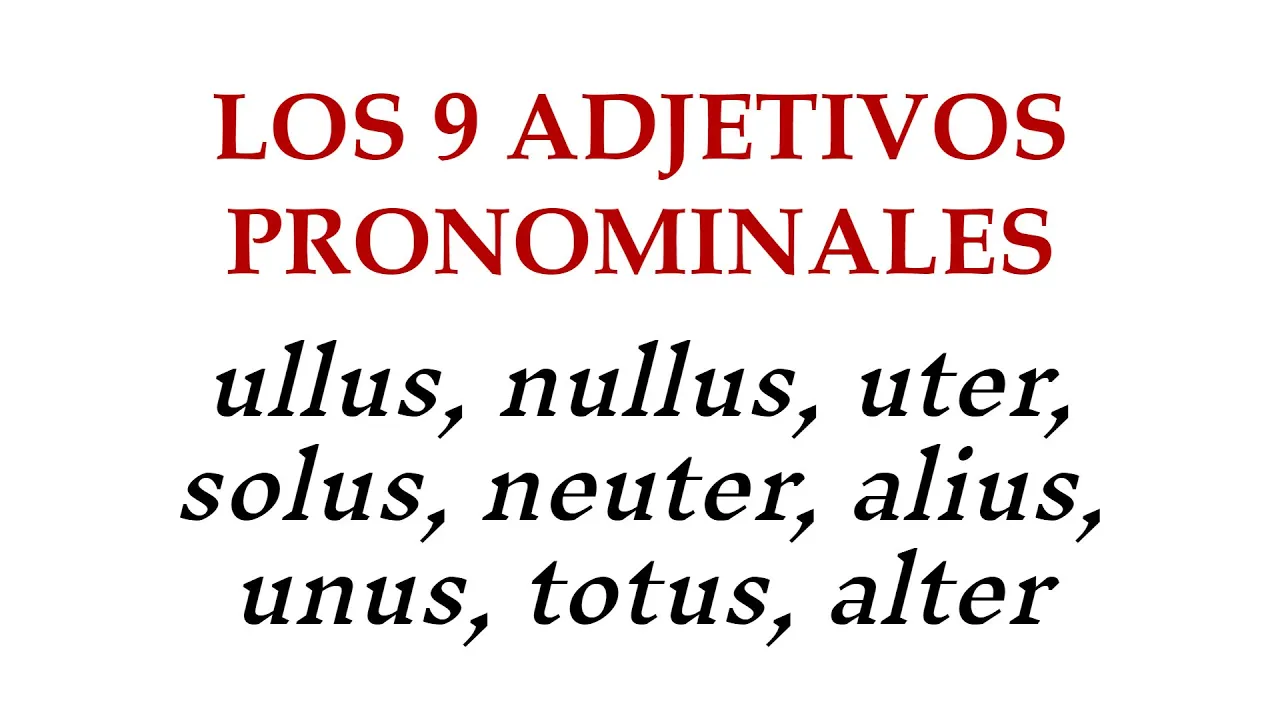
3.3. LOS 9 ADJETIVOS IRREGULARES DE LATÍN
Grammar of Latin: Pronominal Adjectives
In this section, the instructor introduces a group of 9 pronominal adjectives in Latin, discussing their similarities and differences with other adjective classes.
Introduction to Pronominal Adjectives
- The pronominal adjectives in focus are ullus, nullus, uter, solus, neuter, alius, unus, totus, and alter.
- These adjectives align closely with Spanish indefinite pronouns like "alguno" and "ninguno," falling into the first-class adjective models.
- Exceptionally, alius deviates by having a nominative neuter form ending in -d instead of -m.
Declension Patterns and Origins
- The pronominal adjectives follow first-class adjective declensions but exhibit three exceptions: genitive singular ending in -ius for all genders, dative singular ending in -i universally, and nominative neuter singular ending in -d (specifically for alius).
- These unique endings stem from their pronominal origins and were integrated due to their pronoun-like functions.
Mnemonic Device and Declension Details
- A helpful mnemonic is UNUS NAUTAE (a sailor), formed from the initial letters of these pronominal adjectives.