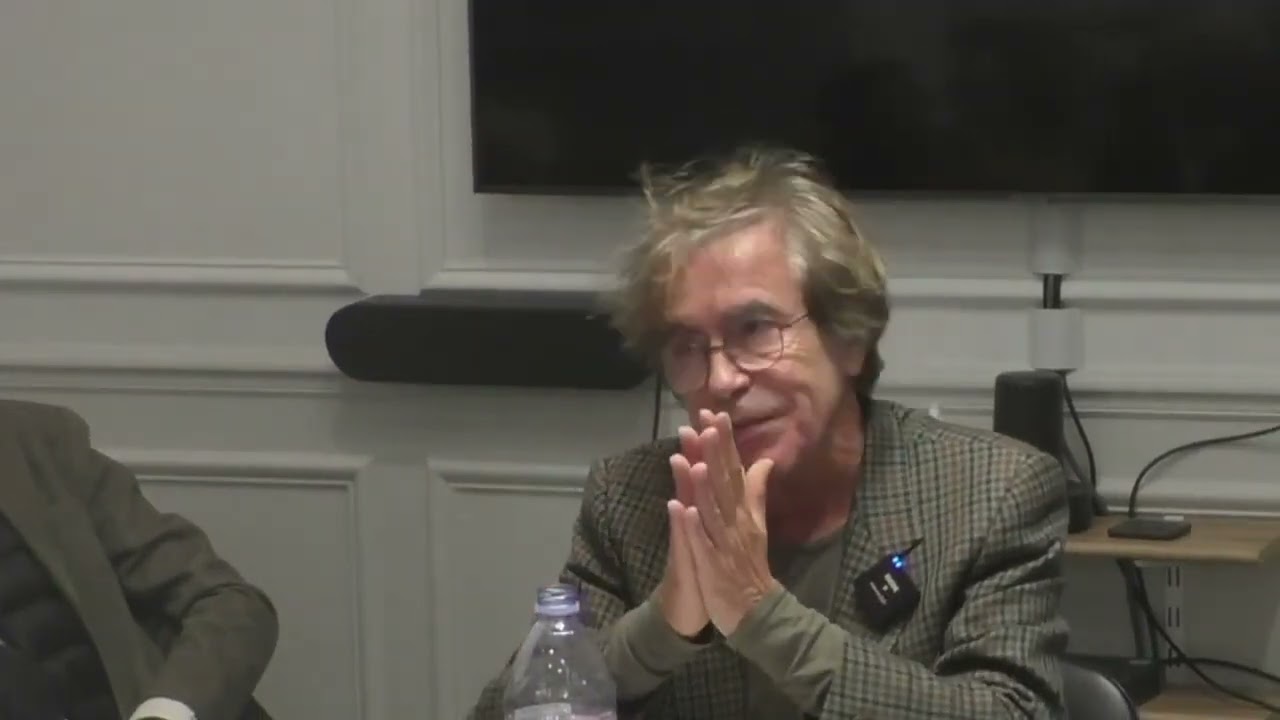
François Jullien : Politique de dé-coïncidence
Desanti's Concept of Coincidences
In this section, François introduces the concept of coincidences as recommended by philosopher Jean Toussaint Desanti. He emphasizes that concepts are not exclusive to philosophers but are practical tools for all individuals.
Desanti's Concept of Coincidences
- François discusses Jean Toussaint Desanti's approach to concepts, suggesting examining them thoroughly to uncover their underlying essence.
- Concepts are not limited to philosophers; they are tools accessible and useful to everyone in various contexts.
- An association called "Association des Coïncidences" was established, emphasizing the importance of collaboration and debate among professionals from diverse fields.
- The association aims to foster discussions on concepts relevant to participants' professional practices, encouraging innovative thinking and overcoming mental stagnation.
- Professionals from different backgrounds such as architects, artists, musicians, physicists, biologists, economists, and business leaders contribute to enriching dialogues on pertinent concepts.
Philosophy-Science Relationship
This part delves into the relationship between philosophy and science within the context of École Polytechnique's unique philosophical engineering tradition.
Philosophy-Science Relationship
- François highlights the underexplored philosophical engineering tradition at École Polytechnique, showcasing a distinctive French intellectual heritage.
- Notable figures like d'Enfantin and Jean Pierre Dupuy have contributed significantly to this philosophical current at École Polytechnique.
- The dialogue between science and philosophy goes beyond mere comparison; it involves navigating the space between disciplines creatively for profound insights.
- Emphasizes the importance of embracing the divergence between science and philosophy rather than seeking convergence for stimulating intellectual exploration.
- By inhabiting this divergence effectively, one can engage in nuanced reflections that transcend traditional disciplinary boundaries.
Conceptual Evolution
François elaborates on how concepts serve as dynamic tools for understanding change and complexity in contemporary contexts.
Conceptual Evolution
- Concepts act as dynamic tools facilitating comprehension and action amid evolving circumstances in modern society.
Projections and Ideal Models
The speaker discusses projecting models onto reality, emphasizing the preference for creating a form of ideal model that connects with desires.
Projecting Ideal Forms
- By projecting a model onto reality, a preference is shown for producing a form of ideal model that connects with desires.
- This ideal form mobilizes individuals towards an abstract form, drawing motivation from Greek teachings on creating an ideal city.
Challenges in Modeling Society
The challenges in modeling society are explored, highlighting the complexities faced due to globalization and changing perceptions of progress.
Globalization Impact
- Globalization presents challenges in modeling society due to increased interconnectedness and the need to consider global perspectives.
- The world's current state of globalization makes isolation for modeling purposes difficult, requiring interconnected approaches instead.
Shift in Cultural Perspectives
A shift in cultural perspectives is discussed concerning beliefs about progress and future outcomes.
Cultural Evolution
- Contemporary culture no longer holds the same belief in progress as before, impacting how societies envision their futures.
- The concept of progress has shifted, challenging traditional views on nature and societal development.
Adapting to Changing Realities
Adapting to changing realities requires reevaluating approaches to modeling and envisioning alternative futures.
Embracing Change
- Adapting to current uncertainties involves proposing new worldviews rather than relying on outdated models or utopian visions.
Des Coïncidences et Clinamen
The discussion delves into the concept of clinamen, a slight deviation that allows for encounters between atoms, leading to the formation of worlds. This deviation challenges deterministic views and opens up possibilities for events to occur.
Des Coïncidences et Clinamen
- The clinamen introduces the idea that atoms are not condemned to fall in a straight line but can meet and create new possibilities. This concept challenges deterministic perspectives.
- Lucrèce's notion of clinamen is likened to a subtle deviation that disrupts the predetermined paths of atoms, allowing for interactions and the emergence of new outcomes.
- Translating clinamen as "coïncidences," it signifies a departure from the expected trajectory of falling atoms towards an open realm of potentialities where events can unfold.
- The biblical narrative involving Adam, Eve, and the serpent is interpreted through the lens of coïncidences, highlighting how this deviation led to their transition from harmony in paradise to becoming historical subjects with agency.
- Coïncidences are seen as fissures that disrupt divine order and lead individuals towards self-awareness and subjectivity, as exemplified by Adam and Eve's shift from passive recipients to active agents shaping their own destinies.
Promotion of God Through Coincidences
The conversation explores how coïncidences play a role in promoting God through various cultural narratives such as biblical texts.
Promotion of God Through Coincidences
- Drawing parallels between physics and cultural narratives like the Bible, coïncidences are depicted as catalysts that transform individuals into historical subjects with agency, akin to Adam and Eve's journey from paradise to exile.
- Analyzing the prologue of John's Gospel within a theological context reveals how coïncidences shape human perceptions of divinity, emphasizing the idea that God becomes relevant through human promotion rather than inherent qualities.
- Delving into theological implications, discussions revolve around avoiding essentializing God by acknowledging human agency in promoting divine attributes through narratives like John's Gospel prologue.
Human Evolution Through Coincidences
The discourse shifts towards human evolution influenced by coïncidences and deviations from natural order.
Human Evolution Through Coincidences
- Human evolution is explored through encounters with coïncidences that propel individuals beyond natural harmony towards subjectivity and self-awareness, contrasting those who remain within predetermined patterns without embracing change or growth.
Desiring to Challenge European Thought
In this section, the speaker reflects on their satisfaction with their work and expresses a desire to challenge European thought by exploring Chinese philosophy and language.
Reflecting on Personal Satisfaction
- The speaker finds their work satisfactory and beautiful, expressing contentment with what they have accomplished. They emphasize the importance of challenging existing thoughts and exploring new possibilities.
Exploring Chinese Philosophy
- There is a personal interest in delving into Chinese philosophy not for assimilation but to disrupt the conformity of European thought. This exploration aims to question and reevaluate established philosophical concepts.
Challenging Assimilated Thoughts
- The speaker discusses the need to break away from entrenched European philosophical ideas, such as the concept of being, which has been extensively explored in Western philosophy.
Exploring Linguistic Influence on Philosophical Thought
This segment delves into how linguistic structures influence philosophical thinking, particularly in relation to the concept of being.
Linguistic Influence on Philosophy
- The discussion centers around the difficulty of breaking away from traditional linguistic frameworks that shape philosophical discourse. Notable philosophers like Derrida and Levinas are referenced for their attempts to transcend conventional modes of thought.
Transcending Linguistic Boundaries
- By learning a new language, such as Chinese, one can challenge ingrained philosophical notions deeply rooted in Western thinking. This linguistic shift opens up avenues for reinterpreting fundamental concepts.
Reimagining Analytical Practices Through Mediation
Here, the focus shifts towards redefining analytical practices through mediation techniques that aim to address trauma and psychological alignment.
Role of Mediation in Analysis
- Mediation is highlighted as a transformative tool within analytical practices, facilitating communication between conflicting parties while addressing psychological imbalances caused by trauma.
Psychological Realignment through Mediation
- The process of mediation serves as a means to realign individuals psychologically by revisiting past experiences and traumas. It aims to reintroduce possibilities for personal growth and self-discovery within therapeutic settings.
New Section
In this section, the speaker reflects on the concept of accidents in painting and how they relate to the work of landscape artists.
Reflection on Accidents in Painting
- The accident in painting is likened to a crack in alignment, which serves to re-engage and rework the ongoing artistic creation.
- Landscape artists aim to bring forth perceptual equations that challenge our perspectives, making visible what may seem invisible.
- Artists and directors alike play a role in deciding what aligns with expectations and conventions, shaping the narrative or visual experience for the audience.
- The ethical dimension underpinning concepts brings individuals together through shared experiences and reflections, emphasizing the importance of self-alignment before engaging with others.
New Section
In this section, the speaker discusses the concept of adequacy and satisfaction in various contexts, touching on the impact of societal norms and media influence.
Adequacy and Satisfaction
- The speaker delves into how adequacy can lead to complacency when individuals are satisfied with the status quo.
- There is a reflection on how societal expectations, such as being benevolent, can sometimes mask underlying issues or complexities.
- The discussion shifts towards how terms like "innovation" and "network device" may lose their critical edge when widely accepted by society and perpetuated by the media.
- Analogies are drawn between societal norms acting as a lid that weighs down on individuals' freedom and creativity.
- The idea of vacations being more about conformity than true relaxation is explored, highlighting how societal constructs can dictate behaviors.
Exploring Language Coincidence
This section focuses on language coincidence, particularly discussing the implications of a globalized English (Globish) on communication and thought processes.
Global English Impact
- The speaker advocates for multilingualism over reliance on a globalized form of English (Globish), emphasizing the importance of preserving diverse linguistic expressions.
- Globish is critiqued for hindering deep linguistic engagement and potentially limiting cognitive flexibility due to its oversimplified nature.
- A concern is raised about ideological obedience influenced by language choices, prompting a call for critical reflection rather than blind acceptance.
Rethinking Cultural Differences
Here, the focus shifts to reevaluating cultural differences beyond mere categorizations of similarities and disparities between cultures.
Conceptualizing Cultural Differences
- The speaker introduces the concept of "quarters" instead of traditional notions of differences or similarities in cultural comparisons.
- A critique is offered regarding how cultures are often framed solely in terms of differences or resemblances without deeper exploration into nuanced interactions.
New Section
In this section, the speaker discusses the concept of "écart" (gap) as opposed to "différence" (difference) when exploring cultural differences and linguistic nuances.
Exploring the Concept of "Écart"
- The speaker introduces the idea of thinking in terms of "écart" rather than "différence" to address cultural differences.
- "Écart" signifies a gap that disrupts or deviates from the norm, unlike "différence," which arranges or categorizes.
- By delving into these gaps, one can explore how far they extend in language and thought processes.
- The notion of "écart" maintains a tension between different perspectives, unlike "différence," which tends to dismiss the other.
New Section
This section delves into contrasting views on the concept of difference and its implications in philosophical discourse.
Philosophical Perspectives on Difference
- The concept of difference has been pivotal in overturning traditional ontological frameworks by emphasizing continual referral and impossibility of containment.
- While difference was crucial for philosophical exploration, it lacked practical or political implications compared to concepts like des coïncidences.
New Section
Here, the discussion shifts towards des coïncidences and its role in challenging established norms for enabling meaningful choices.
Challenging Established Norms with Des Coïncidences
- Des coïncidences involves disrupting existing structures without solely focusing on initial ruptures but rather on opening up possibilities for choice.
- It is essential to first challenge existing adequacies before embarking on transformative decision-making processes.
New Section
This segment explores the significance of denouncing versus fissuring des coïncidences within ideological contexts.
Denouncing vs. Fissuring Des Coïncidences
- Merely denouncing des coïncidences lacks impact unless it leads to critical fissures within prevailing ideologies.
- Fissuring des coïncidences involves dismantling ideological constructs such as resilience and eco-construction for genuine transformational outcomes.
New Section
In this section, the speaker discusses the concept of "des coïncidences" and its implications in various contexts.
Understanding "Des Coïncidences"
- The speaker highlights the risk of "des coïncidences" becoming sterile if not maintained vigilantly.
- It is emphasized that maintaining the operationality of "des coïncidences" is crucial to prevent them from merely coinciding.
- The example of typing a text message on a phone and how words coincidentally align statistically is used to question the act of writing and coincidence.
- Writing is explored as a process that may or may not coincide with predetermined outcomes, challenging notions of linguistic determinism.
- The act of writing is further discussed in terms of maintaining language conventions and established norms.
New Section
This section delves into the discreet nature of "des coïncidences" and its role in communication and political concepts.
Discreet Nature of "Des Coïncidences"
- The importance of communication in relation to "des coïncidences" as a practical and political concept is highlighted.
- A distinction is made between politics as power management and politics as ideals based on communal sharing.
- The concept of "décomagie" is introduced, emphasizing its practical application over theoretical constructs.
- The significance lies in how "décomagie" bypasses traditional theoretical-practical dichotomies, offering immediate practical implications without maximal ideologies.
New Section
This section explores the notion of coercion versus revolution within the framework of practical and political concepts related to "des coïncidences."
Coercion vs. Revolution
- Discussion centers on the idea that revolutions often lead to counter-effects due to imposed coercion, highlighting the complexity inherent in practical applications.
- Emphasis is placed on genuine writing's ability to escape traditional practices by engaging directly with language content rather than conforming to established norms.
- The interplay between theory and practice within our relationship with the world is examined through modulation, reflecting on historical philosophical perspectives.
New Section
This section delves into bridging gaps between understanding reality practically versus theoretically within the context of "des coïncidences."
Bridging Theory and Practice
- The challenge lies in reconciling understanding reality practically with ideal projections, underscoring inherent deficiencies when comparing actual practices against projected ideals.
- By engaging with "des coïncidences," individuals are immediately immersed in effective practices rather than theoretical abstractions, facilitating direct engagement with reality.
New Section
Exploring how "des coïncidences" diverges from traditional Greek philosophical thought towards European conceptualizations.
Departure from Greek Thought
- Contrasting European thought with Greek philosophy reveals shifts from establishing foundational principles (archḗ), as seen in Aristotelian metaphysics, towards contemporary theoretical vocabularies emphasizing beginnings (arkḗ).
Describing the Concept of Coincidences
In this section, the speaker delves into defining a segment that can be illuminated by reason, discussing the concept of coincidences and challenging the traditional notions of beginnings and endings.
Defining a Segment
- The speaker introduces a segment that reason can illuminate, symbolized by the star logo from beginning to end in an arched rise. This defines the concept of coincidences, aiming to undo the principle of commandment at the beginning.
Phenomenon of Lucrèce
- Contrasts between high-speed internet connections and coincidences are highlighted. The emphasis is on multiple coincidences rather than a specific positive principle, suggesting an ideological perspective.
Challenging Traditional Notions
This part explores how the concept of coincidences challenges conventional ideas about beginnings and endings, disrupting teleological thinking prevalent in religious and political spheres.
Disrupting Teleological Thinking
- The discussion centers on how modern uncertainty arises from not knowing definitive ends as seen in religious or political contexts. There is a struggle to dismantle teleology's influence on our thoughts regarding principles and arcs.
Reopening Possibilities
- By challenging imposed thoughts on beginnings and endings, there is an invitation to explore new possibilities beyond predetermined goals. This shift aims to move away from fixed destinies towards open-ended potentialities.
Embracing Initiatives Without Commandments
Here, the focus shifts towards embracing initiatives without singular commands or directives, advocating for diverse engagements that intersect without conforming to predefined theories or rules.
Initiatives Without Commandments
- Emphasizes engaging in initiatives without singular commands but rather through diverse engagements that intersect freely. These initiatives are not bound by specific theories or directives but evolve independently.
Encouraging Diverse Engagements