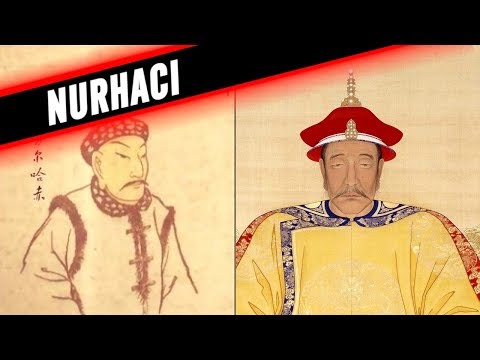
NURHACI DOCUMENTARY - RISE OF THE JURCHEN
The Story of Nurhaci
This section introduces the story of Nurhaci, an orphan tribesman who successfully unified scattered tribes and laid the path to conquer all of eastern Asia.
Rise of Nurhaci
- In the 16th century, the Ming dynasty started to decline as eunuchs in the court centralized power in their hands.
- The semi-sedentary tribes known as the Jurchen confederation were vassals of the Ming but lacked unity.
- In 1573, a Jurchen killed a Ming commander, leading to a Chinese punitive expedition led by veteran Lee Chong yang. With his help, Wankel was captured and executed.
- After Wankel's death, three main contenders tried to take power while Co Chonga allied himself with Lee Chong yang.
Nurhaci's Unification
- Wan GAO sun art i nikan and Nika while on their service launched raids against ming territory in 1582. A new Chinese punitive expedition led by Lee Chong yang was dispatched in which Nurhaci's father and grandfather took part.
- After his family members were killed in unclear circumstances, Nurhaci was fostered by Lee chung-yong who gave him permission to succeed as the new general chieftain under his wing.
- Swearing to avenge his family at age 25, Nurhaci campaigned against rival neighboring tribes in 1584 and then again in 1587. Nikken while an was captured by Lee chung-yong while attempting to escape.
- Using both military strategy and political marriages, Nurhaci's territory and influence grew. In 1591, his brother-in-law demanded lands be ceded to him but Nurhaci refused.
- By October 1593, over 30,000 soldiers from nine different tribes led by his brother-in-law sacked his territory. Using the Chinese strategy he had studied, Nurhaci was able to defeat the much larger enemy coalition killing several thousands.
Conclusion
This section concludes the story of Nurhaci and how he successfully unified scattered tribes and laid the path to conquer all of eastern Asia.
- After fulfilling his revenge by executing Nikken while an, Nurhaci captured a bandit lair rescuing many Chinese captives in 1589.
- He then delivered them to mingi Thoris Eze who thanked him by bestowing in mind a rank on him. By now he had several thousands of retainers loyal to him.
- Despite facing challenges from rival neighboring tribes and even his own family members, Nurhaci's military strategy and political marriages helped him unify all of the Jurchen confederation under his banner.
Expedition to Conquer Korea
This section discusses the events leading up to Nurhaci's rise to power and his early campaigns.
Rise to Power
- In 1592, Korea requested help from the Ming Dynasty against a Japanese invasion.
- Nurhaci offered his help but was refused by Korea.
- As a result of his offer, China viewed Nurhaci favorably.
- In 1595, Nurhaci was bestowed with the title of General of the Dragon Tiger, which no Jurchen before him had ever obtained.
Early Campaigns
- Nurhaci understood the economy and created a monopoly on trade of furs, pearls, and ginseng.
- He ordered two translators to create a transcription of the Jurchen language adapted from Mongol script in 1599.
- Between 1600 and 1601, he reorganized his army into four divisions each following a colored banner: yellow, blue, red or white. These were further divided into companies of several hundred men under this new organization war on a larger scale could now be conducted.
Unification of Jurchen Tribes
This section discusses how Nurhaci unified various Jurchen tribes under his leadership.
Integration of Major Groups
- The increasing number of soldiers within his army led to a new problem. Up until then, the Jurchen would fight in hunting parties of ten to twelve men each but with thousands of soldiers such force could not be controlled effectively.
- Starting in 1607 he began to integrate the two other main Jurchen groups, the Haisan and the Woldan.
- The latter was subdued in 1611 and the four main Haisan tribes of the Hulan alliance did not fare any better. The Hada fell in 1607 and the Allar around 1613. Only the Yehe tribe now remained.
Foreign Relations
- As Nurhaci's power was strengthening, his foreign relations changed. His respect towards his Chinese suzerains diminished, neighboring Mongol tribes recognized him as a Khan, and Koreans grew intimidating ensuring peace on both his eastern and western borders.
Reforms and War with Ming Dynasty
This section discusses Nurhaci's reforms and war with Ming Dynasty.
Reforms
- In order to better manage his increasing banner army, Nurhaci split the four divisions into two creating eight groups each one under their unique colored banner.
- He signed a treaty with China defining official borders thereby imposing authority on his domain.
- He decreed laws, appointed magistrates, built fortresses and strongholds.
War with Ming Dynasty
- On May 7th, 1618 he announced a manifesto of seven grievances against the Ming both justifying war and declaring it on the Chinese Empire.
- A war on a scale that Jurchen had never seen before would be fought.
The Conquests of the Ming
This section covers the early conquests of the Ming in southern Manchuria and the Battle of Sarhu.
The Battle of Sarhu
- Nor had she's army, counting about 60,000 troops mainly cavalry, stood against North China's combined enemy army counted well over 100,000 troops.
- Not Had She decided to send his cavalry to charge in every direction. Each enemy company fell one by one either retreating or surrendering.
- The khan returned triumphantly into his capital city celebrating his brilliant victory against the coalition.
The Conquest of Yeldon Peninsula
This section covers Jean Carnot's conquest of all of Yeldon Peninsula and the integration of Han ethnic Chinese soldiers and commanders.
The Imperial Palace at Shenyang
- In early 1621 he conducted the conquest of all of Yeldon Peninsula capturing Shen yang and Leon from bombing everywhere.
- The capital city was moved to Shenyang to centralize power.
Siege on Ningyuan
This section covers Notah had she's campaign against the Ming at the coastal city of Ming UN and how Ningyuan held out against overwhelming odds.
Standoff at Ningyuan
- Upon learning that most of the Chinese forces had retreated, Notah had she led his men over 100,000 Egyptian soldiers and horses trampled the ground south along the Yellow Sea coast.
- Notice that she led his men over 100,000 Egyptian soldiers and horses trampled the ground south along the Yellow Sea coast.
- The Chinese commander ordered to burn everything outside of the UN in a scorched earth tactic he deployed Portuguese cannons along the walls of the city and patrolled them checking for any defect.
- Burning oil and poison bombs were launched from atop the walls. The siege was failing for the first time in his military career nor thought she was losing.
Fall of Ningyuan
- Amidst yet another attack, the team leader was wounded by a cannon shot.
The Rise of the Qing Dynasty
This section discusses the rise of the Qing Dynasty in China and how it came to power.
Succession Crisis
- Egyptian leader died on September 30, 16:26 without designating an heir.
- His second son, a brilliant general named Bhai Niranjan, used his influence to assemble all the Egyptian princes.
- They agreed to designate his eighth son, better known by his Chinese name Kangxi, as his successor.
Unification and Conquest
- Kangxi cunningly unified all of the different tribes and developed a writing system for his language that was free from Chinese dominance.
- He founded a strong state and laid the path for his descendants to conquer all of China.
- His son would rename Egyptians as Manchus and finally defeat the once great Ming Dynasty.
- They claimed the Mandate of Heaven and established their Qing dynasty as the last dynasty to rule over China.
Conclusion
- The rise of the Qing Dynasty was due to Kangxi's unification efforts and conquests that paved the way for future generations.
- Thank you for watching this video. If you enjoyed it, please leave a like and subscribe to our channel. If you have any questions or requests, don't hesitate to leave them in the comment section below.