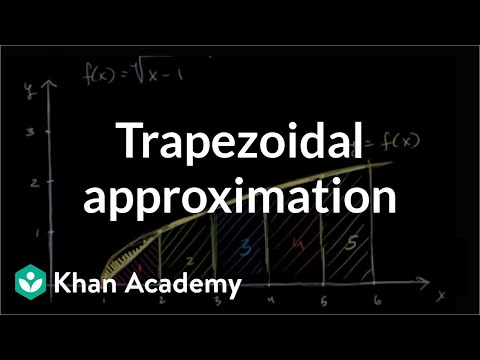
Trapezoidal sums | Accumulation and Riemann sums | AP Calculus AB | Khan Academy
Approximating the Area Under a Curve Using Trapezoids
Setting Up the Problem
- The goal is to approximate the area under the curve y = sqrtx - 1 between x = 1 and x = 6 .
- The area will be approximated using five trapezoids of equal width, with boundaries defined for each trapezoid.
Calculating Width and Shape of Trapezoids
- The total width from x = 1 to x = 6 is divided into five sections, resulting in a width ( Delta x ) of 1 for each trapezoid.
- Each trapezoid's shape is described, noting that some may resemble triangles due to one side having a length of zero.
Area Calculation Methodology
- The area of each trapezoid (or triangle in some cases) is calculated using the average height of its two sides multiplied by the base width ( Delta x ).
- For the first trapezoid, the area formula involves evaluating heights at points f(1) and f(2) .
Summing Areas of Trapezoids
- The areas for subsequent trapezoids are similarly calculated:
- Second trapezoid uses heights at f(2) , f(3) .
- Third uses heights at f(3), f(4).
- Fourth uses heights at f(4), f(5).
- Fifth uses heights at f(5), f(6).
Final Approximation Expression
- All terms can be factored out to simplify calculations. This leads to an expression representing an approximation for the total area under the curve.
- The final expression includes contributions from all evaluated function values, emphasizing how they relate to their respective endpoints.
Evaluating Function Values
- To compute specific areas, function values are evaluated:
- For example, f(1)=0, leading to simplifications in calculating areas.
- (398s)) Further evaluations yield results such as:
- For instance, evaluating at points like 2 and 3 gives insights into how these contribute to overall area calculations.
Mathematical Evaluation and Calculation Process
Evaluating Functions and Square Roots
- The calculation begins with evaluating the expression involving square roots, specifically noting that 2 times sqrt4 - 1 simplifies to 4.
- The function f(6) is evaluated as sqrt6 - 1, leading to the result of sqrt5.
- The speaker prepares to use a TI-85 calculator for further calculations, indicating a transition into practical computation.
- A multiplication operation is set up: 0.5 times (0 + 2 + ...), demonstrating the step-by-step approach in solving the mathematical problem.
- The speaker expresses a momentary loss of focus while calculating, highlighting the challenges faced during complex evaluations.