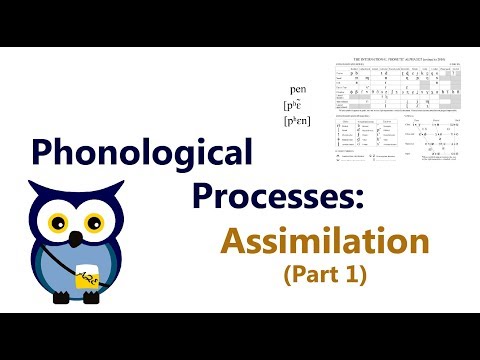
Phonological Processes: Assimilation (Part 1)
Introduction to Ace Linguistics
This section introduces the channel "Ace Linguistics" and its focus on various linguistic topics such as phonetics, phonology, morphology, syntax, semantics, and sociolinguistics.
Importance of Phonology and Sound Change
- Phonology studies the sounds of a language.
- Sounds change when they are put together in words or sentences due to continuous speech without pauses.
- The way words come into contact with each other can result in sound changes within and between words.
- Speaking at different paces and intonation also affect sound quality and may lead to further changes.
Variation in Language
- Sound changes can create variation within a language.
- Variants of the same word may coexist at the same time.
- Some variants may disappear over time, leading to language change.
Phonological Processes
- Sound changes occur through phonological processes in normal speech flow.
- Assimilation, dissimilation, insertion (or appendices), deletion (or elision), metathesis are major phonological processes.
- Assimilation is the most common process where one sound becomes more similar to a nearby sound in one or more features.
Assimilation Examples
- Assimilation can occur between adjacent sounds (contiguous) or at a distance (non-contiguous).
- It can be progressive (forward) or regressive (backward).
- Assimilation can be partial or total and may happen within a word or between two words.
Example: Pronunciation of "pen"
- The word "pen" is aspirated initially with an /h/ sound before the vowel /ɛ/.
- Before saying /n/, nasalization occurs, resulting in /pɛ̃/.
Timestamps provided for specific examples should be used to refer back to the corresponding part of the video for more detailed explanations.
New Section
This section discusses the process of assimilation in speech sounds, specifically focusing on nasal assimilation.
Assimilation of Sounds (Nasal Assimilation)
- Sounds become more similar to each other through a process called assimilation.
- The example given is the words "seen," "beam," "Ben," and "cam" which all have nasal sounds.
- Even if the nasal sound occurs before a non-nasal sound like "math," it still remains nasalized.
- The actual buccal or oral sound is produced when the lips touch and the tongue touches the alveolar ridge.
New Section
This section explains that when pronouncing certain words, such as "can," the final nasal sound can influence how we perceive the word.
Buccal/Oral Sound and Nasality
- If you say the word "can" and remove everything before the final nasal sound, it would sound similar to saying just "can."
- This means that if you pronounce only the buccal/oral sound (the part after the final nasal), it determines whether it's perceived as "ma" or not.
New Section
In this section, different types of assimilation are discussed, with a focus on vowel assimilating to following consonants in nasality.
Vowel Assimilation in Nasality
- Vowels can assimilate to following consonants in terms of nasality.
- Nasality is a manner of articulation.
- In this case, nasality is considered one feature of assimilation.
- The features of /n/ include being voiced and an alveolar nasal.
New Section
This section explains the concept of partial assimilation and how it relates to contiguous assimilation.
Partial Assimilation
- The assimilation in nasality is an example of partial assimilation.
- It occurs when sounds become more similar but don't entirely transform into the other sound.
- In this case, it is partial contiguous assimilation because the sounds are adjacent to each other.
New Section
This section discusses regressive assimilation and its significance in the context of nasal assimilation.
Regressive Assimilation
- The term "regressive" refers to the direction of the assimilating influence, which is backward from /n/ to /m/.
- In this example, /n/ influences the previous sound, making it an example of regressive assimilation.
- All the examples mentioned are also examples of partial contiguous regressive assimilation.