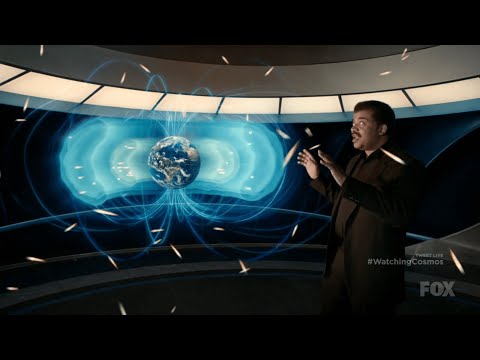
El descubrimiento que nos cambió la vida - Cosmos: Una odisea de tiempo y espacio - (Español Latino)
How Did We Learn to Control Electrons?
The Magic of Instant Communication
- The speaker reflects on the marvel of modern communication, where images and voices can be transmitted instantly across vast distances, a concept that would have seemed magical to our ancestors.
- This transformation in communication speed is attributed to the groundbreaking work of Michael Faraday, whose contributions were pivotal in harnessing electricity.
The Legacy of Isaac Newton
- The narrative emphasizes that without Michael Faraday's existence, the world as we know it might not exist today; his discoveries were crucial for future advancements.
- Isaac Newton is introduced as a foundational figure whose curiosity about planetary motion led to significant scientific inquiries regarding forces acting at a distance.
Michael Faraday's Early Life
- Born into poverty in 1791, Michael Faraday showed little aptitude in school and began working at a bookbinding shop at age 13.
- His time spent binding books allowed him to read extensively at night, igniting a lifelong fascination with electricity.
A Turning Point: Meeting Humphry Davy
- At 21 years old, Faraday attended a public science demonstration by Humphry Davy, which marked a turning point in his life.
- Davy was not only an influential scientist but also an engaging performer who captivated audiences with primitive electrical demonstrations.
From Apprentice to Assistant
- After impressing Davy with his notes from the lecture, Faraday became his assistant when an experiment went awry during one of Davy's demonstrations.
- Together with chemist William Holland, they explored the mysterious relationship between electricity and magnetism.
The Birth of Practical Electricity
- Faraday’s excitement grew as he realized that electricity could potentially be harnessed for practical applications beyond mere entertainment.
- He dedicated himself to designing experiments that would lead to practical uses for electricity, envisioning its potential impact on society.
Revolutionizing Technology
- With simple materials like metal and mercury, Faraday created the first motor that converted electrical energy into continuous mechanical motion.
- This invention was revolutionary and laid the groundwork for countless technological advancements that transformed industries and daily life.
Challenges and Perseverance
- Despite facing challenges such as failing to improve optical glass quality—a task he undertook diligently—Faraday remained focused on advancing scientific knowledge rather than personal gain.
Michael Faraday's Struggles and Discoveries
The Impact of Memory Loss on Faraday's Work
- At 49, Michael Faraday began experiencing severe memory loss and depression, which affected his work significantly. Despite this, he had major achievements still ahead.
Visualization of Magnetic Fields
- Faraday conceptualized the space around a magnet as filled with invisible lines of energy, coining the term "magnetic field" to describe this phenomenon.
Connection Between Electricity, Magnetism, and Light
- After demonstrating the relationship between electricity and magnetism, Faraday speculated about a potential connection to light. He aimed to reveal deeper secrets of nature by linking these three forces.
Experimentation with Polarization
- Understanding that light travels as waves, he explored polarization—where light reflects off surfaces—and sought to manipulate it using an invisible magnetic field.
Challenges in Experimentation
- Despite his efforts with various materials like calcite and acids, Faraday struggled to observe any effects through his ocular device due to the limitations of existing scientific understanding at that time.
Breakthrough with Glass
Discovery Using Glass Brick
- In desperation, Faraday experimented with glass bricks. This led him to successfully demonstrate that a magnetic force could twist light enough for it to pass through glass.
Significance of His Findings
- This breakthrough revealed a previously undetectable physical reality and was likened to observing the cosmos through a telescope for the first time.
Faraday's Continued Curiosity Amidst Adversity
Ongoing Exploration Despite Depression
- Even as he faced depression and doubts about his mental capacity, Faraday remained passionately curious about how electricity, magnetism, and light interacted.
Patterns in Iron Filings
- Recognizing that electric current turns wires into magnets, he investigated patterns formed by iron filings around electrified wires. He saw these patterns as evidence of invisible energy fields rather than mere shapes created by iron itself.
Understanding Earth's Magnetic Field
The Nature of Magnetic Forces
- Faraday noted that compass needles do not just point towards distant magnetic poles but detect continuous energy fields extending from Earth itself—a giant magnet influencing its surroundings invisibly.
How Do Birds Navigate Using Earth's Magnetic Field?
Internal Compass of Birds
- Birds possess an internal compass that allows them to sense the Earth's magnetic field, enabling them to navigate effectively.
- Their brains process magnetic data similarly to how humans process visual information, allowing birds to distinguish directions like north and south.
- This ability is crucial for North American birds during their migration south for the winter.
The Source of Earth's Magnetic Field
- The Earth's magnetic field is generated by liquid iron circulating around the solid core of the planet.