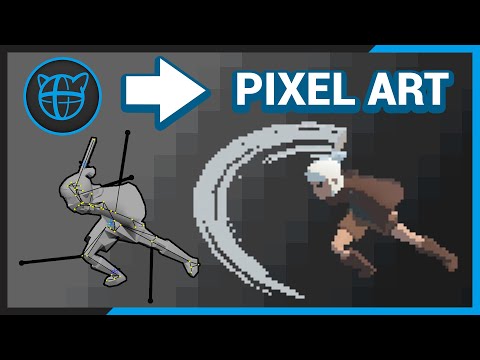
Making an Animation for my 3D Pixel Art Game
Developing Character Animations with a Pixel-Art Feel
Inspiration and Reference Gathering
- The speaker discusses starting character animations, focusing on creating a sword attack combo animation while aiming for a pixel-art aesthetic.
- They reference Hyper Light Drifter’s sword attack as inspiration, noting its effective hitbox representation through smear frames in the animation.
- Observations reveal that the direction of swings varies based on the character's orientation, which is crucial for maintaining clarity in 2D versus 3D environments.
Animation Techniques and Software
- The speaker contrasts Link's sword animation from Breath of the Wild, highlighting its flat arc that works well in 3D but lacks dynamism due to static foot positioning.
- They experiment with Cascadeur software for animating, utilizing auto-posing features to quickly block out key poses like anticipation and recovery during swings.
Key Poses and Motion Representation
- Emphasis is placed on capturing essential poses while ensuring wide and flat swings for better visibility from various angles.
- The speaker aims to emulate traditional pixel art by representing motion primarily through single-frame smears without intermediate frames.
Importing and Implementing Animation
- To integrate animations into the game engine, they export from Cascadeur using FBX format while applying scripts to manage interpolation and frame cleanup.
- A script measures motion changes during gameplay to generate smear effects dynamically based on blade movement direction.
Refinement Process
- Smear generation utilizes cubic Bezier interpolation for both position and orientation of the sword model, aligning axes appropriately for realistic motion representation.
- After initial testing reveals stiffness in motion, adjustments are made in Cascadeur to enhance swing dynamics with stronger poses and follow-through momentum.
Final Adjustments and Completion
- Further refinements include modifying the second swing into a lunge for increased forward motion while enabling interpolation for previewing adjustments effectively.
- Secondary motions are added to elements like capes; extreme poses are cleaned up alongside fixing arm movements during interpolated frames.
Conclusion of Animation Development
- Off-camera edits improve lunge reach; an idle return animation is created. Overall time spent on this animation process totals around 90 minutes.
- The speaker concludes by thanking viewers for watching their journey through character animation development.
Turn any video into a summary like this
YouTube links, meetings, lectures. With transcripts, search, and chat.