Diagramas de Venn
Introduction to Venn Diagrams
What are Venn Diagrams?
- Venn diagrams are graphical representations that illustrate sets and their relationships using circles.
- Typically, two circles represent two sets (e.g., Set A and Set B), with a rectangle often used to denote the universal set encompassing all possible elements.
Purpose of Venn Diagrams
- They serve as a visual tool to understand how sets interact, particularly in terms of intersections and unions.
- The instructor plans to demonstrate examples involving both two and three sets for clarity.
Example of Venn Diagram with Sets
Defining the Sets
- In this example, Set A consists of the divisors of 12, while Set B includes the divisors of 15. The universal set contains numbers from 1 to 15.
Placement in the Diagram
- Elements are placed within overlapping circles: unique elements go in their respective sections, while shared elements occupy the intersection area.
- For instance, number 1 is placed in the intersection since it belongs to both sets.
Filling Out the Diagram
Element Distribution
- Each element is analyzed for its membership in either set; for example:
- Number 2 belongs only to Set A.
- Number 3 belongs only to Set B.
Completing the Universal Set
- All numbers from the universal set must be accounted for. Numbers not belonging to either set are placed outside the circles (e.g., number 7).
Understanding Intersections and Empty Sections
Intersection of Sets
- The intersection includes elements common to both sets; here, those are numbers 1 and 3.
Inclusion Concept
Understanding Set Theory: Inclusion and Disjunction
Introduction to Set Relationships
- The speaker discusses the placement of numbers in a Venn diagram, indicating which numbers belong to specific sets.
- The concept of inclusion is introduced, explaining that if all elements of one set (set B) are also in another set (set A), then B is a subset of A.
- The notation for subsets is explained, emphasizing that set B being contained within set A means every element of B is also an element of A.
Visual Representation in Diagrams
- When illustrating inclusion, the area representing only set B becomes empty since it has no unique elements outside those in set A.
- The speaker contrasts Venn diagrams with Euler diagrams, noting that in Euler diagrams, smaller sets are drawn inside larger ones to show containment visually.
Exploring Disjunction
- Disjunction is defined as the scenario where two sets have no common elements.
- Examples are provided where certain numbers belong exclusively to one set or the other, demonstrating how disjoint sets appear on a diagram.
Diagramming Techniques
- In cases of disjunction, areas representing common elements remain empty because there are no shared members between the two sets.
- The speaker explains how both types of relationships—inclusion and disjunction—are represented differently in Euler diagrams compared to Venn diagrams.
Practical Application: Graphing Sets
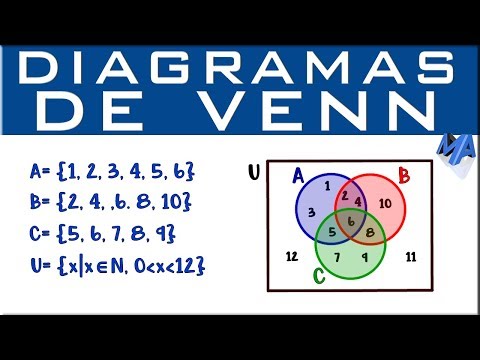
- An example involving three sets illustrates how to graphically represent these relationships using a Venn diagram without necessarily including a universal set rectangle.
- Each number's placement within the circles for each respective set is methodically described based on their membership across multiple sets.
Conclusion and Practice Exercise
- The discussion concludes with an observation about intersections among three sets and emphasizes that only shared members count towards intersection results.
Understanding Set Theory through Letters
Exploring the Intersection of Sets
- The speaker discusses the letters in the word "matemáticas," emphasizing that no letters are repeated. For instance, 'm' is mentioned only once.
- A third set consists of the letters from the name "Álex," which will be organized into a Venn diagram to illustrate relationships between sets.
- The intersection of these two sets reveals that only two letters overlap, specifically vowels present in both "matemáticas" and "Álex."
- The universal set could encompass all letters of the alphabet; however, it was not explicitly written out in this context.