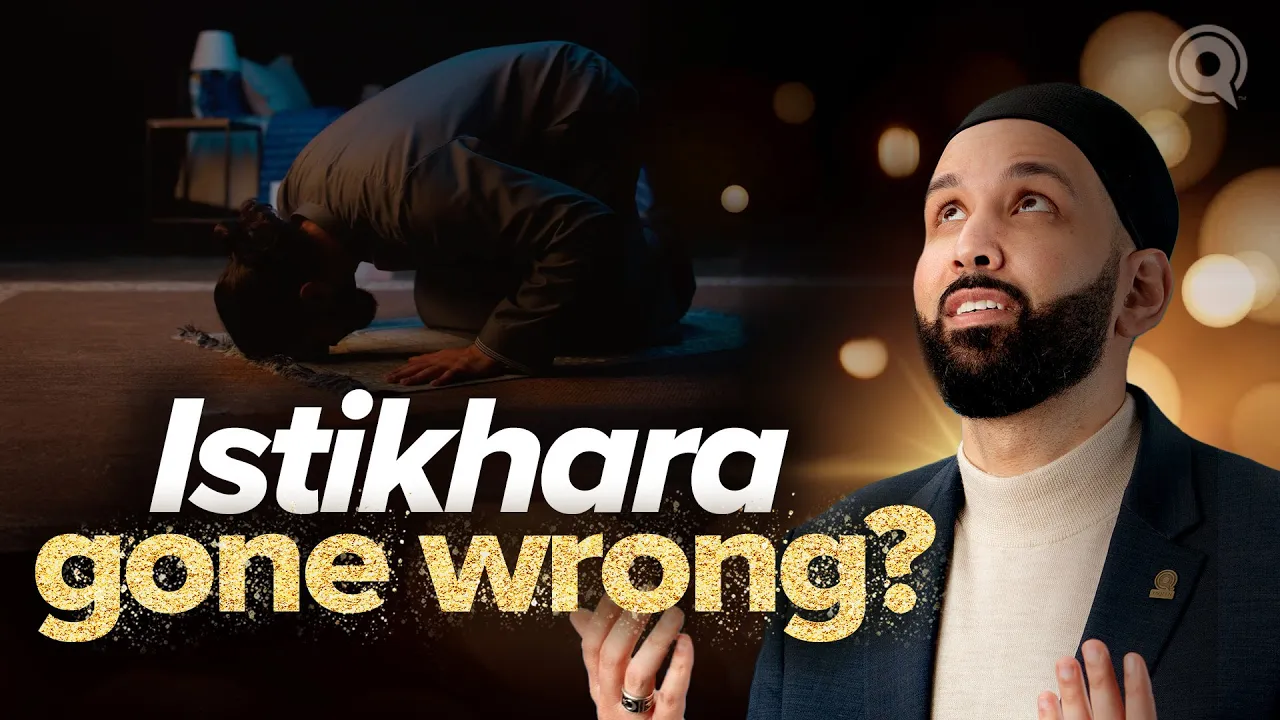
Why Did Allah Send Me Down This Path? | Why Me? EP. 12 | Dr. Omar Suleiman | Ramadan Series on Qadar

Why Did Allah Send Me Down This Path? | Why Me? EP. 12 | Dr. Omar Suleiman | Ramadan Series on Qadar

Desiring the Best Outcome through Prayer

The speaker discusses the importance of seeking guidance from Allah through prayer, particularly in times of decision-making and uncertainty.

Seeking Guidance Through Prayer

  • Imam al Nawawi emphasizes the significance of seeking consultation from righteous individuals (istishara) and praying for guidance from Allah (istikhara).
  • Reflecting on Prophet Muhammad's perseverance in making du'a for 13 years despite challenges highlights the power of continuous prayer even in adversity.
  • Analogies are drawn from Prophets' stories like Zakariya and Ibrahim to illustrate how delayed answers to prayers may lead to unforeseen blessings.
  • Emphasizes that sometimes the process leading up to a desired outcome is as crucial as the outcome itself, citing examples from Prophet Muhammad's life.
  • Discusses how Istikharah prayer aims at aligning one's desires with what is best for both worldly and spiritual aspects, emphasizing trust in Allah's plan.

Understanding Divine Timing and Acceptance

Delving into the concept of Istikharah further, exploring how divine timing plays a role in answering prayers and guiding individuals towards their ultimate good.

Divine Timing and Acceptance

  • Instances like Prophet Muhammad's marriage to Zaynab after an initial failed marriage highlight how apparent setbacks can lead to better outcomes ordained by Allah.
  • Ibn al Qayyim's perspective on understanding Allah's kindness behind delays underscores the importance of trusting His plan even when outcomes seem unfavorable initially.
  • Encourages reflection on missed opportunities that could have led to different paths, emphasizing that every circumstance guiding one back to Allah is ultimately beneficial.

Embracing Rejection as Divine Guidance

Explores rejection as a means of redirection towards spiritual growth and closeness to Allah, highlighting its role in shaping individual journeys.

Rejection as Guidance

  • Sufyan ibn 'Uyaynah's insight on embracing rejection due to its potential for deepening one's connection with du'a emphasizes viewing setbacks as avenues for spiritual elevation.

New Section

The text discusses the concept of surrendering to Allah's will and finding tranquility in accepting outcomes beyond personal desires.

Surrendering to Allah's Will

  • "Tranquility comes when a person decides to let go of the outcome they desperately want, submitting humbly to Allah."

Accepting Unexpected Outcomes

  • Sometimes Allah delays giving what is desired until it is truly wanted. He may break dependence on it before granting it, often in unexpected forms and from unforeseen sources.

New Section

The text emphasizes that having taqwa (God-consciousness) leads to divine assistance and sustenance from unexpected avenues.

Divine Assistance through Taqwa

  • Those who have taqwa of Allah are provided with solutions and provisions from places they never anticipated.

Spiritual Strength for Challenges

Video description

Let your rizq raise a voice for the ummah. Donate to Yaqeen: https://yqn.io/utw When you make Istikharah du'a, you're asking Allah to guide you towards the right choice, a special consultation with Him. But if the results don't turn out good for you, why was it facilitated? What was the point of your Istikharah? Ibn al-Qayyim said, “If the veils were lifted and you could see behind the scenes what Allah does out of kindness for you, your heart would melt out of love for Him…” Allah answers every prayer according to His time and plan and gives the best results for it. So when you ask for good, and something bad happens, know that it was His Wisdom that deemed what you thought was bad to be better for you. And when you finally decide to let go of the outcome you so desperately want and humbly submit to Allah's Wisdom, the tranquility you'll feel will be unparalleled. Captioning provided by Muhsen. SOURCES: Tariq al-Hijratayn Al-Faraj baʻda al-Shiddah 21 Qur’an, 65:2 Al-Hikam al-Ataa’iyyah 6: لا يَكُنْ تأَخُّرُ أَمَدِ العَطاءِ مَعَ الإلْحاحِ في الدُّعاءِ مُوْجِباً لِيأْسِكَ. فَهُوَ ضَمِنَ لَكَ الإِجابةَ فيما يَخْتارُهُ لَكَ لا فيما تَخْتارُهُ لِنَفْسِكَ. وَفي الوَقْتِ الَّذي يُريدُ لا فِي الوَقْتِ الَّذي تُرْيدُ If, in spite of intense supplication, there is a delay in the timing of the Gift, let that not be the cause for your despair. For He has guaranteed you a response in what He chooses for you, not in what you choose for yourself; and at the time He wills, not the time you desire. Dua for Istikhara ‎اللَّهُمَّ إِنِّي أَسْتَخِيرُكَ بِعِلْمِكَ وَأَسْتَقْدِرُكَ بِقُدْرَتِكَ، وَأَسْأَلُكَ مِنْ فَضْلِكَ الْعَظِيمِ، فَإِنَّكَ تَقْدِرُ وَلاَ أَقْدِرُ وَتَعْلَمُ وَلاَ أَعْلَمُ وَأَنْتَ عَلاَّمُ الْغُيُوبِ، اللَّهُمَّ إِنْ كُنْتَ تَعْلَمُ أَنَّ هَذَا الأَمْرَ خَيْرٌ لِي فِي دِينِي وَمَعَاشِي وَعَاقِبَةِ أَمْرِي ـ أَوْ قَالَ عَاجِلِ أَمْرِي وَآجِلِهِ ـ فَاقْدُرْهُ لِي وَيَسِّرْهُ لِي ثُمَّ بَارِكْ لِي فِيهِ، وَإِنْ كُنْتَ تَعْلَمُ أَنَّ هَذَا الأَمْرَ شَرٌّ لِي فِي دِينِي وَمَعَاشِي وَعَاقِبَةِ أَمْرِي ـ أَوْ قَالَ فِي عَاجِلِ أَمْرِي وَآجِلِهِ ـ فَاصْرِفْهُ عَنِّي وَاصْرِفْنِي عَنْهُ، وَاقْدُرْ لِي الْخَيْرَ حَيْثُ كَانَ ثُمَّ أَرْضِنِي بِهِ 'Allahumma inni astakhiruka bi'ilmika, Wa astaqdiruka bi-qudratika, Wa as'alaka min fadlika Al-`azlm Fa-innaka taqdiru Wala aqdiru, Wa ta'lamu Wala a'lamu, Wa anta 'allamu l-ghuyub. Allahumma, in kunta ta'lam anna hadha-lamra Khairun li fi dini wa ma'ashi wa'aqibati `Amri (or 'ajili `Amri wa'ajilihi) Faqdirhu wa yas-sirhu li thumma barik li Fihi, Wa in kunta ta'lamu anna hadha-lamra shar-run li fi dini wa ma'ashi wa'aqibati `Amri (or fi'ajili `Amri wa ajilihi) Fasrifhu anni was-rifni anhu. Waqdir li al-khaira haithu kana Thumma ardini bihi.' (O Allah! I ask guidance from Your knowledge, And Power from Your Might and I ask for Your great blessings. You are capable and I am not. You know and I do not and You know the unseen. O Allah! If You know that this job is good for my religion and my subsistence and in my Hereafter--(or said: If it is better for my present and later needs)--Then You ordain it for me and make it easy for me to get, And then bless me in it, and if You know that this job is harmful to me In my religion and subsistence and in the Hereafter--(or said: If it is worse for my present and later needs)--Then keep it away from me and let me be away from it. And ordain for me whatever is good for me, And make me satisfied with it) [Sahih al-Bukhari 1166] CAST: Narrator Dr. Omar Suleiman Hassan Noaman Farooq Hassan's Father Mohammed Momin Baig Hassan's Mother Safiyyah Saarah Khan Janitor Akeaf Syed Interviewer 1 Basel Abukhalaf Interviewer 2 Randy Fordyce Interviewer 3 Fahad Mohiuddin Man Praying 1 Fawzi Yahya Man Praying 2 Shaheer Naqvi Man Praying 3 Fahad Mohiuddin Hassan's Friend Waleed Zeeshan Wahid Hassan's crush Layla Mariam Amjad Sister in Niqab Sara Qasmi Note: Only vocals were used in the making of the soundtrack. As we venture into the space of producing higher quality media, we’ve worked hard to make sure that our compliance with our religious ethics is not sacrificed. While Yaqeen has always produced vocals for our Ramadan series, this series was unique in that it also included the story of a family in the background. Our talented production team worked with our scholars to ensure that all actors were in proper hijab, and that all gender interactions were only by Mahrams in real life. We’re grateful to the team for its wonderful effort, and grateful to the families that agreed to participate. Subscribe and be sure to turn notifications on to receive the latest videos Yaqeen has to offer! #omarsuleiman #ramadan2024 #ramadanseries #qadr Click SUBSCRIBE for more great content! Visit http://www.yaqeeninstitute.org for full access to all research publications, infographics, and videos. Join the conversation on Twitter, Facebook, and Instagram @yaqeeninstitute!