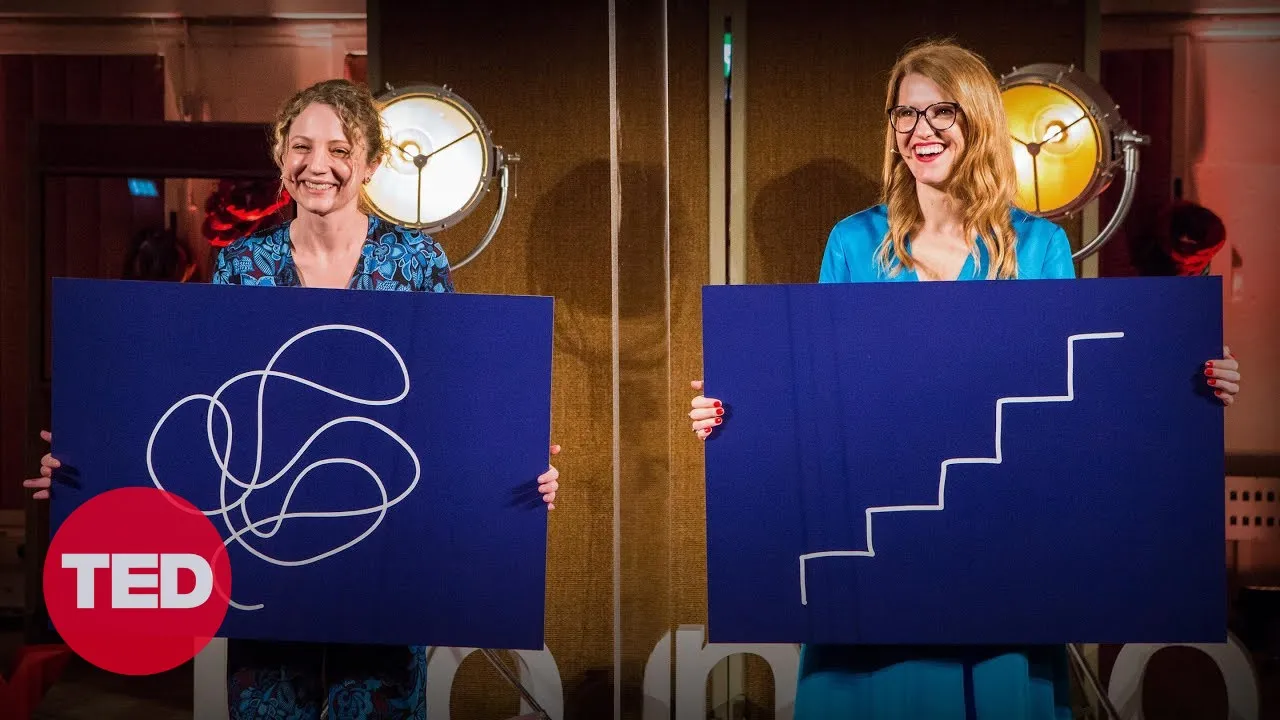
Sarah Ellis and Helen Tupper: The best career path isn't always a straight line | TED
Introduction
In this section, Helen Tupper and Sarah Ellis introduce themselves and discuss their initial ambitions for climbing the career ladder.
Meeting at university
- Helen Tupper and Sarah Ellis met at university 20 years ago.
- They were unlikely friends due to their contrasting personalities - Helen is an extrovert while Sarah is an introverted ideas person.
- Despite their differences, they both shared the ambition to climb the career ladder.
The Limitations of the Career Ladder
In this section, Helen and Sarah discuss how their initial focus on promotions and job titles started to feel limiting.
Preoccupation with promotions
- Initially, Helen and Sarah were focused on promotions and pay rises.
- They were concerned with holding senior job positions and having impressive job titles.
- However, they started to feel that the ladder might be holding them back.
Exploring new opportunities
- Helen and Sarah became excited about exploring opportunities that weren't necessarily based on their previous experiences.
- They realized that the obvious next step in their careers wasn't always the most appealing.
- Their careers started to become more unpredictable and non-linear.
The concept of squiggly careers
- A squiggly career is characterized by uncertainty and possibility.
- Change is constant, some within our control and some not.
- Success is individualized, not one-size-fits-all.
Squiggly Careers in Practice
In this section, Helen and Sarah share examples of their own squiggly careers.
Examples of squiggly careers
- Helen's career involved working on foldable credit cards in one company before moving on to building a loyalty app for another company.
- Sarah transitioned from making magazines to working on food waste and shifted to a four-day workweek to focus on personal projects and volunteering.
Squiggly careers as the norm
- Helen and Sarah highlight that having multiple jobs and working in different organizations is becoming more common.
- The traditional linear career path is no longer the rule but rather the exception.
The Legacy of the Career Ladder
In this section, Helen and Sarah discuss how the legacy of the career ladder still influences organizations and individuals.
Outdated concepts
- Traditional career ladders were created in the early 1900s for a different era of work.
- Today's dynamic work environment, with only six percent of people in the UK working nine-to-five, requires a shift away from conformity and control.
Skills relevance and learning
- The World Economic Forum estimates that 50 percent of current skills will be irrelevant by 2025.
- Learning should not be limited by organizational levels or exclusive to certain individuals.
- Everyone should have access to learning opportunities, regardless of their position or department.
Redefining Learning at Work
In this section, Helen and Sarah emphasize the importance of redefining our relationship with learning at work.
Personalized learning
- Individuals now have the opportunity to curate their own learning experiences.
- TED Talks, books, blogs, podcasts can all contribute to personal development.
- Learning is no longer dependent on others; it is personalized and self-driven.
Breaking down barriers
- Learning should not be limited by job roles or connections.
- Organizations can adopt programs like "Connected Learning" that facilitate cross-functional learning without barriers.
Conclusion
Helen Tupper and Sarah Ellis advocate for embracing squiggly careers instead of adhering to traditional career ladders. They emphasize the need for personalized learning and breaking down barriers to create a more adaptable and fulfilling work environment.
The transcript provided is already in English, so there is no need to translate the content.
New Section
In this section, the speakers discuss the need to change our perspective on career progression and explore different career possibilities.
Changing Perspective on Progression
- The problem with career ladders is that they only go in one direction and limit our opportunities for growth.
- Progression should not be limited to promotions; we should focus on exploring various career possibilities.
- Exploring different career options increases resilience, creates more connections, and helps us discover new skills.
- It is important to give ourselves permission to explore ambitious possibilities, even if we feel unprepared or they seem out of reach.
Support from Organizations
- Organizations play a crucial role in supporting employees' exploration of career possibilities.
- Cook, a food manufacturer, has implemented the "Dream Academy" where colleagues can explore any career they are interested in, both within and outside the organization.
- The Dream Academy empowers employees to have confidence in opening doors for themselves.
Embracing Individual Talents
- Career ladders often focus on job titles rather than individual talents.
- Everyone has unique talents that can be utilized in various ways throughout their careers.
- Squiggly careers allow individuals to define their own success and embrace their uniqueness.
Radical Redo for Better Careers
- A radical rethink is needed to break free from the limitations of traditional career ladders.
- Taking action and advocating for squiggly careers can lead to better opportunities for everyone.
Call to Action
- Managers can help employees explore their career possibilities, while mentors can provide confidence and guidance.
- Sharing knowledge and supporting each other's success is essential in creating better careers for all.
Turn any video into a summary like this
YouTube links, meetings, lectures. With transcripts, search, and chat.