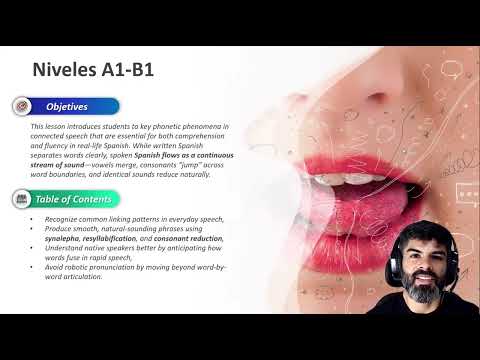
Masterclass #1 - How to speak Spanish fluently
How to Speak Spanish More Fluently
Introduction to Fluidity in Spanish
- Carlos, also known as Charlie, introduces himself as a Spanish teacher and emphasizes the importance of connecting words for natural speech. He notes that in Spanish, words are not spoken individually but rather blend together to create a rhythm.
Connecting Consonants and Vowels
- The lesson focuses on how vowels connect with consonants when one word ends with L, N, R, S, or Z and the next begins with a vowel. This connection creates smoother transitions in speech.
Examples of Connections
- L + Vowel: "El idioma" is pronounced as "li" (the sound attracts the following vowel). Repetition is encouraged for practice.
- N + Vowel: Example given is "un ejemplo," where the final N connects smoothly with the following vowel. Students are prompted to repeat this phrase.
- R + Vowel: In "hablar español," the R connects fluidly with the vowel E in "español." Repetition is again encouraged for mastery.
- S + Vowel: The example "los amigos" demonstrates how S connects with A; students are asked to repeat this phrase too.
- Z + Vowel: Differences in pronunciation between Spain and Latin America are highlighted using "pesa azul," where Z sounds like S in Latin America but has a different pronunciation in Spain. Students practice repeating this phrase as well.
Practicing Phrases
- Several phrases are introduced for practice:
- “El amor”
- “Un objeto”
- “Flor amarilla”
- “Mis ideas”
- “Paz interior”
Students can pause the video to practice these phrases before moving on to connecting vowels and vowels themselves.
Connecting Vowels
- When one word ends with a vowel and another starts with a vowel, they merge into one syllable.
Specific Examples
- A + A: In "la amiga," both As connect into one sound ("la miga"). Students should practice this connection.
- E + E: Example given is "de España," where both Es connect smoothly during pronunciation. Students are reminded about exceptions such as verbs like leer and creer which pronounce both vowels distinctly regardless of their placement at word boundaries.
Additional Connections
- Other examples include:
- “mi hermano” (I brother) where I merges into M.
- “yo hablo” (I speak) shows O merging into A.
- Finally, “Tú eres” illustrates U connecting seamlessly into E; students should pause for further practice here too.
Advanced Practice Sentences
- Five additional sentences provided for advanced practice:
- “La historia”
- “He ido”
- Examples from perfect tense constructions like "he hablado."
- Future constructions such as "voy a comer" demonstrate how future intentions combine words naturally.
- Variations including pronouns like él/ella or ellos/ustedes also show similar connections when followed by verbs starting with vowels (e.g., van a comer).
Conclusion of Lesson Structure
- The lesson wraps up by emphasizing that understanding these connections enhances fluency and naturalness in speaking Spanish.
Pronunciation Connections in Spanish
Common Consonant Connections
- The connection of plural forms is discussed, particularly with the letter "S". For example, "los sábados" reduces to a single 's' for a more natural sound.
- The combination of "N + N" is illustrated using the word "Navidad", highlighting regional differences between Latin America and Spain. Both pronunciations are correct.
- The connection of "L + L" is exemplified with "el libro", where both 'l's are pronounced as one.
- The pronunciation of the letter "R" is explained, emphasizing its consistent sound at the beginning and end of words. Examples include phrases like "habla rápido".
- Viewers are encouraged to pause the video for practice on these connections, reinforcing learning through repetition.
Practice Exercises
- Four example phrases are provided for practice:
- “Es seguro”
- “Un niño”
- “El lápiz”
- “Señor responsable”
- A series of ten sentences in Spanish are presented for listeners to write down and understand:
- Example: “Voy a estudiar con mi amiga” demonstrates connected speech.
- Additional examples include:
- “Mi novia viene a casa hoy”
- “Quiero ir al cine esta noche”
- More sentences continue with:
- “Los sábados salgo con mis amigos”
- “Un niño juega el fútbol en el parque”
- The speaker encourages repeated viewing for better comprehension and mentions additional resources available on their profile regarding Spanish grammar topics such as past tenses and subjunctive vs. indicative contrasts.