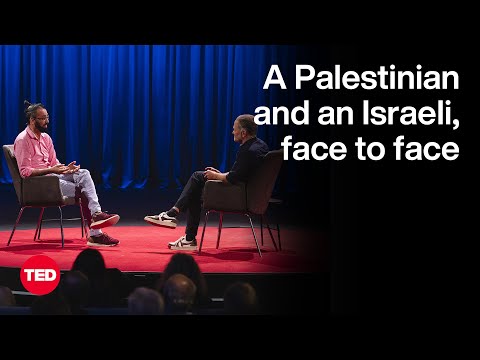
A Palestinian and an Israeli, Face to Face | Aziz Abu Sarah and Maoz Inon | TED
Maoz Inon's Journey of Reconciliation
Maoz Inon shares his personal journey of loss, reconciliation, and the path to peace following the tragic death of his parents.
Maoz's Dream of Healing Humanity
- Maoz recounts a dream where humanity collectively cries, healing each other's wounds with tears, symbolizing unity in sorrow.
- The dream transitions to purifying blood-stained ground through tears, revealing a path to peace.
Choosing Reconciliation Over Revenge
- Despite immense loss, Maoz chooses the path of reconciliation over revenge after his parents' death.
- Aziz Abu Sarah acknowledges Maoz's stance against revenge and war as a brave choice amidst tragedy.
Aziz Abu Sarah's Perspective on Peace
Aziz Abu Sarah reflects on his journey towards peace and forgiveness despite personal loss and challenges.
Personal Transformation Towards Peace
- Aziz shares his initial anger and desire for vengeance after losing his brother but later realizes the power of choosing peace over hate.
- Despite ongoing tragedies in Gaza, Aziz remains committed to peace and preventing hate from consuming him.
Shared Narratives for Peacebuilding
Both speakers emphasize the importance of shared narratives and understanding for building a peaceful future.
Commitment Amid Tragedy
- Despite profound losses in Gaza, individuals like Abdelrahim remain dedicated to peace rather than succumbing to hate.
Recognizing Shared Problems and Building Bridges
In this section, the speaker discusses the common problems faced in various workplaces, emphasizing the importance of recognition, understanding historical narratives, and having a shared vision for the future to overcome conflicts and divisions.
Lack of Recognition and Understanding
- Conflicts often stem from a lack of recognition, unwillingness to understand each other's historical narratives, and absence of a shared vision for the future.
- Personal anecdotes highlight how individuals may be unaware of others' traditions or experiences due to societal divides.
Importance of Asking Hard Questions
- Encouragement to ask hard questions and be willing to listen leads to transformative dialogues and understanding.
- Sharing personal experiences where difficult questions sparked meaningful interactions and learning opportunities.
Promoting Dialogue Through Dual-Narrative Tours
This segment delves into initiatives aimed at fostering dialogue between different communities through dual-narrative tours led by both Israelis and Palestinians. The focus is on building mutual understanding and pushing each other towards growth.
Dual-Narrative Tours for Understanding
- Establishment of Mejdi Tours with a Jewish friend to facilitate dual-narrative tours led by Israelis and Palestinians.
- Anecdote about a challenging question posed by a Palestinian friend leading to impactful exchanges.
Forgiveness, Reconciliation, and Building a Better Future
Here, the speaker reflects on forgiveness as a crucial step towards reconciliation while acknowledging the deep-rooted divide between Israeli and Palestinian narratives. The emphasis lies on forging a path towards peace through understanding and collaboration.
Embracing Forgiveness for Progress
- Acknowledgment of past grievances while emphasizing forgiveness for creating a better future.
- Highlighting the widening gap between Israeli and Palestinian stories over time but expressing hope in their convergence in a reconciled future.
Working Towards Peaceful Coexistence
This part focuses on collaborative efforts towards peacebuilding, outlining concrete steps taken to realize shared dreams of peace among Palestinians, Israelis, and global supporters. The narrative underscores unity in values as key to driving collective action.
Collaborative Peacebuilding Initiatives
- Description of ongoing efforts including detailed road mapping for peacebuilding initiatives.
- Execution of initial steps from the roadmap signifies progress towards amplifying voices for legitimacy as leaders advocating for peace.
Harnessing Anger Positively Towards Change
Addressing anger as an emotion prevalent amidst conflict situations, this segment advocates channeling anger constructively towards positive change rather than succumbing to hate or vengeance. It emphasizes using anger as motivation for improvement.
Transforming Anger into Action
- Acknowledgment of anger amid challenging circumstances but reframing it as fuel for constructive actions.
Hope and Unity for a Better Future
In this section, the speaker outlines a formula for creating hope and emphasizes the importance of collective action in envisioning and realizing a better future.
Creating Hope Together
- Hope, like love, is not achieved alone but through collaboration with others.
- The process of creating hope involves envisioning a better future collectively.
- Action is crucial in transforming this envisioned future into reality.
- Convincing oneself and others of the effectiveness of actions is essential in the journey towards hope.
Building Bridges Through Unity
This segment focuses on unity, justice, peace, and equality as unifying principles that transcend divisions based on nationality or religion.
Uniting for Justice and Peace
- Emphasizes the power of ideas in driving change.
- Calls for unity based on shared beliefs in justice, peace, and equality rather than divisive factors like nationality or religion.
- Encourages collective efforts to stand together against enmity and division.
Turn any video into a summary like this
YouTube links, meetings, lectures. With transcripts, search, and chat.