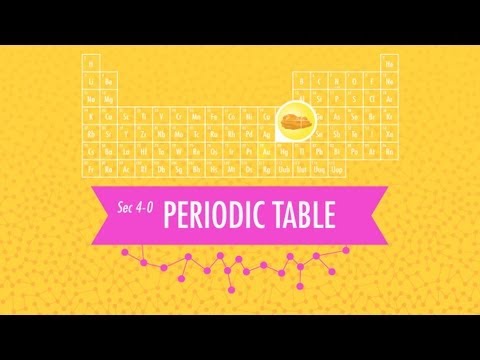
The Periodic Table: Crash Course Chemistry #4
Introduction to the Periodic Table
In this section, Hank Green introduces the topic of the periodic table and its significance in chemistry.
The Creation of the Periodic Table
- Dmitri Ivanovich Mendeleev became a prominent figure in Russian science and revolutionized how we see the world.
- Mendeleev's insights into the properties of elements led him to create a theoretical framework for organizing them.
- He observed that certain elements exhibited similar characteristics and realized there was a periodic repetition in their properties.
- Mendeleev faced challenges in arranging elements based on atomic weights but eventually inserted gaps to accommodate undiscovered elements.
- He accurately predicted the properties of these missing elements, even before they were discovered by other scientists.
Groups in the Periodic Table
This section focuses on different groups within the periodic table and their characteristics.
Alkali Metals
- Alkali metals are soft, shiny, and extremely reactive.
- They tend to form positive ions (cations) by losing an electron.
- Due to their reactivity, alkali metals are not found freely in nature and must be extracted from compounds containing them.
Alkaline Earth Metals
- Alkaline earth metals are also reactive but less so than alkali metals.
- They form cations with two positive charges instead of one.
(Timestamps provided for each bullet point indicate where they can be found in the video.)
New Section
This section provides an overview of the elements in the periodic table and their properties.
The Majority of Elements are Metals
- Metals are unreactive, good conductors of heat and electricity, malleable, and can be formed into sheets.
- Metals are important in chemistry and have similarities to each other.
The Halogens and Transition Metals
- The halogens are extremely reactive gases that form negative ions with one negative charge.
- They react with alkali and alkaline earth metals.
- Between the halogens and transition metals is a scatter shot of metals, metalloids, gases, and nonmetals.
Lanthanides and Actinides
- Lanthanides and actinides are metals that were largely undiscovered during Mendeleev's time.
- They are difficult to separate from each other due to their similarities.
Noble Gases
- Noble gases are completely unreactive.
- Mendeleev never thought he was done with his table; he held it back for quite a while before publishing it.
New Section
This section discusses Dmitri Mendeleev's contributions to the periodic table.
Mendeleev's Contributions
- Mendeleev was obsessive about his work on the periodic table.
- He knew the data better than anyone else and realized the far-reaching consequences of periodicity.
Mendeleev's Beliefs
- Mendeleev believed in God but thought organized religions were false paths to understanding God.
- He may have seen a divine pattern in his tables but this is pure conjecture.
Periodicity as a Physical Phenomenon
- The periodicity of elements is a physical phenomenon based on the behavior of electrons.
- It is not mystical but rather a function of electron properties.
Different Representations of the Periodic Table
- Mendeleev's table looks like a map, while de Chancourtois envisioned it as a globe.
- There are various designs for periodic tables with different advantages.
New Section
This section highlights the impact and future developments related to Mendeleev's periodic table.
Mendeleev's Guide for Future Chemists
- Mendeleev's table provided guidance for understanding elements that were yet to be discovered.
- After its publication, scientists questioned why it worked and sought further explanations.
The Electron's Role
- The discovery of electrons answered the question of why the periodic table worked.
- Mendeleev would have disliked electrons, but they are essential to understanding chemistry.
Conclusion and Next Episode Preview
- The episode concludes by thanking viewers and summarizing key points covered in this episode.
- The next episode will delve into the peculiar physical reality behind the periodic table.
Turn any video into a summary like this
YouTube links, meetings, lectures. With transcripts, search, and chat.