2.5 Polarizacion Directa e Inversa del Diodo Semiconductor
3D Animation of a Semiconductor Diode
Overview of the Semiconductor Diode
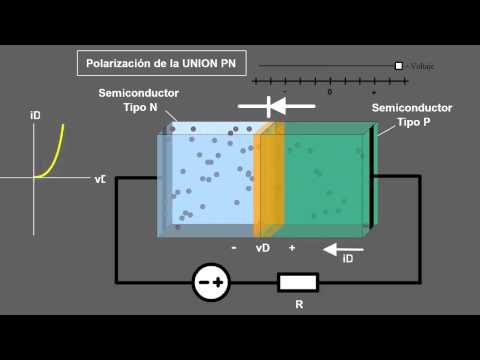
- The video presents a 3D animation of a semiconductor diode, highlighting the p-type semiconductor in green and the n-type semiconductor in blue. It emphasizes the abundance of free electrons in the n-type material compared to minority carriers in the p-type.
Understanding Diode Polarization
- The diode's symbol is introduced, with the arrow pointing towards the n-type semiconductor (anode), while the vertical line represents the p-type (cathode). This establishes basic terminology for understanding diode operation.
Direct Polarization Experiment
- A simple circuit is described, consisting of black wires, a resistor (R), and an empty space for a power source to demonstrate direct and reverse polarization effects on the diode.
- When applying direct polarization, positive voltage is connected to p-type and negative to n-type. This results in electron flow from n to p, illustrating conventional current flow versus actual electron movement.
Historical Context on Current Flow
- The speaker references Benjamin Franklin's misconception that positive charges move through circuits. This historical error led to defining conventional current as flowing opposite to actual electron movement.
- Clarification is provided regarding how this misunderstanding affects interpretations of current direction; real electron flow contradicts conventional definitions but will be used consistently throughout analyses.
Effects of Increased Voltage
- Increasing direct polarization voltage reduces charge accumulation at junctions, allowing greater electron flow from n to p without obstruction by external sources.
Reverse Polarization Dynamics
- In reverse polarization, negative voltage is applied to p-type and positive to n-type. This causes charge accumulation at junctions, preventing significant current flow despite minor reverse electron movement.
- A small reverse current exists but can often be neglected; however, forward current remains blocked under these conditions due to increased charge density at junction interfaces.
Summary of Diode Functionality