Organização de Computadores - Aula 03 - Barreira de potência e multicores
Organização de Computadores: Barreira de Potência Multicor
In this lecture, the focus is on power barriers in multicore processors, shifting the paradigm of computing development and performance evaluation through benchmarks. The discussion delves into performance metrics, emphasizing the impact of clock frequency on processor performance and the trade-offs associated with increasing clock speed.
Performance Metrics and Clock Frequency Impact
- Performance depends on instruction count, cycles per instruction, and clock cycle time.
- Increasing processor clock frequency has historically been a key driver for performance improvement in computing.
- Higher clock frequencies have led to significant performance gains over the years but come with increased power dissipation.
Power Dissipation Challenges
- The industry's pursuit of higher performance through increased clock speeds resulted in escalating power dissipation levels.
- Managing high power dissipation becomes crucial as excessive heat can impair processor functionality.
Calculating Processor Power Dissipation
Understanding how to calculate the power that a processor will dissipate involves considering factors such as technology used, semiconductor characteristics, and transistor switching activities.
Factors Influencing Power Dissipation Calculation
- The choice of technology impacts how power dissipation is calculated; advancements in electronics lead to new calculation methods.
- In semiconductor technology like CMOS, transistor switching is a primary source of power dissipation due to energy loss during state changes.
Relationship Between Frequency and Power Dissipation
- Power dissipation increases with frequency due to more frequent state changes within the processor.
- The formula for calculating power considers capacitive load, voltage squared, and frequency; higher frequencies result in increased power consumption.
Technological Advancements Impacting Power Consumption
Technological advancements have influenced factors like capacitive load reduction and voltage scaling, altering the relationship between frequency growth and power consumption.
Technological Evolution's Influence on Capacitive Load and Voltage Scaling
- Changes in electronic technologies have reduced capacitive loads within processors over time.
Desempenho de Processadores: Evolução e Desafios
The discussion delves into the evolution of processor performance, highlighting challenges faced due to limitations in reducing voltage and increasing frequency.
Technological Advancements and Frequency Increase
- Significant increase in frequency by around 1000 times due to reduced tension and advancements in capacitive load technology.
- Limitations in further reducing voltage to ensure proper transistor operation without leakage or electronic issues.
- Inability to achieve desired performance gains despite advancements in electronics, leading to the concept of a "Power wall."
Historical Performance Trends and Architectural Contributions
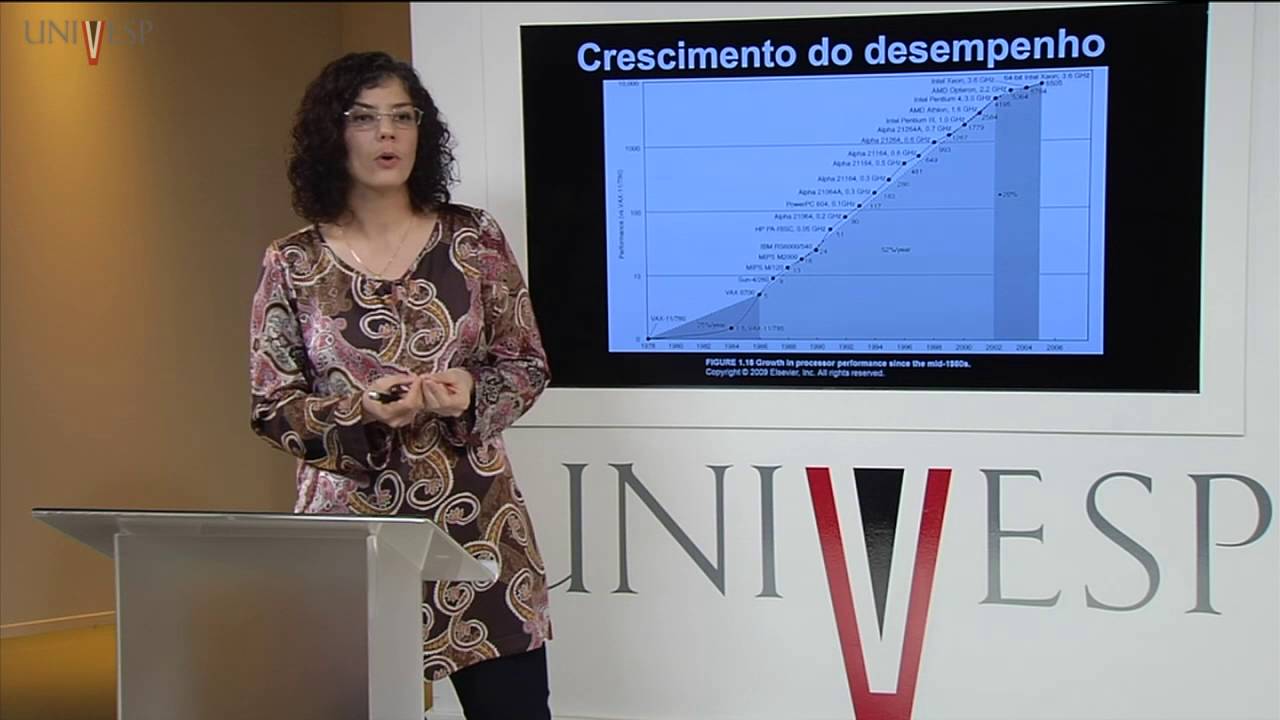
- Analysis of performance gains from late 1970s to mid-2000s, emphasizing technological improvements driving performance enhancements.
- Notable performance growth attributed to advancements in computer architecture organization, introducing new ideas for processor systems.
Memory Access Limitations and Performance Growth Constraints
- Discrepancy between processor speed and memory access time leading to a 20% annual growth limitation post early 2000s.
- Industry reevaluation towards achieving performance gains beyond clock speed increases through architectural innovations.
Multicore Processors for Enhanced Throughput
- Introduction of multicore processors as a solution for enhancing throughput when traditional methods no longer improve execution time significantly.
New Section
In this section, the speaker discusses different processor models and their configurations in terms of cores, frequencies, and power dissipation.
Processor Configurations
- The AMD Opteron X4 had four cores per chip, a power dissipation of 120W, and a frequency around 2.5 GHz.
- The Intel Nehalem also had four cores with a similar frequency of 2.5 GHz but a lower power dissipation of around 100W.
- Contrasting these, the IBM Power 6 opted for two cores working at a higher frequency of 4.7 GHz to achieve increased performance.
- Another approach was seen in the Dação Ultrapark T2 with eight cores for higher transistor density but reduced frequency to manage within a 100W power limit.
New Section
This part delves into the impact of core count and frequency on power dissipation in processors.
Core Count vs. Frequency
- Higher frequencies lead to increased power dissipation due to more intense processing demands.
- Different strategies are employed across processor models to balance core count, frequency, and power dissipation effectively.
New Section
Strategies for managing power dissipation while optimizing performance through core count variations are explored here.
Power Dissipation Strategies
- Various processor models adjust core count and frequencies to stay within specified power dissipation limits.
- These adjustments aim to enhance performance while efficiently managing heat dissipation associated with processors.
New Section
The discussion shifts towards parallel programming as a means to improve performance when working with multicore processors.
Parallel Programming for Performance
- Multicore systems require explicit parallel programming for performance gains without significantly altering execution times.
- To leverage multiple cores effectively, alternative problem-solving approaches must be adopted to enable parallel processing and enhance instruction throughput.
New Section
Balancing task distribution and synchronization in multicore environments is crucial for optimal performance gains through parallel processing.
Task Distribution Challenges
- Load balancing among tasks is essential when distributing workloads across multiple cores.
- Ensuring synchronization between elements of communication is vital for efficient task management in parallel computing environments.
Evolution of Computing and Parallel Programming
The discussion delves into the evolution of computing, from specialized purpose computers to modern-day systems that utilize their own code for processing. It highlights the shift towards parallel programming and the significance of benchmarks in evaluating performance metrics.
Evolution of Computing
- Specialized purpose computers required manual programming initially.
- Modern computers use self-generated code for processing, showcasing significant technological advancements leading to improved performance at reduced costs.
Importance of Benchmarks in Parallel Programming
- Benchmarking serves as a reference for parallel programming, emphasizing metrics like throughput for comparing single-core computers with similar instruction sets.
- Transition from single-core processors to multi-core processors due to energy efficiency constraints like the Power Wall, marking a paradigm shift in computing.
Conclusion and References
- Concludes Chapter One by referencing sections 1.5 to 1.9 and section 1.10 on the historical evolution of computing, highlighting the transition towards multi-core processors.