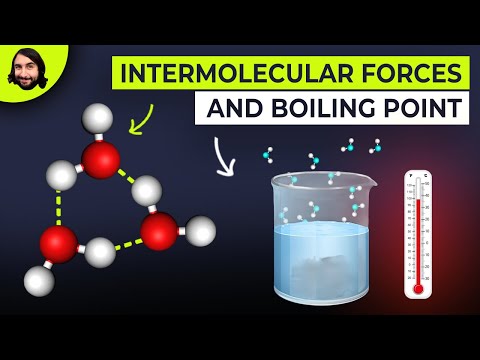
Intermolecular Forces and Boiling Points
Intermolecular Forces and Boiling Points
Understanding Intermolecular Forces
- Professor Dave introduces the concept of intermolecular forces, explaining their role in boiling liquids and why different liquids have varying boiling points.
- He categorizes the types of intermolecular forces, starting with ion-ion interactions, which are the strongest due to formal charges involved in ionic bonds.
Types of Intermolecular Forces
- The discussion moves to ion-dipole interactions, where water's polar nature allows sodium ions to interact with its negative side and chloride ions with its positive side.
- Dipole-dipole interactions occur between polar molecules like water, leading to hydrogen bonds when N-H, O-H, or F-H bonds are present. These are stronger than regular dipole-dipole interactions due to high electronegativity.
- Van der Waals forces (or London dispersion forces) are introduced as weak attractions that can occur between all substances, even noble gases like helium.
Mechanism of Van der Waals Forces
- Helium atoms exhibit momentary dipoles due to uneven electron distribution; this leads to induced dipoles when they approach other atoms.
- The strength hierarchy of intermolecular forces is established: ion-ion > ion-dipole > dipole-dipole > van der Waals.
Phase Changes and Energy Requirements
- A thought experiment illustrates how particles behave at absolute zero (0 Kelvin), where all substances exist as solids without energy for motion.
- To transition from solid to liquid to gas phases, heat energy must overcome intermolecular forces. Stronger forces require more energy for phase changes.
Comparative Analysis of Substances
Understanding Intermolecular Forces and Boiling Points
The Role of Temperature in Phase Changes
- Water melts and boils at 273 K and 373 K, respectively. Sodium chloride has strong ion-ion interactions, requiring significant energy to melt (1074 K), indicating substantial energy stored in these forces.
- The boiling point of a compound is determined by the strength of its intermolecular forces; stronger forces necessitate more heat energy to separate molecules.
Identifying Molecular Interactions
- To predict boiling points, one must analyze the type of molecular interactions present. Covalent compounds with nonpolar bonds exhibit only van der Waals forces.
- For covalent compounds with polar bonds, geometry plays a crucial role in determining overall dipole moments.
Dipole Moments and Molecular Geometry
- Water exhibits a dipole due to its molecular structure, while carbon dioxide does not have an overall dipole despite having polar bonds that cancel each other out.
- Comparing BF3 (nonpolar due to symmetrical geometry) with NH3 (polar because bond directions create a net dipole).
Turn any video into a summary like this
YouTube links, meetings, lectures — with transcripts, search, and chat.