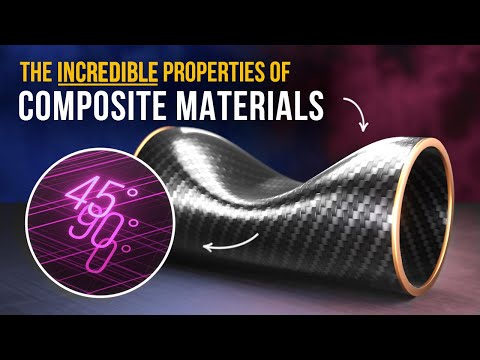
The Incredible Properties of Composite Materials
New Section
The development and properties of composite materials.
What are composite materials?
- Composite materials are made from two or more distinct constituent materials.
- They can be found in nature, such as wood, or engineered for specific applications.
- Composites have mechanical, electrical, thermal, or magnetic properties tailored to suit their purpose.
Structure of composites
- Most composites consist of a dispersed phase contained within a matrix phase.
- The dispersed phase provides desirable material properties like strength or ductility.
- Composites can be categorized based on the form of the dispersed material (particle-reinforced or fiber-reinforced) and the type of matrix material (polymer, ceramic, or metal).
Fiber-reinforced polymer-matrix composites
- Widely used in engineering applications.
- Epoxy matrix with glass or carbon fibers as the dispersed material.
- Fiber reinforcement is typically in the form of unidirectional tape or bundles called tows.
- Laminate structures are built by stacking multiple layers with different fiber orientations to achieve desired strength and stiffness.
Weave patterns
- Fibers can be arranged in weave patterns like plain weave or twill weave.
- Weave patterns have good stiffness and strength along fiber axes but are weak at 45 degrees.
- Layering weave patterns in different orientations can achieve quasi-isotropic properties.
Assembling composite parts
- Wet layup method involves building up fiber layers in a mold and applying resin using a roller or brush.
- Pre-preg method uses pre-impregnated fibers that can be applied directly to the mold without additional resin.
New Section
Methods for assembling composite parts.
Wet layup method
- Fiber layers are built up in a mold, and resin is applied to each layer using a roller or brush.
- Number of plies and ply orientation are carefully selected to achieve required properties.
Pre-preg method
- Uses pre-impregnated fibers that have been partially cured with epoxy resin.
- Fibers can be applied directly to the mold without needing additional resin.
The transcript does not provide further content beyond this point.
Filament Winding and Fiber-Reinforced Composites
This section discusses the manufacturing method of filament winding and the mechanical properties of fiber-reinforced materials.
Filament Winding
- Filament winding is a manufacturing method where unidirectional tape impregnated with resin is wound around a mandrel using a machine.
- The mandrel can be left in place or removed once the winding process is complete, and the structure is then cured.
Mechanical Properties of Fiber-Reinforced Materials
- Fiber-reinforced composites have special mechanical properties that make them desirable.
- Tensile strength and Young's modulus are important parameters to understand these properties.
- Carbon-fiber reinforced polymers have high tensile strength and stiffness, especially in unidirectional form.
- Glass-fiber reinforced polymers have lower stiffness but excellent tensile strength. Different compositions like E-glass and S-glass are optimized for specific applications.
- Fiber-reinforced composites exhibit impressive strength-to-weight and stiffness-to-weight ratios, making them ideal for industries where weight reduction is critical, such as aerospace and automotive industries.
Advantages and Limitations of Fiber-Reinforced Composites
This section explores the advantages and limitations of using fiber-reinforced polymer matrix composites compared to traditional materials like steel and aluminum alloys.
Advantages
- Fiber-reinforced composites have excellent internal damping properties, good corrosion resistance, and interesting thermal properties.
- They are poor conductors of heat with low thermal expansion coefficients compared to metals, providing dimensional stability over a wide range of temperatures.
Limitations
- The cost of fiber-reinforced composites is higher than using standard metals, making them more expensive.
- Designing with fiber-reinforced composites can be challenging due to their anisotropic nature and complex failure modes, making accurate modeling and failure prediction difficult.
- Integration of fiber-reinforced parts into larger assemblies can be complicated as welding is not an option, and mechanical fasteners may not perform as well as in metals. Adhesives are commonly used for bonding.
- Fiber-reinforced composites tend to be brittle compared to steel and aluminum alloys, with low strain at failure. However, Kevlar-reinforced polymers offer improved impact resistance.
New Section
This section discusses the use of ceramic materials, such as Alumina, Silicon Carbide, and Silicon Nitride, for high-temperature applications. These materials have high melting points and can withstand temperatures upwards of 1000 degrees Celsius. They possess properties like high thermal shock resistance, low thermal expansion coefficients, high strength, and stiffness.
Ceramic Materials for High Temperatures
- Ceramic materials like Alumina, Silicon Carbide, and Silicon Nitride are used for extremely high temperatures.
- These materials have higher melting points compared to metals and polymers.
- They can withstand temperatures upwards of 1000 degrees Celsius.
- Ceramics offer properties like high thermal shock resistance, low thermal expansion coefficients, high strength, and stiffness.
New Section
This section explains how composites can enhance the toughness of brittle ceramic materials. By adding fibers to a ceramic matrix material like Silicon Carbide, the resulting composite exhibits increased toughness.
Enhancing Toughness with Composites
- Ceramic materials are brittle and fracture easily at low strains.
- Composites can improve the toughness of ceramics by adding fibers to the matrix material.
- For example, adding Silicon Carbide fibers to a Silicon Carbide matrix increases toughness.
- The fibers bridge cracks in the matrix material, preventing them from growing and enhancing overall toughness.
New Section
In this section, the difference between polymer-matrix composites and ceramic-matrix composites is explained. Unlike polymer-matrix composites where a strong bond between matrix and fibers is desired for load transfer, in ceramic-matrix composites the fibers are coated to allow some sliding within the matrix. This prevents overstressing of fibers by cracks in the matrix.
Coating Fibers in Ceramic-Matrix Composites
- In ceramic-matrix composites, the fibers are coated to allow them to slide somewhat within the matrix.
- This coating prevents cracks in the matrix from overstressing the fibers.
- The resulting composite is highly resistant to temperature without being too brittle.
New Section
This section highlights some applications of ceramic-matrix composites and metal-matrix composites. Ceramic-matrix composites with Silicon Carbide matrix and fibers are used in high-temperature jet engine turbine blades. Carbon-carbon composites find applications in spacecraft heat shields, aircraft braking systems, and high-performance cars. Metal-matrix composites are used to improve the strength or stiffness of metals.
Applications of Composites
Ceramic-Matrix Composites
- Used in high-temperature jet engine turbine blades.
- Utilized in spacecraft heat shields for protection during atmospheric re-entry.
Metal-Matrix Composites
- Used to enhance the strength or stiffness of metals.
- Incorporate carbon fibers into aluminum or titanium matrices.
- Find applications in aerospace, such as aircraft braking systems.
New Section
This section discusses how composite materials can be used to improve the properties of metals for specific applications. For example, replacing pure magnesium with a composite material that has a magnesium matrix and dispersed ceramic particles improves its degradation rate control, strength, and other properties. Magnesium-based composites show promise for biomedical implants due to their lightweight nature and biocompatibility.
Improving Properties of Metals with Composites
- Composite materials can modify properties of metals for specific applications.
- Magnesium-based composites offer improved degradation rate control, strength, and other properties compared to pure magnesium.
- Magnesium-based composites show potential for biomedical implants due to their lightweight nature and biocompatibility.
New Section
This section mentions particle-reinforced materials and their diverse applications. For example, a composite with a copper matrix and diamond particles can be used as a heat spreader for electronic components, providing higher thermal conductivity. Concrete is another example of a particle-reinforced material where the matrix phase is cement and the dispersed phase is aggregate.
Particle-Reinforced Materials
- Particle-reinforced materials have various applications.
- A composite with a copper matrix and diamond particles can be used as a heat spreader for electronic components, offering higher thermal conductivity.
- Concrete is an example of a particle-reinforced material where the matrix phase is cement and the dispersed phase is aggregate.
New Section
This section introduces engineering cementitious composites, which incorporate short randomly-oriented polymer fibers into concrete matrices. These composites provide properties similar to concrete but also exhibit ductility, earning them the name "bendable concrete."
Engineering Cementitious Composites
- Engineering cementitious composites incorporate short randomly-oriented polymer fibers into concrete matrices.
- These composites possess properties similar to concrete but also exhibit ductility, making them known as "bendable concrete."
New Section
This section discusses sandwich composites, which consist of a lightweight core material sandwiched between thin skin layers made of stronger and stiffer materials like metals or composites. The resulting structure offers high bending stiffness.
Sandwich Composites
- Sandwich composites feature a lightweight core material sandwiched between thin skin layers.
- The core can be foam or honeycomb structure while the skin layers are typically metals (e.g., aluminum) or composites (e.g., CFRP).
- Adhesive bonding holds the layers together, creating a lightweight structure with high bending stiffness.
New Section
This section mentions the use of inserts in honeycomb panels to allow the use of threaded fasteners. Honeycomb panels are extensively used in satellites as structural panels for attaching instruments and communication equipment.
Inserts in Honeycomb Panels
- Inserts are incorporated into honeycomb panels to enable the use of threaded fasteners.
- Honeycomb panels find widespread application in satellites as structural panels for attaching instruments and communication equipment.
New Section
The final section emphasizes that the study of composites is an exciting and evolving field within materials science, offering new opportunities for innovation.
Conclusion
- The study of composites is an exciting and constantly evolving field within materials science.
- Composites provide new opportunities for innovation across various industries.
New Section Access to the Right Tools with OnShape
In this section, the speaker discusses the importance of having access to the right tools in the design process and introduces OnShape as a cloud-based CAD platform that offers a wide range of functionality.
OnShape: A Unique Cloud-Based CAD Platform
- OnShape is a cloud-based CAD platform that provides all the functionality expected from modern CAD software.
- It runs directly in your web browser, eliminating the need for installation or powerful hardware.
- The platform offers a rich parametric modeling toolset for easy part modeling and assembly management.
- It includes various tools to enhance workflow efficiency, such as standard part libraries and features like Frame and Sheet Metal.
- Users can develop custom features or download ones created by the community.
Collaboration and Version Control
- One of OnShape's most powerful features is its collaboration system, allowing multiple people to work on the same files simultaneously. This feature is particularly useful for team projects.
- The platform also offers an effective version control system, enabling users to log changes easily and roll back to previous versions if needed.
Accessibility and Mobile Apps
- As a cloud-based solution, OnShape can be accessed from any machine by simply logging in.
- The platform does not require high-performance hardware since processor-heavy tasks are handled in the cloud.
- OnShape provides Android and iOS apps for convenient access to files on mobile devices.
Get Started with OnShape
- Users can create their own designs using OnShape for free within minutes.
- To get started, visit OnShape.pro/EfficientEngineer to create a free account and begin designing.
Timestamps have been associated with each bullet point to facilitate studying the transcript.