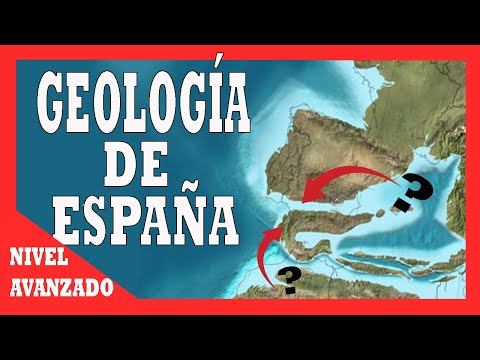
✅✅✅ Evolución GEOLÓGICA de la PENÍNSULA IBÉRICA ✅✅✅
Geological History of the Iberian Peninsula
Introduction to Geological Concepts
- The video introduces the geological history of the Iberian Peninsula, tracing its evolution from Pangaea to present day.
- It raises questions about geographical features like the Pyrenees and Balearic Islands, hinting at their formation processes.
- The discussion will cover tectonic plates, including constructive, destructive, and passive boundaries.
Understanding Plate Tectonics
- To grasp these concepts, it's essential to understand Earth's internal temperature exceeding 6,000 degrees Celsius.
- The narrative begins with the Big Bang theory as a foundation for understanding cosmic material formation.
Formation of Celestial Bodies
- Approximately 4.6 billion years ago, a nebula in our galaxy collapsed under gravity, leading to solar system formation.
- Dust and gas coalesced into protoplanets through gravitational attraction; this process explains how planets formed over millions of years.
Early Earth Conditions
- Early Earth was bombarded by meteorites, creating extreme heat conditions that shaped its initial structure.
- Heavier elements sank towards the core while lighter ones formed an atmosphere around Earth.
Temperature and Pressure Dynamics
- The high temperatures within Earth are due to radioactive materials under immense pressure from outer layers.
- As impacts ceased, Earth's surface cooled gradually forming a solid crust while retaining residual heat from its formation.
Structure of Earth's Layers
- The inner core is solid due to extreme pressure; conversely, the outer core is liquid along with a viscous mantle layer.
Magma Movement and Convection Currents
- Scientists describe magma movement as convection currents originating from disturbances in the outer core affecting mantle dynamics.
Types of Rocks in Continental Crust
- Understanding rock types is crucial: igneous rocks can be volcanic (rapid cooling on surface leading to fragile structures like pumice).
Characteristics of Igneous Rocks
Geological Evolution of the Iberian Peninsula
Formation and Cooling of the Earth's Crust
- The rapid cooling of incandescent magma upon reaching the surface (around 20 degrees) leads to the formation of volcanic rock, as seen in La Palma in September 2021.
- The primitive crust was initially a thick layer of plutonic rock, but it is not continuous; rather, it is fractured into tectonic plates.
- There is uncertainty regarding when convection currents began and how the primitive crust formed, yet their existence is confirmed by geological evidence.
Supercontinents and Their Fragmentation
- The first supercontinent was Pannotia, which fragmented to form another supercontinent called Columbia. This cycle continued with Rodinia and eventually led to Pangaea.
- While there is limited geological information before Pangaea's formation, extensive data exists on events following its breakup.
Geological Events in the Iberian Peninsula
- Pangaea formed from the collision between Eurasia and Gondwana, resulting in the Variscan orogeny that created a significant granite mountain range in Iberia.
- A long mountain chain formed along continental collision lines extending from North America through Spain to parts of Asia.
Tectonic Activity and Plate Movements
- The Iberian Massif was part of Pangaea before fragmentation began; it connected with Africa, Canada, Greenland, France, and England.
- As Pangaea fragmented, major faults opened up: one separating North America from Europe and another separating Africa from Europe.
Sedimentation Processes
- New tectonic faults around the Iberian Massif led to sediment accumulation in areas like the Betic Trench and Pyrenean Trench.
- Accumulated sediments undergo diagenesis under pressure and temperature conditions, transforming into more resilient limestone.
Rotational Dynamics of Plates
- The Iberian Massif rotated counterclockwise over millions of years while separating from France, leading to the formation of the Bay of Biscay.
Major Geological Changes During Cenozoic Era
- Significant changes occurred during this era as continents continued separating fully opening up the Atlantic Ocean; much of Europe remained submerged except for some archipelagos including parts of Iberia.
Geological Evolution of the Iberian Peninsula
Formation of Major Mountain Ranges
- The Catalan coastal mountain range and the Gibraltar Arc formed a long chain extending from North Africa to the Balearic Islands, contributing to the geological structure of the Iberian Peninsula.
- These mountain ranges are primarily composed of limestone, which is sedimentary in origin and has a marine background. This area is referred to as "Spain's limestone."
- As the Iberian system rose, it created an inland hypersaline sea due to the Ebro Valley being cut off from maritime access until erosion reestablished a connection with the Mediterranean.
Hydrological Changes and River Systems
- The notion that the Iberian Peninsula tilted westward is misleading; instead, rising mountains created new watersheds that redirected rivers towards the Atlantic Ocean.
- Alpine orogeny rejuvenated several mountain ranges such as Galicia and Cantabria by compressing them against Eurasia, leading to subduction zones and internal faults.
Granitic Landscapes and Erosion Processes
- Compression caused cracks in rocks, resulting in large granitic blocks emerging in regions like Galicia and Madrid's Sierra de Guadarrama.
- The Pedriza granite block exemplifies how erosion shapes landscapes into rounded forms over time.
Sedimentary Basins and Metamorphic Rocks
- During secondary periods, sedimentary basins accumulated thick layers of sediments that transformed into metamorphic rock under pressure and heat from magmatic intrusions.
- This metamorphic zone was compressed between granitic areas, leading to folded relief characterized by anticlines and synclines.
Tectonic Activity and Its Impact on Geography
- The eastern part of Gibraltar's arc underwent significant erosion during alpine orogeny, leaving behind remnants like today's Balearic Islands.
- Tectonic plate movements eventually closed off marine access through Gibraltar, forming what we now know as the Guadalquivir Valley.
Volcanic Origins of Canary Islands
- The Canary Islands emerged during the Tertiary era as volcanic formations driven by hot spots within tectonic plates. Each island represents a massive underwater volcano.
- These islands' geology consists entirely of volcanic rock due to magma flowing through fissures in Earth's crust caused by mantle plumes.
Continuous Geological Change Over Time
Glacial Periods and Geological Evolution of the Iberian Peninsula
Overview of Glacial Periods
- The transcript discusses glacial periods, highlighting significant climate cooling that led to much of Europe being covered in ice.
- It notes the impact of glaciers on Spain's mountain peaks, particularly in the Pyrenees, where deep valleys were carved out.
Erosion and Sedimentation Processes
- The Bético systems experienced erosion that shaped high peaks and created deep cirques and glacial valleys.
- Accumulation of sediment layers from the Tertiary and Quaternary eras is emphasized, especially in river basins like Duero, Tajo, Guadiana, Ebro, and Guadalquivir.
Geological Events During Different Eras
Primary Era
- A brief overview is provided about the formation of Pangaea through continental collisions during the primary era.
Secondary Era
- In this era, Pangaea began to separate; the Iberian plate was formed with boundaries defined by various geological features including mid-Atlantic ridge and fault lines.
Tertiary Era
- The collision between Africa/India and Eurasia resulted in significant orogeny leading to major mountain ranges such as the Pyrenees.
- Erosion during this period reshaped regions like Gibraltar’s archipelago into its current form.
Quaternary Era Developments
- This era saw continued erosion in large mountains while sedimentation occurred in major basins. Glaciers played a crucial role in shaping extensive valleys during glacial phases.
Conclusion & Recommendations for Further Learning