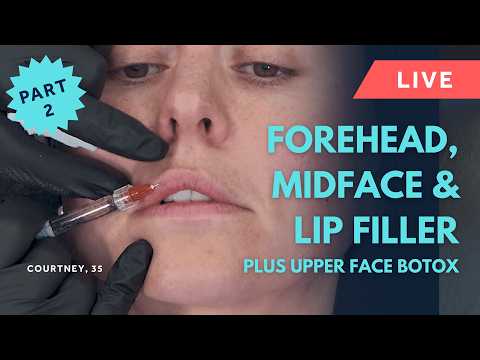
Live Forehead Filler, Lip Filler & Midface Filler Treatments Using Evidence-Based GEM©️ Techniques
Forehead Filler Injection Techniques and Risks
Understanding Vascular Anatomy of the Forehead
- The forehead is considered a high-risk area for filler injections due to its proximity to critical blood vessels.
- Key vessels include the supraorbital and supratrochlear arteries, which emerge from the glabella area and are branches of the internal carotid circulation.
- These arteries connect to the ophthalmic artery, which supplies blood to the retina via the central retinal artery, increasing risk during injections.
- The superficial temporal artery also connects with these vessels, highlighting the importance of understanding vascular anatomy in this region.
- Different layers (skin, frontalis muscle, fat pads) affect how these vessels traverse at varying depths; knowledge of this is crucial for safe injection practices.
Injection Strategies and Safety Measures
- It’s advised that practitioners should have significant experience (e.g., 2,000 fillers) before performing forehead filler injections due to associated risks.
- Injections should avoid deep penetration in the lower third of the forehead where blood vessels become more superficial around the brow ridge.
- A canula entry point is recommended just medial to the temporal crest, allowing access behind the frontalis muscle into a safer injection plane.
- Lidocaine is used generously during procedures to numb areas and create space between muscles and periosteum for smoother injections. This enhances patient comfort significantly.
Practical Application in Forehead Fillers
- Assessing volume deficits from an overhead position allows for precise marking of areas needing additional volume for optimal aesthetic results.
- Multiple entry points may be necessary when injecting with a canula to effectively reach central areas without causing discomfort or complications.
- A medium-to-low G prime filler is preferred for longevity while ensuring effective treatment outcomes in forehead aesthetics.
Forehead Filler Technique and Patient Experience
Injection Technique Overview
- The injector uses Reveness Ultra for forehead filler, aiming to avoid creating specific shapes beneath the skin.
- A 22 gauge cannula is employed to minimize vascular risk, allowing deep injections down to the frontal bone.
- The injector glides on the super periosteal plane while applying gentle pressure with the cannula, ensuring a desired convexity in the forehead.
- Continuous monitoring of patient comfort is emphasized; any discomfort or pain is addressed immediately during the procedure.
Importance of Forehead Treatment
- Forehead treatments are often overlooked by patients but can significantly enhance aesthetic appearance from an injector's perspective.
- Current training at Harley Academy does not include this technique in their courses, highlighting its advanced nature.
Learning Path for New Injectors
- Discussion about what new injectors should learn includes starting with safer areas like preauricular regions and nasal folds for practice.
- Confidence builds through experience in lower-risk areas before advancing to more complex techniques such as temple injections.
Risks Associated with Filler Injections
- Vascular compromise is rare; approximately one case every couple of years among thousands treated annually at the academy.
- Filler-associated blindness is also exceedingly rare, indicating that proper training reduces risks significantly.
Post-Treatment Assessment
- After treatment, care is taken to avoid leaving thumbprints on the forehead; gauze is used for massaging instead of fingers unless necessary.
- The aesthetic improvement post-treatment shows a rounded shape in the upper face, demonstrating effective results from forehead filler application.
Lip Filler Techniques and Facial Rejuvenation
Understanding Lip Anatomy and Treatment Approach
- The speaker discusses the loss of brow ridge and facial feminization, emphasizing the importance of maintaining natural aesthetics during treatment.
- Focus shifts to assessing lip shape and volume, highlighting that the goal is to enhance natural features without overcomplicating the process.
- The lips consist of 24 compartments divided by the orbicularis oris muscle; preserving these compartments while adding volume is crucial for a natural look.
- A systematic injection technique is preferred to minimize trauma, swelling, and product migration, ensuring a more controlled outcome.
- The speaker introduces the "lip bolus technique" using Reveness Ultra filler, aiming for even volume distribution in the upper lip.
Injection Technique Details
- The injection method involves placing filler just beneath the skin layer to allow it to flow into designated compartments naturally.
- Emphasis on depth control during injections is critical to avoid large vessels located deeper in the lip structure.
- Minimal pain reported by patients indicates effective numbing; this contributes positively to patient experience during treatment.
- Simplicity in technique helps manage complexity associated with lip anatomy; careful execution leads to better results with less swelling.
- Each compartment receives approximately 0.1 ml of filler per injection, allowing for real-time assessment of results without excessive trauma.
Final Adjustments and Observations
- After initial injections totaling 0.4 ml, strategic enhancements are made based on visual assessment while maintaining proportions relative to facial features.
- Massaging techniques are applied post-injection to achieve desired convexity in lips while checking capillary refill for proper blood flow.
- The final result showcases rejuvenated lips that appear natural without signs of excessive filler use; focus remains on aesthetic balance across facial features.
- Observations from both practitioner and patient highlight noticeable changes in facial contouring after treatment completion, indicating successful outcomes.
- Future treatments will address additional areas such as masseter muscles and cheek support for comprehensive facial enhancement.
Aesthetic Treatments and Innovations
Initial Observations Post-Treatment
- The patient notes that their lips appear natural and full, indicating satisfaction with the aesthetic results.
- Acknowledgment of minor irregularities in the forehead area is normal as it settles; slight changes in eyebrow positioning may also be observed.
Introduction to GEM Framework
- Dr. Tristan Meta introduces GEM (Global Evidence Matrix), a framework designed for injectors to ensure safe and effective treatments based on scientific research rather than corporate interests.
- GEM integrates clinical research, anatomical knowledge, and injector expertise, providing an interactive guide for facial aesthetics.
Patient Follow-Up After Four Weeks
- The patient reports feeling happier with their appearance, noting a softer look compared to previous chiseled features inherited from family.
- The patient observes a slimmer face and appreciates the changes made to their forehead.
Clinical Assessment of Treatment Results
- Dr. Meta highlights noticeable changes in facial structure post-treatment, emphasizing the importance of muscle relaxation for achieving a feminine tapering effect.
- The treatment's impact on muscle size reduction is discussed; effects are expected to last four to six months before gradually returning.
Addressing Side Effects and Future Plans
- The patient mentions experiencing fewer headaches since treatment; Dr. Meta confirms reduced tension across the jaw as a potential benefit.
- Plans include adding filler to compensate for reduced muscle strength while maintaining structural support in the lower third of the face.
Forehead Treatment Insights
- Dr. Meta praises the outcome of forehead filler treatment, noting its natural appearance without dimples or indications for further intervention.
- Emphasis on performing filler treatments prior to Botox is highlighted; this sequence ensures optimal results by allowing fillers to establish structural support before muscle relaxation occurs with Botox.
Filler and Toxin Treatments Overview
Midface Filler Application
- The speaker discusses finishing the midface treatment with filler, mentioning a subtle tweak to the lips that was done years ago.
- The patient expresses satisfaction with the results so far, indicating readiness to proceed with further treatments.
Jawline Enhancement Techniques
- The speaker uses Revenous Ultra filler for jawline enhancement, aiming for a natural look without excessive projection.
- Emphasizes the patient's good skin quality which minimizes visibility of filler under the skin, reducing risks of complications.
Treatment Assessment and Adjustments
- A visual check is performed to assess improvements in jawline definition and cheek tapering after treatment.
- Discusses techniques for navigating resistance during injections to ensure comfort and minimize trauma.
Considerations for Age and Skin Quality
- If the patient were older, bio-stimulators might be considered; however, current dermal strength suggests volume replacement is sufficient.
- Observations on tissue toughness indicate that collagen stimulation isn't necessary at this time.
Toxin Treatment Planning
Injection Marking Process
- The speaker marks injection points for toxin treatment focusing on specific facial muscles responsible for frowning.
Forehead Movement Analysis
- Analyzes forehead movement patterns to determine appropriate injection depths; superficial injections yield weaker effects while deeper ones provide stronger relaxation.
Injection Technique Insights
- Explains how nerve supply affects injection efficacy; deeper injections are more effective due to proximity to facial nerves.
Final Assessment Before Treatment
- Evaluates muscle contraction patterns before proceeding with toxin injections, ensuring targeted treatment areas are identified accurately.
Botox Injection Techniques and Patient Treatment
Tailoring Botox Treatments
- The depth of injection can significantly affect the results; deeper injections may yield a more relaxing effect for patients who do not respond well to high doses.
- Courtney is identified as an ideal candidate for Botox due to her limited movement, suggesting that she will achieve a beautiful relaxing effect post-treatment.
Injection Techniques
- The procerus muscle and medial corrugator require deep injections; the practitioner touches down on the bone before slightly lifting off for effective treatment.
- Subdermal blebs are created with two units of Botox at specific points, ensuring precise placement just beneath the dermis.
Finalizing Treatment Areas
- The forehead treatment is completed with additional injections around the tail of the brow, using four units to lift and two units on each side for balance.
- Post-treatment expectations include minor swelling (referred to as "mosquito bites") in the forehead area, which will be documented through follow-up photos from Courtney.
Anticipated Results
- A focus on achieving a beautiful curve in the forehead, enhanced cheek lifts, and improved jawline definition is emphasized. Follow-up images are encouraged to assess treatment outcomes.