CAP 53 2/5: Cóclea y lamina basilar l Fisiología de Guyton
Anatomy and Functioning of the Cochlea
In this section, the video discusses the anatomy and functioning of the cochlea, focusing on its role in translating vibrations into auditory signals.
The Structure of the Cochlea
- The cochlea translates vibrations generated by ossicles, specifically from the base of the stapes hitting the oval window.
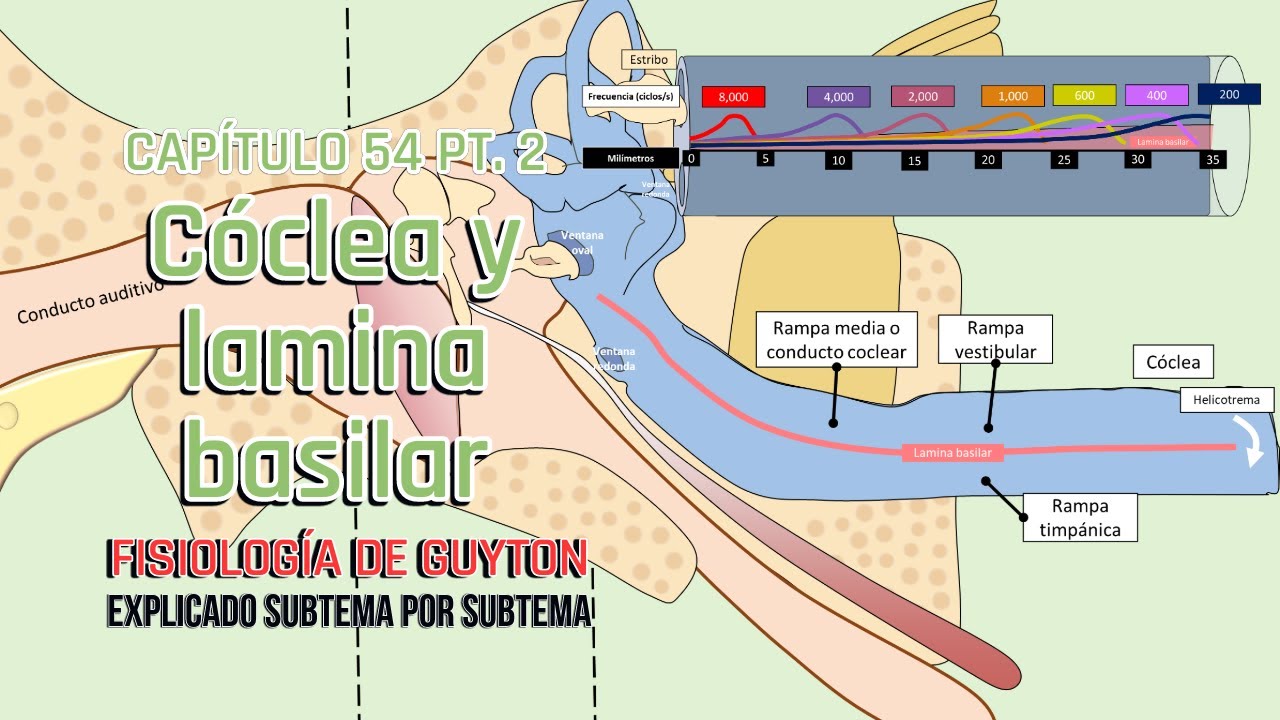
- It consists of a giant tube formed by several channels or tubes, with three specific tubes that are coiled like a snail shell.
- The cochlea is a system of spiral tubes represented by three cavities when viewed in a transverse cut.
Understanding Cochlear Enrollments
- The cochlea's unique structure results from an intricate coiling process rather than simple overlapping layers.
- Each coil or turn occurs at different positions within the structure, creating distinct layers visible in a transverse cut.
Membranes and Divisions Within the Cochlea
- Important divisions exist between each ramp or cavity within the cochlea, such as vestibular ramp, middle ramp, and tympanic ramp.
- Membranes like Raisner membrane separate these ramps to maintain distinct fluid environments crucial for cell function.
New Section
In this section, the speaker discusses the structure of the cochlea and the fluids present within its different compartments.
Cochlear Structure and Fluids
- The thin Reissner's membrane allows vibrations from the vestibular ramp to quickly transmit to the cochlear duct.
- Different fluids exist in various parts of the cochlea: perilymph in the vestibular and tympanic ramps, and endolymph in the cochlear duct.
- A transverse cut through the cochlea reveals its structure, with a descending tube that loops around before connecting back up.
- The cochlear tube houses extensions of bone that penetrate parts of the cochlea, crucial for anchoring structures like the basilar membrane.
- The basilar membrane varies in length and diameter along the cochlea, affecting its responsiveness to sound frequencies.
New Section
In this section, the discussion revolves around the functions of different structures within the cochlea, focusing on how they contribute to sound perception.
Membrane Functions in Cochlea
- The Risner's membrane does not prevent fluid movement between the vestibular and middle scalae.
- The basilar membrane plays a crucial role in dividing the two important cavities within the cochlea.
- The oval window is where the base of the stapes impacts, leading to movements that affect the basilar membrane.
Basilar Membrane Mechanics
- Initially, the basilar membrane is rigid with thick diameters but later becomes thinner and elongated upon stimulation.
- Stimulation from sound waves causes flexion and generation of waves in the basilar membrane.
Frequency Response in Basilar Membrane
- High-frequency sounds cause rapid vibrations in short, thick parts of the basilar membrane.
- Medium-frequency sounds impact a more flexible part of the basilar membrane, affecting its vibration patterns differently.
Differentiation by Frequency Range
- High frequencies primarily stimulate regions at the beginning of the basilar membrane due to rigidity.
- Medium frequencies target specific areas within the middle portion of the basilar membrane for pronounced vibrations and neural activation.
Listening Mechanism in the Cochlea
The discussion delves into how different frequencies are perceived in the cochlea, highlighting the role of elasticity and frequency distinctions.
High, Medium, and Low Frequencies
- High frequencies are likened to a bird's chirp or whistle.
- Medium frequencies are compared to voices.
- Low frequencies, such as drums, are mentioned.
- The basal membrane's initial high elasticity aids in transmitting all frequencies effectively.
Elasticity and Frequency Transmission
Elasticity plays a crucial role in facilitating the transmission of different frequencies within the cochlea.
Distinct Frequency Transmission
- Elevated elasticity at the beginning of the basal membrane allows for easy transmission of high frequencies.
- This elasticity enables high frequencies to advance swiftly and be distinguished from other frequency ranges.
Wave Transmission in the Basilar Membrane
Wave transmission through the basilar membrane is discussed, emphasizing rapid propagation facilitated by elasticity.
Efficient Wave Propagation
- High elasticity ensures rapid transmission of all waves across the membrane.
Amplitude Patterns and Sound Waves
The generation of amplitude patterns by sound waves on the basilar membrane is explored through examples.
Amplitude Generation
- Sound waves create varying amplitudes on the basilar membrane.
- Example: Stapes displacement generates distinct wave patterns based on its position relative to the cochlea.
Pattern Recognition in Sound Waves
Specific wave patterns generated by sound waves aid in recognizing different sounds within the cochlea.
Pattern Identification
- Different stapes positions result in unique wave patterns.
Discerning Multiple Sound Waves
The ability to discern multiple sound waves within a single sound is attributed to specific vibration zones on the basilar membrane.
Vibration Zones