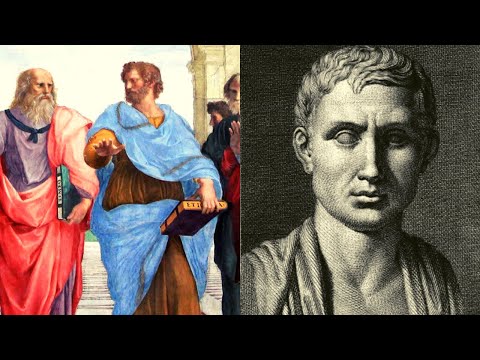
Aristóteles: biografía y pensamiento (filosofía)
Aristotle: The Father of Logic and His Legacy
Overview of Aristotle's Contributions
- Aristotle was a prominent Greek scholar known for his extensive contributions to various fields, particularly philosophy, which established him as a key figure in Western thought.
- Often referred to as the "father of logic," he authored several works on the subject, influencing future generations of scholars and thinkers.
- He was associated with the Academy of Athens for over two decades and studied under Plato, further shaping his philosophical outlook.
Early Life and Education
- Born in 384 BC in Stagira, Macedonia, Aristotle came from a family with medical ties; his father served as a physician to the Macedonian king.
- After losing his father at a young age, he was raised by Proxenus of Atarnaeus and later sent to study at Plato's Academy around age 17.
Philosophical Development
- Aristotle spent nearly twenty years at the Academy but left after Plato's death due to disagreements over leadership and philosophical direction.
- His departure was influenced by both personal ambitions and political sentiments against Macedonia during Philip II’s rise.
Travels and Research
- During his time away from Athens, he traveled to Aso where he married Pythias, Hermias' adoptive daughter. This period marked significant personal developments alongside academic pursuits.
- In Lesbos, he focused on zoological studies for two years, culminating in "The Story of Animals," emphasizing empirical observation over theory.
Role in Macedonia
Rebuilding Stagira and Aristotle's Early Influence
The Reconstruction of Stagira
- Philip II of Macedon rebuilt the city of Stagira, which had been destroyed in 348 BC, and returned its inhabitants who had become slaves.
- At the time Aristotle began teaching Alexander the Great, Alexander was around 13 years old and already showing military promise by age 15.
Aristotle's Instruction
- In 335 BC, Aristotle returned to Athens to establish his own educational center called the Lyceum.
- The Lyceum was located near a temple dedicated to Apollo and became a hub for intellectual activity; followers were known as "peripatetics" due to Aristotle's practice of walking while teaching.
- Although not the first to use the Lyceum for instruction (Socrates and Plato did), Aristotle utilized this public space since he lacked Athenian citizenship.
Aristotle's Later Life and Death
Personal Life Changes
- Before leaving Athens permanently, Aristotle experienced personal loss with the death of his wife Pythias and began a relationship with Herpilis of Stagira.
Political Context
- Following Alexander’s death in 323 BC, anti-Macedonian sentiment grew in Athens, prompting Aristotle to move to Chalcidia on Euboea Island.
- Facing charges of "impiety," similar to those against Socrates, he chose exile as a means to avoid conflict with Athenian authorities.
Final Days
- Aristotle died at approximately 62 years old on Euboea Island; no illness records exist regarding his death.
Aristotle's Legacy: Will and Philosophy
Inheritance Details
- His will detailed that Theophrastus would inherit his library and texts while Nicanor would receive his estate upon reaching maturity.
- He arranged for family matters concerning his daughter and included provisions for Herpilis regarding her future.
Philosophical Contributions
- In his philosophy, Aristotle proposed an approach distinct from Plato’s teachings at the Academy; he emphasized empirical observation over metaphysical speculation.
Aristotle's New Approach to Knowledge
Classification of Sciences
- He categorized sciences into practical, theoretical, and poetic branches; experience was deemed foundational for knowledge acquisition.
Practical Sciences Focus
- Practical sciences included rhetoric, politics, ethics, and economics—areas vital for daily life among Greeks during that era.
Rhetoric Importance
- For Aristotle, rhetoric was essential as it distinguished humans from animals; persuasion could be achieved through ethos (credibility), pathos (emotion), or logos (logic).
Political Philosophy Insights
Aristotle's Contributions to Government and Ethics
Forms of Government
- Aristotle identified six forms of government based on the number of rulers and their intentions:
- Monarchy (one ruler for common good)
- Aristocracy (few rulers for common good)
- Democracy (many rulers for common good)
- Tyranny (one ruler for personal gain)
- Oligarchy (few rulers for personal gain)
- Demagoguery (many rulers for personal gain).
Economic Concepts
- Aristotle distinguished between "economy" as home management and "chrematistic," which refers to wealth accumulation, deeming the latter unethical.
Ethics in Aristotle's Philosophy
Practical Nature of Ethics
- In his work, Nicomachean Ethics, Aristotle emphasized ethics as a practical science aimed at achieving goodness through habit formation. Happiness is attained when one's soul and mind act in harmony.
Theoretical Sciences According to Aristotle
Categories of Theoretical Sciences
- Aristotle categorized theoretical sciences into three areas:
- Physical philosophy (natural sciences)
- Mathematics
- Metaphysics, which he regarded as foundational to other sciences.
Metaphysics Overview
- Although not using the term "metaphysics," Aristotle referred to it as "the first philosophy," arguing against Plato’s Theory of Forms by asserting that matter and form are inseparable. Metaphysics deals with being itself rather than specific scientific inquiries.
Natural Sciences: Biology, Chemistry, and Geology
Elements and Movement Theories
- He supported Empedocles' four elements plus ether, detailing their characteristics but later proposed incorrect theories about body movements.
Biological Contributions
- Despite errors like spontaneous generation theory, Aristotle significantly contributed by classifying over 500 living beings based on blood presence and conducting embryological studies on bird eggs.
Psychology and Aesthetics in Aristotelian Thought
Study of the Human Mind
- He classified souls into three types: vegetable, sensitive, and rational—asserting that humans possess all three while plants have only the first type. This unity contrasts with Plato's view on separability between body and soul.
Poetics: The Study of Aesthetics
- In Poetics, he initiated formal aesthetics study by categorizing artistic disciplines into imitative/non-imitative forms; he viewed imitation as a natural human process essential for learning rather than a degrading activity. Poetry was seen closer to philosophy than history due to its exploratory nature regarding consequences.
Aristotle's Epistemology
Departure from Platonic Ideals
Understanding Aristotle's Philosophy of Knowledge
The Role of Sensitive Knowledge
- Sensitive knowledge is foundational in understanding, as Aristotle posits that the senses initiate comprehension.
- He distinguishes between sensitive knowledge and intellectual knowledge, where abstraction allows for grasping universal concepts and essences.
- Aristotle emphasizes that form and matter are inseparable in his philosophy.
Abstraction and Experience
- Abstraction is achieved through experience and memory, which serve as tools to develop broader concepts.
Logic and Process of Knowledge
Basic Statements in Aristotelian Logic
- Understanding follows a logical order; basic statements (akin to axioms today) must be true and justifiable.
- These basic statements differ from secondary principles, which were also termed axioms in Aristotelian logic.
Distinction from Plato
- Unlike Plato, Aristotle argues that these fundamental statements cannot be deduced since they are principles rather than hypotheses.
The Legacy of Aristotle: Father of Logic
- Aristotle is recognized as the father of Western logic; his work influenced philosophical thought for over a millennium.