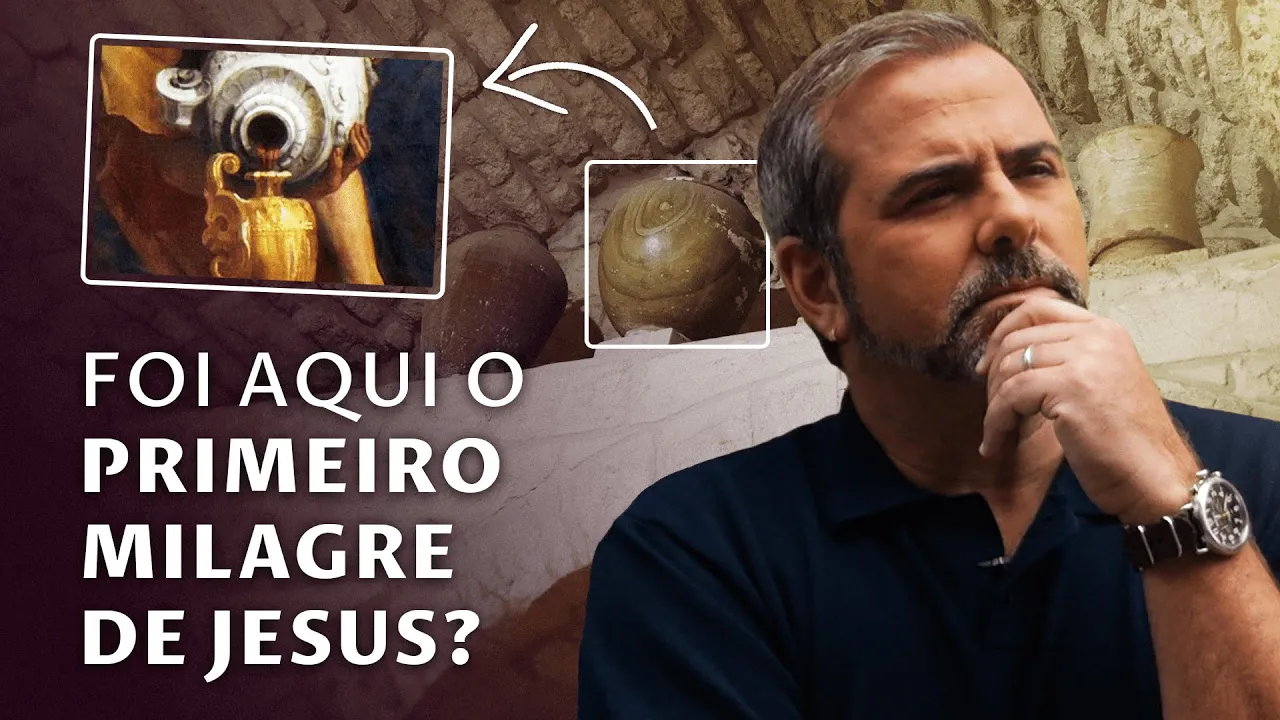
Onde JESUS transformou ÁGUA EM VINHO? Viaje comigo para as BODAS DE CANÁ!
New Section
The speaker discusses the importance of having what matters most inside oneself, such as love and wisdom. Jesus is portrayed as the transformation and the new covenant brought by the wine. Jesus is depicted looking at the people in front of him, communicating with them.
The Miracle of Water to Wine
- The expression "changed from water to wine" is mentioned, referring to personal transformation.
- People often stop engaging in silly things when they find a good path in life.
Introduction to Cana and the Wedding
- Cana, in Galilee, is introduced as the location where Jesus' first miracle took place.
- According to the Gospel of John, this miracle involved transforming water into wine during a wedding.
- Another place is mentioned but not specified yet.
Identifying Cana's Location
- Kfar Kana, Khirbet Qana, and Qana are discussed as potential locations for Cana.
- Archaeologists face challenges similar to finding a specific city name among multiple options in Brazil.
Invitation to Join the Journey
- Viewers are invited to join an "Infinite Journey" through sacred places worldwide.
- Subscription and membership options are mentioned for further engagement.
New Section
The focus shifts back to Cana and its significance as a sacred place associated with Jesus' first miracle. The Church of Marriage is highlighted as a site built by Franciscan priests. Excavations have revealed remains of ancient churches and synagogues, indicating long-standing devotion in this area.
Ancient Devotion in Cana
- The Church of Marriage was constructed by Franciscan priests assigned by the Vatican.
- Excavations have uncovered remnants of Byzantine-era churches and synagogues.
- This suggests that there has been an ancient devotion associated with this location.
Symbolism of Water to Wine
- An amphora found in Cana is believed to symbolize Jesus' miracle of transforming water into wine.
- Visitors come to Cana to renew their vows and leave notes with requests, emphasizing the symbolism of love and commitment.
New Section
The speaker mentions that Mary became an intercessor due to the Miracle of Cana. However, this topic will be explored further in a different location. The focus then shifts to the largest painting in the world depicting the Wedding at Cana, located in Paris' Louvre Museum.
Mary as an Intercessor
- Mary's role as an intercessor began due to the Miracle of Cana.
- Further details about this will be provided later when discussing another location.
Introduction to the Painting at Louvre Museum
- The speaker expresses excitement about the painting and its connection to Cana.
- Paris' Louvre Museum is mentioned as housing the largest painting on this topic.
New Section
The speaker shares a desire for wine when thinking about Cana and its associated painting. France, particularly Paris and the Louvre Museum, is highlighted as a significant location related to this topic.
Connection between Cana and France
- The mention of wine evokes thoughts of France.
- Paris and the Louvre Museum are specifically associated with this topic.
The Wedding at Cana - A Neglected Masterpiece
In this section, the speaker discusses the painting "The Wedding at Cana" by Paolo Veronese and its overshadowing by the popularity of the Mona Lisa.
The Neglected Beauty of "The Wedding at Cana"
- Despite being a beautiful and huge painting, "The Wedding at Cana" is often overlooked in favor of the Mona Lisa.
- The speaker expresses their preference for "The Wedding at Cana" over the Mona Lisa and encourages others to appreciate it as well.
- "The Wedding at Cana" is considered one of the most beautiful paintings in the Louvre Museum.
Historical Context and Symbolism
- The painting was completed by Paolo Veronese in 1563 and commissioned by Benedictine monks for a monastery refectory.
- The silence depicted in the painting reflects the atmosphere of a refectory where talking was not allowed.
- The inclusion of Sultan Suleiman, a leader from the Ottoman Empire, adds historical significance to the painting.
- Various painters, including Paolo Veronese himself, are portrayed within the artwork as musicians.
- The presence of a servant transferring wine from large amphorae to smaller jars represents Jesus' miracle of turning water into wine.
- A bearded man looking at a glass of wine serves as a witness to this miracle.
Symbolism and Meaning
- The presence of men with knives and a sacrificed animal symbolizes Jesus as the sacrificial lamb.
- The butler's statement about saving the best wine until the end represents Jesus as the new covenant in Christianity.
- The painting explores the relationship between earthly pleasure and mortality, emphasizing the importance of eternal life in the kingdom of God.
- The contrast between light and shadows in the painting directs attention towards heaven.
Mary's Role
- Mary is depicted as an intercessor beside Jesus, highlighted by a halo over her head.
This summary focuses on key points from the transcript related to "The Wedding at Cana" painting.
New Section
In this section, Mary tells Jesus about the lack of wine at a wedding. Jesus initially seems impatient and questions the relevance of the situation. He mentions that his time has not yet come. However, Mary insists that Jesus grant her request, and she tells the servants to do as Jesus instructs.
Mary's Intercession (0:15:29 - 0:15:52)
- Mary asks Jesus to address the wine shortage at the wedding.
- Despite Jesus' initial reluctance, Mary insists that the servants follow his instructions.
- This moment highlights Mary's role as an intercessor and her ability to influence Jesus' actions.
New Section
This section discusses the symbolism behind a hourglass seen in a painting and emphasizes the transient nature of earthly possessions. It also touches upon the importance of love and wisdom over material wealth.
Symbolism of Time (0:16:21 - 0:17:11)
- The hourglass in the painting represents the passage of time and serves as a reminder of the impermanence of worldly things.
- Accumulating wealth is futile if one lacks love, wisdom, and compassion.
- The violent nature of society is highlighted, with crimes being punished excessively even for acts that may no longer be considered crimes today.
- Jesus represents a new covenant brought about by transformation through wine.
New Section
This section focuses on how Jesus engages with those viewing a painting. It highlights how he looks directly into their eyes, suggesting communication between him and the viewers.
Eye Contact with Viewers (0:17:31 - 0:17:53)
- Unlike other figures in the painting who look away or have fixed gazes, Jesus looks directly at those observing the artwork.
- This eye contact implies a personal connection and suggests that Jesus is communicating a secret or message to those who engage with him.
New Section
The speaker reflects on the positioning of the bride and groom in the painting, noting their placement at the corner of the table. They also speculate about the nature of the wedding and raise a toast to love.
Positioning of Bride and Groom (0:18:01 - 0:18:34)
- The bride and groom are depicted in a squeezed corner of the painting, while Jesus occupies the central position.
- Despite their placement, it is suggested that it must have been a beautiful wedding due to Jesus' presence as a guest.
- The speaker speculates that it may have been a love match rather than an arranged marriage.
- A toast is raised to celebrate love, both in this particular wedding and for everyone.
Timestamps provided are approximate and should be verified against the actual video for accuracy.