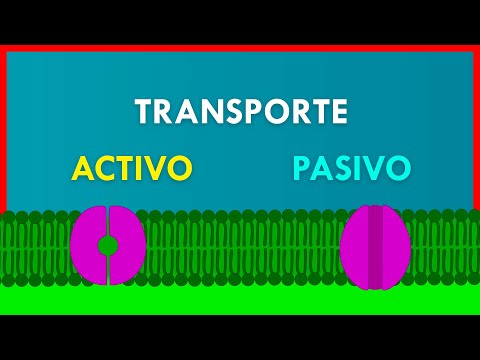
TRANSPORTE ACTIVO y PASIVO en la MEMBRANA PLASMÁTICA
Understanding Active and Passive Transport in Cells
Introduction to Cell Membrane Structure
- The video discusses the differences between passive and active transport of substances in cells, emphasizing the importance of understanding cell membrane structure.
- The plasma membrane is described as a selectively permeable structure that defines cellular boundaries and facilitates molecular transport.
- It consists of a phospholipid bilayer, with proteins and carbohydrates embedded within it.
Passive Transport Mechanisms
- Passive transport occurs without energy expenditure from the cell; substances move along their concentration gradient.
- A concentration gradient must exist for passive transport, where particles diffuse from areas of higher concentration to lower concentration until evenly distributed.
- Two forms of passive transport are highlighted: simple diffusion (e.g., small molecules like oxygen and carbon dioxide passing through the bilayer) and facilitated diffusion (larger molecules requiring protein assistance).
Types of Diffusion
- Simple diffusion allows small molecules to pass directly through the phospholipid bilayer, while osmosis specifically refers to water movement.
- Facilitated diffusion involves channel proteins forming pathways for larger molecules or carrier proteins changing shape to allow substance entry into the cell.
Active Transport Mechanisms
- Active transport requires energy input as substances move against their concentration gradient—from low to high concentration.
- Proteins involved in active transport are known as pump proteins; an example is the sodium-potassium pump which exchanges sodium ions out for potassium ions in.
Bulk Transport Processes
- Bulk transport includes processes like endocytosis, where large particles are engulfed by the plasma membrane.
- Fagocytosis refers to solid particle uptake, while pinocytosis pertains to liquid uptake.
Receptor-Mediated Endocytosis
- This process involves specific receptor proteins on the membrane recognizing target molecules before engulfing them.
- Additionally, exocytosis is mentioned as a method for expelling large substances from cells.
Conclusion