Архитектура ЭВМ Лекция 10: Устройство жесткого диска. Виртуальная память.
Virtual Memory and Hard Disk Structure
In this section, the speaker introduces the topic of virtual memory and its mechanisms, starting with an overview of hard disk structure.
Virtual Memory Introduction
- The discussion begins with an explanation of the structure of a hard disk to lay the foundation for understanding virtual memory.
- Details are provided about the components on a hard disk, such as cache memory, and how they relate to virtual memory mechanisms.
- A comparison is made between cache memory and RAM in terms of miss rates due to their different sizes.
Virtual Memory Mechanism
- The concept of virtual memory is introduced as an extension of physical RAM address space by storing parts of RAM on disk.
- The speaker explains how virtual memory allows for efficient distribution of memory between RAM and disk storage.
Hard Disk Construction and Evolution
This part delves into the construction and historical evolution of hard disks, providing insights into their physical makeup.
Hard Disk Classification
- An overview is given on the genesis and development of hard disks, categorizing them into HDD (Hard Disk Drive) and SSD (Solid State Drive).
Physical Composition
- Details are shared about HDD's physical composition involving platters, distinguishing it from more modern SSD technology.
Magnetic Recording Process
- The magnetic recording process on hard disks is explained using ferromagnetic materials that store data through magnetic orientation.
Data Storage on Hard Disks
This segment focuses on the physical technology behind data storage on hard disks through magnetic materials.
Ferromagnetic Material Explanation
- Insights are provided into ferromagnetic materials' properties used in data storage due to their ability to orient in a magnetic field.
Data Writing Process
- The process of writing data onto a hard disk using magnetization techniques is detailed for understanding information storage methods.
Data Reading Mechanism
Understanding Data Storage Systems
In this section, the speaker delves into the intricacies of data storage systems, focusing on the components and mechanisms involved in reading and writing data from surfaces.
Components of Data Storage Systems
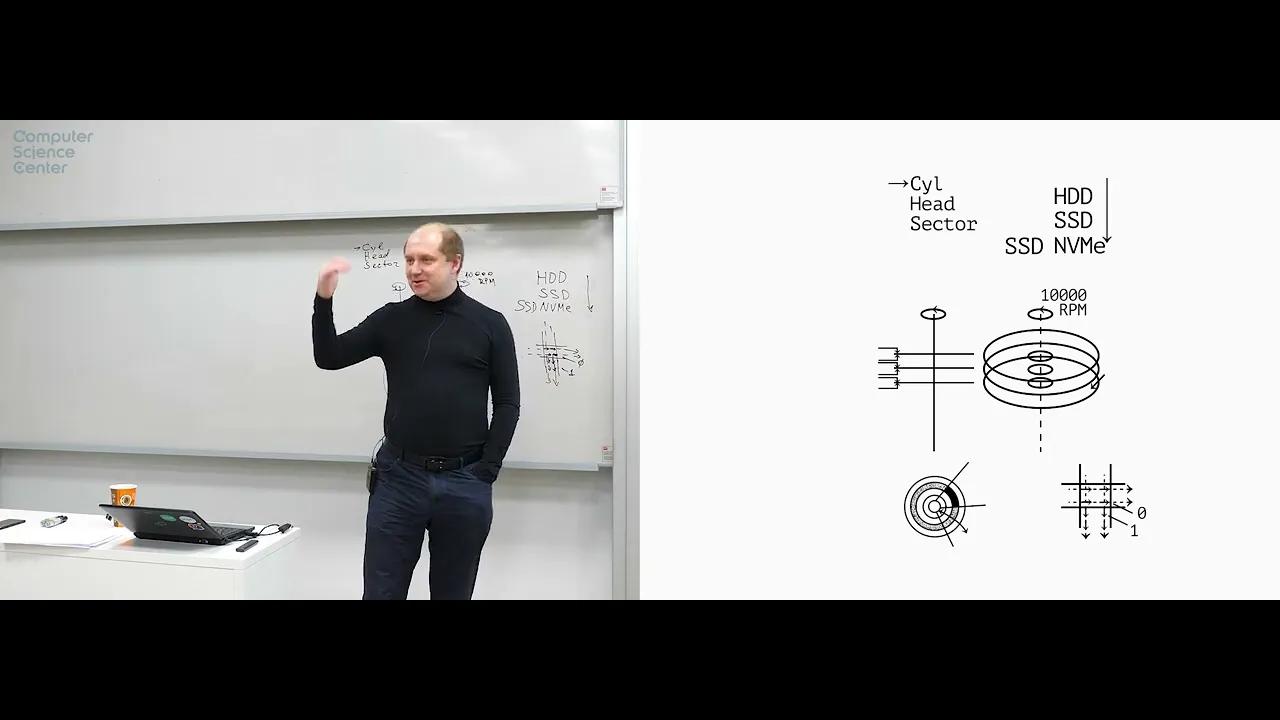
- The system comprises spinning spindles with three pancakes mounted on them, rotating at varying speeds up to 10,000 RPM.
- Adjacent to the spinning spindle is a mechanical system housing multiple reading and writing heads that align with each side. This setup allows for data reading and writing from surfaces efficiently.
- An actuator, capable of moving along a trajectory, facilitates head movement to access different areas on the corresponding surface.
Data Addressing Schemes
- The initial data addressing scheme involves cylinder-head-sector (CHS) addressing. It divides the disk into concentric circles for efficient data retrieval.
- By selecting specific parts within disk assemblies, such as cylinders and sectors, a structured addressing system enables precise data access across surfaces.
Disk Access Challenges and Solutions
- Clusters or blocks are formed by selecting specific sectors within cylinders using designated heads. This method streamlines data access on disks.
- Reading or writing data involves accessing blocks rather than individual bits or bytes. This block-based approach optimizes disk operations for enhanced efficiency.
Challenges in Disk Interfaces
The discussion shifts towards challenges encountered in disk interfaces due to rotational constraints and BIOS configurations affecting disk recognition and compatibility.
Rotational Constraints and BIOS Configuration
- Disks rotate unidirectionally at constant speeds during read/write operations, impacting access speed and efficiency.
- Disk installation complexities arise from BIOS requirements for supporting various disk geometries, leading to compatibility issues for users unfamiliar with these configurations.
Modern Interface Innovations
- Contemporary interfaces simplify disk access by abstracting operations into block-level interactions, enhancing user experience through streamlined commands.
- Logic block addressing schemes optimize disk control by converting block requests into geometric positions efficiently managed by controllers for seamless data retrieval.
Evolution to Solid State Drives (SSDs)
Transitioning to SSD technology is explored as a solution to traditional disk limitations through flash memory-based architectures offering improved performance characteristics.
Flash Memory Architecture
- SSD technology revolutionizes storage with solid-state drives leveraging flash memory properties for enhanced performance over conventional disks.
- Architectural optimizations enhance capacity and access speed through innovative geometrical configurations maximizing storage efficiency.
SSD Functionality Comparison
- SSD functionality mirrors that of traditional disks but operates more efficiently due to inherent flash memory characteristics facilitating rapid address assignment and data retrieval.
Understanding Computer Memory and Virtual Memory
In this section, the speaker discusses computer memory interfaces like SATA, direct memory access, and virtual memory. The focus is on how these components function within a computer system.
SATA Interface and Direct Memory Access
- The SATA interface allows direct connection to hard drives without going through the operating system.
- Direct memory access enables faster data transfer speeds.
Virtual Memory and Address Translation
- Virtual memory involves storing part of the RAM on disk.
- Understanding virtual memory requires grasping terms like cache lines and pages.
Cache Line Length and Page Size
- Cache line length corresponds to page size in virtual memory systems.
- Page faults occur when data is not in the cache, leading to slower access times.
Logical vs. Physical Memory Addressing
- Programs operate using logical addresses that are translated into physical addresses by the system.
- Logical address spaces differ from physical ones, impacting how programs interact with memory.
Memory Models: Logical vs. Physical Address Space
- Logical address space refers to how programs view memory addresses logically.
- Physical address space represents actual hardware implementation of memory storage.
Understanding Virtual Memory Systems
In this section, the speaker delves into the concept of virtual memory systems and how they function in linking virtual pages to physical memory.
The Concept of Virtual Memory
- Virtual pages can be displayed on any physical page, allowing for flexibility in memory allocation.
- Translation mechanisms link specific pointers within an application to physical addresses.
- Translation mechanisms can associate a page with different physical memory content if it has been swapped out.
Address Spaces and Page Sizes
This section explores address spaces and page sizes within virtual memory systems.
Address Spaces and Page Sizes
- Address space determines the number of bits used for addressing within a page.
- Address spaces are divided into logical/virtual address space and physical address space.
Building Virtual Memory Mechanisms
Here, the discussion centers on constructing virtual memory mechanisms.
Constructing Virtual Memory
- Dividing physical memory into pages facilitates mapping between disk storage and RAM.
- Logical/virtual address spaces are crucial for efficient memory management.
Page Tables and Disk Storage
The speaker elaborates on page tables and their relationship with disk storage.
Page Tables and Disk Storage
- Page tables enable mapping between logical/virtual addresses and physical addresses.
- Disk storage is partitioned into pages for efficient data retrieval.
Swap Files in Virtual Memory Systems
This part focuses on swap files' role in virtual memory systems.
Swap Files Functionality
- Swap files aid in managing data overflow by acting as additional storage areas.
- Swap files must maintain contiguous addressing similar to RAM for seamless data access.
Translation Schemes in Memory Management
The discussion shifts towards translation schemes employed in memory management processes.
Translation Schemes
- Translation schemes ensure seamless mapping between virtual and physical addresses.
Understanding x86 Architecture
In this section, the speaker delves into the intricacies of x86 architecture, focusing on linear addresses, page tables, and translation schemes.
Linear Address Structure
- Linear addresses consist of three fields: offset, page number in the table of pages, and table number in a directory of page tables.
- The offset represents the displacement within a page.
- The second field denotes the page number in the table of pages.
- The third field signifies the table number in a directory of page tables.
Page Table Organization
- Page tables contain pairs of VPN (Virtual Page Number) and PPN (Physical Page Number).
- These pairs map virtual pages to physical addresses.
Hierarchical Translation Scheme
- A hypothetical scenario involves dividing four gigabytes into 64-kilobyte pages for translation purposes.
- This division necessitates a translation scheme facilitated by a table containing mappings for efficient address resolution.
Memory Management with Page Tables
Here, the discussion centers on memory management using page tables and catalog tables to optimize address space utilization.
Memory Optimization Strategies
- To enhance memory efficiency, large tables can be stored on disk rather than solely in RAM.
- This approach requires an additional level of translation through catalog tables to access stored data efficiently.
Catalog Tables Functionality
- Catalog tables store mappings between global page table numbers and individual page chunks.
- These structures create an organizational hierarchy that streamlines memory access operations.
Address Resolution Process
Address resolution mechanisms are explored through CR3 register usage and hierarchical indexing within page directories.
CR3 Register Utilization
- The CR3 register stores the physical address pointing to the directory of page tables for efficient address resolution.
- Accessing any address within linear space involves referencing this register for index retrieval and subsequent offset calculation.
Simplified Address Resolution Scenario
- By leveraging CR3 contents, users can easily navigate through hierarchical structures to locate specific memory addresses.
New Section
The discussion revolves around the initialization process of a processor, focusing on the actions taken when power is supplied or the reset button is pressed.
Processor Initialization Process
- The processor transitions to an initial state defined by its architecture when power is supplied or the reset button is pressed.
- Upon pressing reset, registers are filled with certain values, such as zeros, including the instruction pointer register.
- Specific registers like CR3 are also initialized during this process.
New Section
This section delves into the concept of processor modes and the transition from real mode to protected mode in x86 processors.
Real Mode vs. Protected Mode
- x86 processors support multiple operating modes; initially, they start in real mode without virtual memory.
- During boot-up, code execution begins with BIOS followed by loading and executing an initial bootloader.
- The bootloader transitions the computer to protected mode, involving tasks like loading CR3 register.
New Section
Exploring protected mode further and its implications on memory access and privilege levels in Intel processors.
Protected Mode Features
- In protected mode, all operations and instructions are categorized into privileged and non-privileged types.
- Memory management involves not only page tables but also access flags for security.
- Code execution in protected mode includes descriptor privilege level checks for memory access control.
New Section
Discussing potential risks associated with modifying system registers at high privilege levels within an operating system environment.
Risks of Register Modification
- Operating at maximum privilege levels within an OS allows unrestricted modification of system registers.
- Deliberate tampering with registers can lead to system instability or security vulnerabilities.
New Section
Detailing how memory protection mechanisms work in protected mode through descriptor privileges and memory segmentation.
Memory Protection Mechanisms
- Memory segments contain not just page tables but also access flags for each segment's content.
- Descriptor Privilege Level (DPL) indicates the privilege level required for accessing specific memory regions.
New Section
Explaining how privileged commands can lead to security violations within a processor's memory management unit.
Security Violations Due to Privileged Commands
- Execution of privileged commands within a process context can result in security breaches or access violations.
New Section
Highlighting the significance of maintaining proper privilege levels to prevent unauthorized access or system disruptions.
Importance of Privilege Levels
- Maintaining correct privilege levels ensures that only authorized commands are executed at appropriate permissions.
New Section
Addressing potential consequences of mishandling register values at elevated privilege levels within an operating system environment.
Consequences of Mishandling Registers
Understanding Memory Management in Computer Systems
In this section, the speaker discusses memory management in computer systems, focusing on the complexities of addressing physical memory and virtual memory.
Memory Addressing and Implementation
- The implementation of memory management involves distributing space differently without page numbers.
- Reading about Intel architecture can aid in understanding how it operates on Intel processors.
- Addressing physical memory involves complexities like translation between addresses and pages.
Physical Memory Organization
- Physical memory addressing seems complex initially, involving virtual and physical aspects.
- Operational management of RAM is simplified but may not cover all details like address translations.
Memory Allocation Strategies
- Memory allocation uses locators to organize memory into chunks for efficient storage.
- Logical organization resembles a tree structure to manage different-sized memory blocks effectively.
Memory Management Techniques and Challenges
This part delves into strategies for managing memory efficiently, avoiding fragmentation, and optimizing resource utilization.
Fragmentation Prevention
- Organizing memory aims to minimize fragmentation by consolidating smaller blocks into larger ones.
Page Table Management
- The system employs a page table to map logical addresses to physical addresses efficiently.
Swap Mechanisms and Resource Optimization
- Allocating physical pages based on application requirements ensures optimal resource usage.
- Linux utilizes swap mechanisms like "kswapd" to manage swapping processes efficiently.
Virtual Memory Handling and Optimization
Exploring virtual memory handling, optimization techniques, and challenges faced in maintaining an efficient system operation.
Virtual Memory Operations
- Virtual memory systems aim to optimize process-related data storage efficiently.
Swapping Processes
- Swapping processes involve transferring data between disk and RAM based on application demands.
Process Termination Strategies
Virtual Memory Management
In this section, the speaker discusses virtual memory management and how operating systems allocate memory to processes.
Virtual Memory Allocation
- Operating systems allocate memory in address spaces or page tables.
- Over-committing memory allows applications to believe they have more memory than physically available.
- Processes face challenges when there is no free memory, leading to paging and process suspension.
Memory Structure and Management
This part delves into the structure of memory in protected mode and the role of registers in managing memory.
Memory Organization
- Explanation of how memory is structured in protected mode.
- Introduction to special purpose registers like CR1, CR2, CR0 for managing paging and virtual memory.
Descriptor Tables and Process Execution
The discussion focuses on descriptor tables, process execution, and segment descriptors.
Descriptor Tables
- Description of global and local descriptor tables for segment description.
- Segments are defined by descriptors indicating size, access rights, etc.
Task Registers and Task Switching
Task registers' significance in task switching is explained along with task state selectors.
Task Registers
- Task register points to the Task State Segment (TSS), containing information about segments owned by a process.
- Each processor core has its own task register for managing tasks efficiently.
Interrupt Handling and Protected Mode
The importance of interrupt handling mechanisms in protected mode operation is discussed.
Interrupt Handling