Лекція 15. Вчитель як суб'єкт педагогічної діяльності. Педагогічна майстерність вчителя
Teacher as the Subject of Pedagogical Activity
In this section, the focus is on discussing the teacher as the subject of pedagogical activity and exploring aspects such as professional development and communication skills.
Understanding Professional Activity
- Professional activity involves transmitting culture, accumulated experience, and preparing individuals for societal roles.
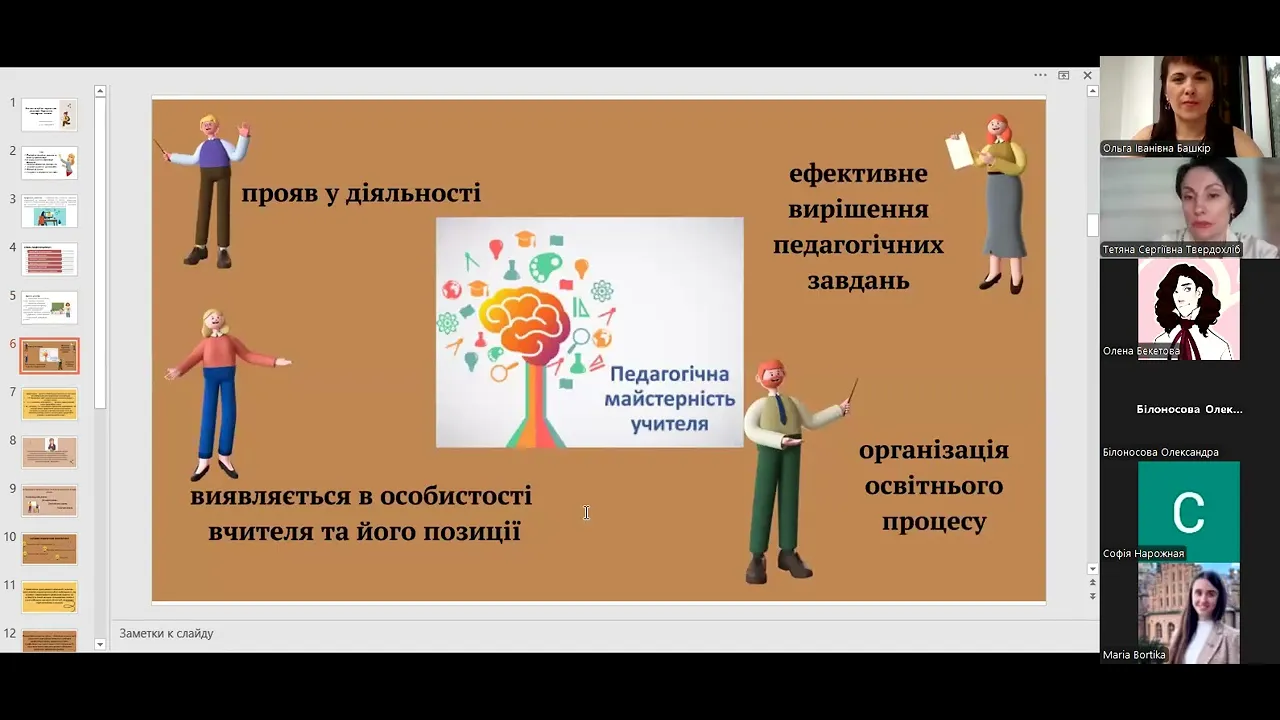
- Emphasis on the teacher as a subject of professional activity, highlighting pedagogical skills like techniques and communication components.
Professionalization Process
- Definition of professional activity: a unique form of social activity aimed at personal development and societal role fulfillment.
- Professionalization involves objective (knowledge, skills) and subjective (motivation) readiness. It progresses through stages like self-determination.
Professional Self-Determination and Training
This part delves into professional self-determination, training phases, and the significance of aligning one's career choice with personal attributes.
Self-Determination in Career Choice
- Professional self-determination entails recognizing oneself as suited for a specific profession based on individual qualities.
- Importance of accurate self-determination post-schooling to ensure alignment with chosen profession.
Training for Proficiency
- Countries like Czech Republic offer time post-schooling for individuals to explore professions through practical work experiences.
- Following self-determination, professional training enhances knowledge, skills, aligning them with vocational abilities for competitiveness in the job market.
Professional Adaptation and Development
This segment covers professional adaptation dynamics, balancing personal traits with work environments for effective performance.
Adaptation Dynamics
- The system encompasses primary training institutions, retraining programs during employment, including unemployed seeking skill enhancement.
Professionalism and Mastery in Teaching
The discussion delves into the stages of professionalization, focusing on the teacher as a subject of professional activity, emphasizing qualities such as self-determination, cultural context, and continuous professional development.
Teacher as a Subject of Professional Activity
- Teachers are seen as creators and constructors within their pedagogical activities, emphasizing self-determination in the world of cultural values.
- The essence of a teacher lies in being a professional at the highest level, showcasing integrity, systematization, and autonomy.
New Professional Standards for Teachers
- The new teacher standard proposes five labor functions emphasizing modern educational content, methods, and technologies.
- Essential aspects for every teacher include partnership with educational participants, creating safe learning environments, managing educational processes, and continuous professional development.
Pedagogical Mastery and Artistry
Exploring the significance of pedagogical mastery in educational effectiveness through insights from prominent educators like Vasily Sukhomlynsky and Konstantin Ushinsky.
Importance of Pedagogical Mastery
- Vasily Sukhomlynsky highlights the crucial role of mastery in educational efficiency and human development.
- Pedagogical mastery intertwines closely with pedagogical artistry, reflecting excellence in creative reflection and skillful execution.
Manifestations of Mastery in Teaching
- Pedagogical mastery is demonstrated through creative representation in artistic forms and expert proficiency in various tasks.
- Mastery is evident through practical application encompassing theoretical knowledge alongside practical skills essential for effective teaching practices.
Teacher's Role: Personal Development & Interaction
Discussing how a teacher's mastery extends beyond theoretical knowledge to practical application within interactions with students fostering personal growth.
Demonstrating Mastery Through Actions
- A teacher's expertise is showcased not only through theoretical understanding but also through practical implementation during teaching and nurturing processes.
- Emphasizing that a teacher should exhibit initiative, creativity, democratic principles in communication to be an effective educator fostering student engagement.
Significance of Teacher's Persona & Effectiveness
Highlighting the importance of a teacher's personality traits and approaches towards creating an engaging learning environment for students' holistic development.
Impactful Teacher Characteristics
Elementary, Basic, and Creative Levels of Pedagogical Mastery
The discussion focuses on the elementary, basic, and creative levels of pedagogical mastery, highlighting the characteristics and qualities associated with each level.
Elementary Level
- At the elementary level, teachers possess only isolated professional qualities and primarily demonstrate knowledge for pedagogical actions.
- Teachers at this level exhibit a basic understanding of pedagogical skills, humanistic-oriented interactions with students and colleagues, and proficient subject knowledge.
Basic Level
- Teachers at the basic level showcase a solid grasp of pedagogical fundamentals, effective teaching methods, and independent organization of educational processes.
- Proficiency in subject matter teaching is evident along with methodological confidence in structuring educational processes during lessons.
Advanced Level
- Educators at the advanced level display clear direction in their actions, high-quality dialogic interactions in communication, long-term activity planning focusing on student development.
- This level is characterized by initiative, a creative approach to organizing professional activities through original pedagogical techniques.
Defining Pedagogical Mastery
The conversation delves into defining pedagogical mastery as a complex set of personal attributes enabling high-level self-organization in professional activities based on reflection.
Definition of Pedagogical Mastery
- Pedagogical mastery represents the highest level of pedagogical activity quality. It reflects the teacher's creative engagement and psychological mechanisms for successful performance.
- Understanding the roots of mastery development aids in formulating a precise definition: a combination of personal traits facilitating high-level self-management based on reflection.
Components of Pedagogical Mastery
Exploring the components or elements that constitute pedagogical mastery including humanistic orientation, professional competence, teaching abilities, and pedagogical techniques.
Components Breakdown
- Humanistic orientation stands out as a crucial aspect emphasizing personal focus within mastery. It encompasses ideals, interests, values directed towards nurturing individuals' highest spiritual values.
Professional Competence of Teachers
In this section, the speaker delves into the concept of professional competence among teachers, emphasizing its importance in pedagogical activities.
Understanding Professional Competence
- Professional competence stems from a teacher's deep professional knowledge, skills, and abilities in pedagogy and psychology.
- It involves mastery of teaching methods for effective educational processes and reflects the unity of theoretical and practical readiness to conduct pedagogical activities.
- Teacher's preparation for lessons involves considering subject matter and students' psychology to tailor an individualized approach to teaching.
Components of Professional Competence
This part explores the components that constitute professional competence in teaching, highlighting the significance of comprehensive knowledge and skills.
Components of Professional Competence
- Profound understanding of subject matter, teaching methodologies, pedagogy, and psychology is crucial for successful pedagogical tasks analysis.
- Effective resolution of pedagogical challenges requires synthesizing knowledge into a coherent system that guides instructional decisions.
Teacher's Personal Qualities
The discussion shifts towards the personal qualities that teachers should possess to foster positive learning environments.
Importance of Personal Qualities
- Encouraging open dialogue with students by expressing personal views fosters engagement and critical thinking rather than rote memorization.
Understanding Pedagogical Techniques
In this section, the importance of pedagogical techniques in teaching is discussed, emphasizing the role of a teacher's professional knowledge and skills in fostering effective communication and understanding in the classroom.
The Essence of Pedagogical Techniques
- Young teachers are advised to focus on minor details such as expressing thoughts clearly, engaging students effectively, and managing classroom dynamics to enhance mutual understanding.
- Discrepancies in teaching styles among educators with similar qualifications are attributed to differences in pedagogical techniques. The technique of initiating educational processes impacts student-teacher relationships significantly.
- Research highlights common errors made by novice teachers, including difficulties in sincere communication with students and parents, managing anger, and overcoming insecurities during initial lessons.
- Novice teachers often struggle with excessive nervousness that affects their professionalism and authority. Challenges include maintaining discipline without appearing overly strict or fearful.
Developing Effective Teaching Skills
- Aspiring teachers recount feelings of anxiety, excessive severity, fear of losing control, and physical stiffness during initial teaching experiences. Body language plays a crucial role in conveying confidence and competence.
- Common physical shortcomings observed among students include slouching posture, lowered head position, fidgety hand movements, monotonous speech patterns, lack of expressive reading skills, and unclear articulation.
- Educators acknowledge the need to enhance their pedagogical techniques for improved interaction with students. Emphasis is placed on utilizing psychological and physical attributes effectively for impactful teaching practices.
Mastering Internal & External Teaching Techniques
This segment delves into the significance of internal (emotional regulation) and external (verbal/non-verbal communication) teaching techniques for educators to create a conducive learning environment.
Internal Teaching Technique: Emotional Regulation
- Teachers must master emotional self-regulation to project inner states effectively through verbal and non-verbal cues. Non-verbal gestures can carry more weight than spoken words in communication dynamics.
- Effective verbal communication involves controlling breathing patterns, diction clarity, speech pace modulation while influencing attention management. Non-verbal cues play a pivotal role in shaping personal interactions within educational settings.
External Teaching Technique: Communication & Influence
- Internal technique focuses on cultivating inner experiences that influence actions through mental alignment with intentions. External technique translates these internal states into tangible expressions through body language like mimics or voice modulation.
- Teachers' moods impact students' perceptions significantly; every word conveys not just information but also attitudes towards it. Verbal/non-verbal elements shape teacher-student relationships affecting classroom dynamics positively or negatively.
Achieving Professional Excellence
- Maintaining optimal emotional states during teaching is challenging due to inherent emotional intensity; educators must balance psychological demands efficiently for sustained performance without unnecessary strain.
New Section
The importance of non-verbal communication in teaching, focusing on external appearance and gestures.
External Appearance and Gestures
- Teachers must pay attention to their external appearance as 85% of information is perceived through gestures rather than words.
- A teacher's appearance should be aesthetically expressive, reflecting confidence and respect towards students.
- Body language, including posture and facial expressions, plays a crucial role in conveying dignity and confidence to students.
- Gestures should be organic, restrained, and purposeful to enhance the emotional significance of information for better student comprehension.
- Facial expressions should reflect appropriate emotions related to the subject matter without burdening students with personal concerns.
New Section
Enhancing pedagogical techniques through effective communication strategies.
Communication Strategies
- Effective communication involves expressing confidence, approval, dissatisfaction, joy, indifference, interest, enthusiasm, or annoyance appropriately.
- Mastery of communication techniques is essential for successful teaching outcomes by understanding student motivations and educational objectives.
- Developing communication skills within the context of improving overall pedagogical culture is crucial for teacher professionalism.
New Section
Exploring professional communication in educational settings.
Professional Communication
- Professional pedagogical communication entails establishing favorable psychological climates with students, parents, and colleagues.
- Effective communication involves exchanging information perceptively and interactively while fostering personal growth and self-affirmation among students.
New Section
The section discusses barriers faced by novice teachers, particularly the fear of direct contact with students and negative perceptions towards certain classes.
Novice Teachers' Barriers
- Novice teachers may struggle with a fear barrier when it comes to interacting directly with students.
- Stereotypes associated with specific classes can influence a new teacher's perception, potentially leading to a negative mindset towards challenging classes.
- Negative attitudes towards certain classes can create barriers for teachers, impacting their approach and effectiveness in the classroom.
New Section
This section delves into aspects of professional teaching activities, focusing on pedagogical skills and communication within educational settings.
Professional Teaching Activities
- Emphasis is placed on pedagogical mastery, including techniques and communication skills essential for effective teaching.