Физический уровень | Курс "Компьютерные сети"
Introduction to Physical Layer in Telecommunications
Overview of the Physical Layer
- The physical layer is the lowest level in the Open Systems Interconnection (OSI) model, responsible for transmitting a stream of bits over a transmission medium.
- At this level, data units are referred to as bits, and its primary function is to represent these bits as signals for transmission.
Signal Distortion and Transmission Challenges
- Signal distortion can occur during transmission, leading to degraded signal quality at the receiver's end. The receiver must interpret the received signal despite potential distortions.
- The focus will remain on how the physical layer transmits bits rather than delving into signal processing intricacies.
Characteristics of Communication Channels
- Key characteristics of communication channels include bandwidth (measured in bits per second), which indicates how much data can be transmitted over time.
- Delay is another critical characteristic that measures the time taken for a message to travel from sender to receiver; modern channels typically have low but non-zero delay.
Error Rates and Protocol Responsibilities
- The frequency of errors in a channel affects protocol design; protocols may need to implement error correction if errors are frequent or rely on higher layers for infrequent errors.
Types of Communication Channels
- There are three types of communication channels: simplex (one-way), duplex (two-way simultaneously), and half-duplex (two-way alternately).
Transmission Media Used in Networks
Historical Context and Current Technologies
- Various types of cables have been used historically for data transmission, starting with telephone cables and evolving through coaxial cables used in early Ethernet technologies.
Modern Cable Types
- Twisted pair cables are now commonly used, consisting of pairs of copper wires twisted together to reduce interference. Optical fibers use light for data transmission.
Wireless Technologies
Evolution and Current Use Cases
- Wireless technologies have gained popularity, utilizing radio waves and infrared radiation for data transfer. Early Wi-Fi technology also employed infrared methods.
Satellite Communication Limitations
- Satellite communication offers high costs and lower speeds compared to optical fiber connections.
Detailed Examination of Twisted Pair Cables
Structure and Functionality
- Twisted pair cables consist of multiple pairs of copper wires twisted together within a single sheath, designed to minimize electromagnetic interference.
Data Transmission Techniques
- Modern systems utilize all four pairs within twisted pair cables simultaneously for bidirectional data transfer.
Wireless Signal Distribution
Characteristics and Regulations
- Unlike wired connections, wireless signals propagate in various directions; however, proximity between multiple sources can lead to signal distortion. Regulatory frameworks govern frequency usage.
Frequency Bands Utilized
Wi-Fi Routers and Interference
The Impact of Household Devices on Wi-Fi Performance
- Setting up a Wi-Fi router at home without seeking permission can lead to interference from other devices, such as microwaves and remote controls for barriers.
- When a microwave operates near a Wi-Fi router, data transmission may become impossible or significantly slower due to frequency conflicts.
Error Rates in Data Transmission
- The error rates in different data transmission mediums vary significantly; optical cables have the least errors, while wireless connections experience frequent issues.
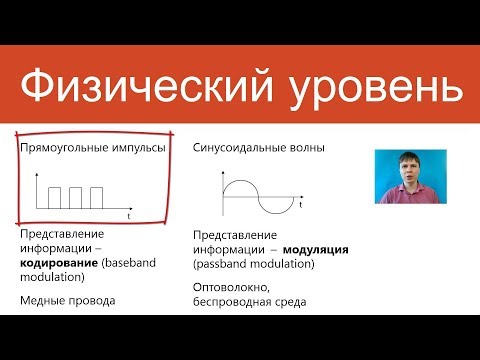
- Two primary approaches exist for representing information in network technologies: rectangular pulses (digital signals) and sinusoidal waves (analog signals).
Signal Representation Techniques
- Digital representation typically uses '0' for no voltage and '1' for high voltage, but more complex schemes are often employed in practice.
- Analog signal representation involves modulation techniques that adjust frequency, phase, and amplitude; complex combinations of these methods are commonly used.
Physical Layer of Network Models