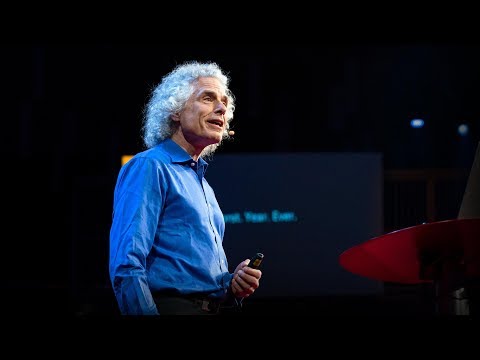
Is the world getting better or worse? A look at the numbers | Steven Pinker
Introduction
The speaker discusses how people often view the world with pessimism and nostalgia for earlier times. However, the speaker questions whether this perspective accurately reflects the progress and well-being of humanity in the 21st century.
Is the World Getting Worse?
- Many people perceive the present as a time filled with shootings, inequality, pollution, dictatorship, war, and nuclear weapons.
- The year 2016 was considered the "Worst. Year. Ever." until 2017 surpassed it.
- People often long for earlier decades when they believe the world was safer, cleaner, and more equal.
Comparing Present Data with 30 Years Ago
The speaker compares various indicators of well-being from present data to that of 30 years ago to determine if there has been progress over time.
United States Comparison
- Homicide rate in the US decreased from 8.5 per hundred thousand to 5.3 per hundred thousand.
- Poverty rate in the US decreased from 12% to 7%.
- Emissions of particulate matter and sulfur dioxide in the US decreased significantly.
Global Comparison
- Number of ongoing wars worldwide decreased from 23 to 12.
- Number of autocracies worldwide decreased from 85 to 60.
- Percentage of global population living in extreme poverty decreased from 37% to 10%.
- Number of nuclear weapons worldwide decreased from over 60,000 to over 10,000.
Progress or Decline?
The speaker explores whether these improvements indicate progress or if there are other factors at play.
Terrorism Comparison
- Western Europe experienced fewer deaths due to terrorism in recent years compared to 1988.
The Notion of Progress
- Intellectuals often dislike the idea of progress.
- Believing in progress is seen as having blind faith and a naive optimism.
- However, progress can be measured and tested as a hypothesis.
Measuring Human Well-being
The speaker argues that human well-being can be measured using various indicators, and if these indicators have improved over time, it signifies progress.
Life Expectancy
- Life expectancy at birth has increased from around 30 to over 70 worldwide.
- In developed parts of the world, life expectancy is now over 80.
Child Mortality
- In the richest countries 250 years ago, one-third of children did not live to see their fifth birthday. Today, less than six percent of children in the poorest countries face this fate.
Famine and Poverty
- Famine has been largely eradicated from most parts of the world.
- Extreme poverty has decreased significantly from 90% to fewer than 10% globally.
Peace and Democracy
- Wars between powerful states have become rare occurrences.
- Democracy has expanded globally with two-thirds of people living in democracies.
Safety and Crime Rates
- Homicide rates have significantly decreased over time.
- Various risks such as car crashes, plane crashes, on-the-job accidents, and natural disasters have become less likely to cause death or harm.
Conclusion
The speaker concludes that progress can be observed through measurable improvements in various aspects of human well-being. The notion of progress should not be dismissed but rather embraced as a testable hypothesis based on data analysis.
The Progress of Human Civilization
This section discusses the improvements in the resilience of infrastructure that have reduced the likelihood of natural disasters causing significant harm. It also highlights the increase in literacy rates and reduction in working hours, as well as the advancements in household technology that have decreased the time spent on housework.
Advances in Infrastructure and Safety
- Natural disasters such as landslides, earthquakes, and meteor strikes are now less likely to cause harm due to improvements in infrastructure resilience.
- The probability of being killed by a lightning strike has decreased by 97%.
Increase in Literacy and Reduction in Working Hours
- In the 17th century, only 15% of Europeans could read or write. However, by the middle of the 20th century, Europe and the United States achieved universal literacy. Today, over 90% of people under 25 worldwide can read and write.
- In the past, Westerners used to work more than 60 hours per week. Nowadays, they work fewer than 40 hours per week.
Advancements in Household Technology
- With running water, electricity, and widespread adoption of household appliances like washing machines, vacuum cleaners, refrigerators, dishwashers, stoves, and microwaves; the amount of time spent on housework has significantly reduced from 60 hours a week to fewer than 15 hours a week.
The Impact on Happiness
This section explores whether these advancements have made people happier.
- In recent decades, happiness has increased in approximately 86% of countries worldwide.
Recognizing Progress
The speaker aims to convince the audience that progress is not a matter of faith or optimism but a fact of human history.
- Progress should be seen as a fact rather than a matter of belief.
- News coverage tends to focus on negative events, leading to a perception that progress is not happening.
Understanding Perception and Journalism
This section delves into why people may fail to appreciate progress and how journalism plays a role in shaping perceptions.
- People tend to estimate risk based on what they can easily recall from memory, leading to an overemphasis on negative events.
- Journalism focuses on reporting events rather than non-events, creating a skewed perception of the world.
Cognitive Biases and News Coverage
This section explores cognitive biases and the nature of news coverage that contribute to the perception that the world is constantly in crisis.
- Cognitive biases, such as our morbid interest in negative events, combined with news media's focus on sensationalism, contribute to the belief that the world is always on the brink of disaster.
Dangers of Pessimism
This section discusses the dangers associated with thoughtless pessimism.
- Fatalism can arise from indiscriminate pessimism, leading people to believe that efforts for improvement are futile.
- Radicalism can also result from pessimistic views about institutions' failure, leading individuals to seek drastic measures for change.
The Idea of Progress
This section explores the concept of progress and its underlying idea.
- Progress is not a mystical force but the result of human efforts guided by reason and science, as associated with the Enlightenment.
Problems and Solutions
This section emphasizes that progress involves problem-solving and acknowledges the existence of unsolved global problems.
- Progress does not mean everything becomes better for everyone all the time; it involves solving problems, which may create new ones.
- Climate change and nuclear war are among the significant challenges that require proactive solutions.
Human Nature and Progress
The speaker reflects on whether progress aligns with human nature.
- Despite acknowledging human nature's shortcomings, understanding statistics on human progress has led to a more optimistic worldview.
[t=0:13:57s] Understanding Human Nature and Enlightenment Norms
In this section, the speaker discusses how human nature can be both a problem and a solution. They mention that while some intellectuals have criticized the idea of progress, many readers have expressed gratitude for changing their perspective on the world.
Human Nature as Problem and Solution
- The speaker argues that human nature is both the problem and the solution when it comes to understanding our tribulations and woes.
- Some intellectuals have responded with fury to the idea of progress, but many readers are grateful for changing their view of the world from fatalism to something more constructive.
- While some find the idea of progress boring, others see it as an opportunity for redemption.
[t=0:15:04s] The Narrative of Human Nature
In this section, the speaker presents a narrative about human nature. They discuss how we are born into a challenging universe but possess unique qualities that allow us to overcome obstacles.
The Narrative of Human Nature
- We are born into a pitiless universe, facing steep odds against life-enabling order and constant jeopardy.
- Our nature is shaped by ruthless competition, vulnerability to illusions, self-centeredness, and at times astounding stupidity.
- However, human nature is also blessed with resources such as recursive thinking, language instinct, and capacity for sympathy.
- These endowments have been magnified through written language, history, journalism, narrative arts, reason norms and institutions.
[t=0:16:32s] Eking Out Victories and Enhancing Human Flourishing
In this section, the speaker discusses how humanity has made progress in various aspects of life. They emphasize the importance of applying knowledge to enhance human flourishing.
Eking Out Victories and Enhancing Human Flourishing
- Through recursive improvement, we have achieved victories against the forces that grind us down.
- We have deepened our understanding of the cosmos, lived longer, suffered less, learned more, and enjoyed more small pleasures and rich experiences.
- While much suffering remains, ideas on how to reduce it have been voiced, and there are infinite possibilities yet to be conceived.
- The speaker emphasizes that we will never have a perfect world but can continue to attain betterments by applying knowledge to enhance human flourishing.
[t=0:17:54s] The Heroic Story of Humanity
In this section, the speaker presents the idea that the story of human progress is not just another myth but a true narrative based on our knowledge. They highlight that this story belongs to all of humanity.
The Heroic Story of Humanity
- The story of human progress is not a fiction but true based on our knowledge.
- This story belongs to all sentient creatures with reason and an urge for persistence in their being.
- It requires convictions such as valuing life over death, health over sickness, abundance over want, freedom over coercion, happiness over suffering, and knowledge over ignorance and superstition.
Turn any video into a summary like this
YouTube links, meetings, lectures. With transcripts, search, and chat.