Introduction to Balancing Chemical Equations
Introduction to Balancing Chemical Equations
Understanding Balanced vs. Unbalanced Equations
- The video introduces the concept of balancing chemical equations, explaining what it means for an equation to be balanced or unbalanced.
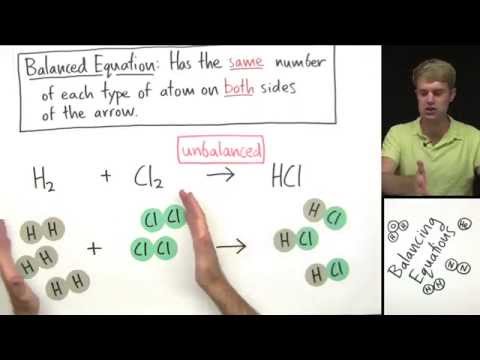
- A word equation is presented: hydrogen gas and chlorine gas combine to form hydrochloric acid, which will be translated into a chemical equation.
- The chemical formulas are introduced: H2 for hydrogen gas, Cl2 for chlorine gas, and HCl for hydrochloric acid.
Visualizing Atoms in Reactions
- Diagrams illustrate the atoms involved in the reaction: two hydrogen atoms from H2 and two chlorine atoms from Cl2 combine to form one molecule of HCl.
- A definition of a balanced equation is provided: it has the same number of each type of atom on both sides of the arrow.
Identifying Unbalanced Equations
Characteristics of Unbalanced Equations
- An unbalanced equation is defined as having different numbers of one or more types of atoms on either side.
- The importance of balancing equations before using them for calculations in chemistry is emphasized.
Process of Balancing Equations
- To balance an equation, adjustments are made by changing the number of molecules until both sides have equal atom counts.
Example 1: Balancing Hydrogen and Chlorine Reaction
Steps to Balance the Equation
- The initial unbalanced state shows two hydrogens and chlorines on one side versus one hydrogen and chlorine on the other.
- By adding another molecule (HCl), we achieve balance with two hydrogens and chlorines on both sides.
Example 2: Balancing Hydrogen and Oxygen Reaction
Assessing Balance in Water Formation
- The reaction between hydrogen gas (H2), oxygen gas (O2), and water (H2O) is analyzed; initially found to be unbalanced due to differing oxygen counts.
Adjustments Made for Balance
- Adding another water molecule adjusts oxygen counts but disrupts hydrogen balance, requiring further adjustments.
Common Mistakes in Balancing
Misunderstanding Subscripts vs. Coefficients
- A common mistake involves altering subscripts instead of coefficients; this changes compound identities (e.g., turning water into hydrogen peroxide).
Importance of Correct Notation
- Emphasizes that subscripts must remain unchanged while coefficients can be adjusted to maintain correct molecular identity during balancing.
Using Charts for Balancing Chemical Equations
Chart Methodology Explained
- Introduces a chart method for tracking atom counts across reactants and products when balancing equations involving nitrogen (N2), hydrogen (H2), and ammonia (NH3).
Practical Application Through Examples
- (647)s Further examples demonstrate how adjusting coefficients impacts atom counts, reinforcing understanding through practice.