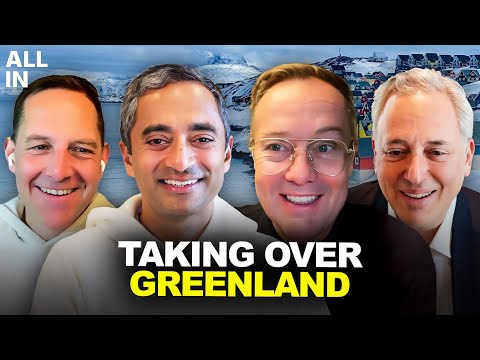
Iran's Breaking Point, Trump's Greenland Acquisition, and Solving Energy Costs
Welcome to the All-In Podcast
Introduction and Davos Invitation
- The hosts of the All-In Podcast, including David Freeberg, Jamal Pololly, Hapatia, and David Saxs, welcome listeners back and discuss their week.
- Jal receives an invitation to Davos, prompting excitement about bringing his guitar for the event.
- The podcast will have a stage at Davos to interview attendees; Jason cancels a ski trip in Japan to attend.
- The format at Davos involves various houses where countries and companies host events; constant interviews occur among attendees.
Interview Dynamics at Davos
- Attendees are primarily interviewing each other in a circular fashion, akin to a podcast circuit.
- Heads of state will also be engaging in interviews with one another during the event.
- Jason mentions networking opportunities at USA House, which is centrally located in Davos.
Anticipated Activities
- Producer Lisa will help facilitate introductions between attendees and hosts for potential interviews.
- There’s discussion about possibly conducting street interviews using wireless microphones during the event.
Humor and Impressions
- A humorous exchange occurs regarding Jal's ability to impersonate Triumph the Insult Comic Dog while interviewing leaders.
Current Events: Iran Protests
Overview of Situation in Iran
- Discussion shifts to significant anti-regime protests occurring in Iran after years of authoritarian rule since 1979.
- Inflation has surged dramatically over recent years due to sanctions; average inflation rates have been around 30% since 2019.
Demographics and Aspirations
- A large portion of Iran's population consists of young people who desire modernization and access to global information through technology like Starlink.
Perspectives on Intervention
- Sachs expresses caution regarding foreign intervention but acknowledges that these protests stem from grassroots movements rather than external influences.
Discussion on Iran's Political Situation
Overview of Current Events
- The speaker mentions that commenting on certain issues often leads to misrepresentation, specifically referencing Trump adviser David Sax.
- Predictions regarding the Iranian leadership change indicate a significant drop in the likelihood of Kani being ousted as supreme leader by January 31st, from 27% to 10%.
- The discussion highlights the impact of sanctions on Iran's economy, with average monthly income around $200 and food prices comparable to those in the U.S.
Economic Strain and Civil Unrest
- The cost of living is emphasized; for instance, a McDonald's meal costs about $4, which is substantial given the low average income.
- The speaker argues that civil society breaks down when basic needs are unmet, leading people to resist oppressive regimes.
U.S. Involvement and Potential Outcomes
- There is speculation about whether Trump will support revolutionary efforts in Iran by targeting IRGC sites, crucial for regime control.
- Concerns are raised about how to manage a transition if Reza Palavi returns from Europe; historical parallels with Venezuela are drawn regarding governance challenges.
Regional Implications
- Increased sanctions are discussed as an effective strategy for applying pressure on Iran’s regime amidst its large population (approximately 95 million).
- A potential regime change could significantly affect regional dynamics, especially concerning groups like Hezbollah and Houthis supported by Iran.
Cultural Context and Information Warfare
- The unique cultural identity of Iranians is noted; their diaspora contributes positively wherever they settle.
- Caution is advised against oversimplifying Middle Eastern dynamics due to cultural differences among countries.
Challenges in Information Access
- The speaker emphasizes that accurate information about Iran may only be available through military and intelligence channels amid widespread misinformation.
- Discussion shifts towards information warfare tactics used during unrest in Iran, highlighting difficulties in obtaining reliable data due to communication blockages.
Understanding Modern Warfare and Information Tactics
The Role of Technology in Warfare
- The discussion highlights the evolving nature of warfare, emphasizing the integration of information technology in conflicts, particularly with tools like Starlink.
- It is suggested that these technological advancements will lead to an increase in tactical operations across various conflicts.
Cultural Insights from Iran
- A reference is made to Anthony Bourdain's "Parts Unknown," showcasing a vibrant portrayal of life in Iran despite oppressive conditions.
- The conversation reflects on the resilience and similarities between young Iranians and people globally, underscoring their desire for freedom amidst challenges.
Political Commentary on Leadership
- There’s a discussion about former President Trump’s approach to military intervention, suggesting he may act against dictators if it avoids larger conflicts like World War III.
- Speculation arises regarding how potential actions taken by Trump could define his legacy, especially concerning global freedom movements.
Microsoft's Data Center Strategy
Energy Consumption Concerns
- Microsoft addresses public concerns over energy consumption related to data centers amid rising electricity costs.
- Trump publicly criticizes Microsoft for potentially increasing electricity bills for Americans due to their data center operations.
Corporate Responsibility Initiatives
- Microsoft announces plans to cover higher electricity rates and replenish water used by its data centers, aiming for responsible energy consumption practices.
- The company commits not to accept tax breaks or discounts on electricity rates as part of its new strategy.
Broader Implications for Utilities
- Discussion points out that while Microsoft's initiatives are positive steps, they only address part of a larger issue regarding overall energy demand and utility infrastructure.
Future Recommendations for Energy Management
- Suggestions include creating substantial tax equity vehicles funded by tech companies to subsidize homeowners' renewable energy installations (solar/storage).
- Emphasis is placed on ensuring local communities benefit from corporate investments through sustainable infrastructure improvements.
AI and Power Generation: A New Era?
Innovative Energy Solutions for Data Centers
- Discussion on the concept of using battery systems, likened to "little R2-D2 tubes," which store energy when it's cheap and release it during peak demand times. This approach is seen as a win-win situation.
- The importance of proactive communication regarding AI's impact on energy consumption is highlighted, with mentions of discussions involving key figures like Chris Wright.
- The administration's early recognition that AI companies would need substantial power led to plans for these companies to generate their own energy rather than relying solely on the grid.
Collocation and Its Benefits
- Hyperscalers are planning to set up their own power generation systems (collocation), which could ultimately lower electricity rates for residential consumers by allowing data centers to sell back excess power.
- Fixed costs in power generation can be spread over larger supplies as scale increases, leading to reduced variable rates for consumers.
- Criticism from figures like Bernie Sanders is viewed as misguided; the real issue lies in overregulation hindering new power generation setups.
Regulatory Challenges and Solutions
- Microsoft’s pledge to self-generate power reflects a broader trend among hyperscalers who have always intended not to rely heavily on the grid due to regulatory barriers.
- Regulations from organizations like FK complicate collocation efforts, but directives from Secretary of Energy Chris Wright aim to ease these restrictions.
Misconceptions About Data Center Operations
- Incentives related to living near nuclear plants are discussed, highlighting how local populations benefit financially compared to average regional taxes.
- Addressing misconceptions about water usage in data centers, emphasizing that modern cooling systems recycle water rather than deplete it significantly.
Economic Implications of Scaling Power Supply
- The argument against fears surrounding water usage in data centers is made clear; most modern facilities utilize closed-loop systems that minimize waste.
- Affordability issues tied back to inflation are noted, suggesting that scaling both demand and supply can alleviate pricing concerns through economies of scale.
- A proposal for a significant tax equity fund aimed at reducing electricity costs for millions of American households is introduced, underlining the potential economic impact of improved energy strategies.
Electricity Pricing and Consumption Models
Overview of Electricity Consumption
- The U.S. has a total electricity consumption of 250 billion, with one-third attributed to residential use and two-thirds to industrial and commercial sectors.
- A proposal suggests increasing industrial and commercial electricity prices by 50%, allowing for free residential electricity up to a certain cap based on home size.
Incentives for Private Power Systems
- This pricing model could incentivize industrial users to invest in private power systems, potentially increasing overall electricity supply in the U.S.
- Transitioning to solar and storage solutions could remove significant demand from the grid, making homes more self-reliant.
Market Dynamics and Grid Dependency
- Current homeowners still rely on grid services; however, if industrial prices rise, it may drive investments in solar systems.
- There are approximately 80 million freestanding homes in the U.S., with an estimated cost of $10-$15k per battery pack for energy independence.
Financial Implications
- A rough calculation indicates that investing around $100 billion could provide energy independence for about 10% of American households.
- By generating their own power, consumers would feel less financial pressure related to energy costs while freeing up terawatt hours for commercial applications.
Corporate Responsibility and Future Vision
- The discussion emphasizes leveraging AI advancements as a means to achieve affordable energy solutions without burdening taxpayers.
- Corporations should contribute positively towards reducing household energy costs as part of wealth redistribution efforts.
Long-term Goals for Energy Independence
- The vision includes making all residential electricity free over the next decade, which would alleviate financial stress on Americans while promoting distributed energy production.
- This approach encourages corporations to take responsibility rather than centralizing energy production, fostering innovation in renewable resources.
Economic Implications of Private Utilities
The Future of Utility Economics
- Discussion on the potential shift where private homeowners become their own utilities, raising questions about the future role and financial viability of traditional utility companies.
- Mention of a transformative idea where individuals could receive a certain amount of free electricity annually, highlighting its aspirational nature for America.
OpenAI's Major Compute Deal
- OpenAI has entered into a significant agreement with Cerebras to purchase compute capacity worth over $10 billion, committing to 750 megawatts over three years.
- Speculation around the credibility of information regarding investor Sam Altman's involvement with Cerebras, emphasizing the importance of verifying sources in tech news.
Innovations in Chip Technology
- Introduction to Cerebras' unique approach in chip manufacturing by creating one large chip instead of multiple smaller ones, which enhances performance.
- Explanation on how combining compute and memory reduces physical distances and complexity, leading to faster inference speeds.
Diversification Strategies at OpenAI
- Insight into OpenAI's strategy to diversify its computing resources by partnering with multiple companies like AMD and Nvidia alongside Cerebras.
- Prediction that there will be a renaissance in silicon technology similar to past PC wars, presenting opportunities for small teams in chip development.
Future Trends in AI Compute Needs
Potential Slowdown in Compute Demand?
- Inquiry into whether AI compute needs might plateau due to increased efficiency from software improvements and existing capacity.
- Discussion on Anthropic as a competitor to OpenAI, suggesting that they are achieving better results with fewer resources.
Taxation and Wealth Management Discussions
Concerns Over Wealth Taxes
- Commentary on the implications of moving states for tax purposes, particularly focusing on California's taxation policies compared to Texas'.
States Banning Asset Taxes
- Listing states that constitutionally ban asset taxes: Alaska, Florida, Nevada, New Hampshire, South Dakota, Tennessee, Texas.
- Clarification that while only Texas explicitly bans wealth taxes through its constitution, other states have implicit prohibitions based on their legal frameworks.
Discussion on Taxation and Property Rights
Constitutional Limitations on Taxation
- Florida's constitution prohibits personal taxes, while Pennsylvania enforces a strict uniformity clause that prevents graduated tax rates among populations.
- In states like New Mexico, Nebraska, and North Carolina, civil asset forfeiture laws protect individuals from having their assets seized by the state.
Perspectives on Asset Seizure Tax
- Freeberg expresses skepticism about the asset seizure tax making it to the ballot, suggesting a slight overweight towards it not happening.
- The discussion highlights that allowing government collection of post-tax assets undermines private property rights, as it enables future seizures based on legislative votes.
Distinction Between Property and Income Taxes
- Unlike income tax—which is a percentage taken from earnings—property tax is viewed as a service fee tied to specific assets that enhance their value through public services.
- Property taxes are uniform across counties; however, the proposed asset seizure tax targets specific demographics (e.g., individuals with net worth over a billion dollars), leading to nonuniform taxation.
Implications of Demographic-Based Taxation
- The proposed asset seizure tax represents demographic discrimination by taxing individuals based on wealth rather than income earned.
- This approach could set a precedent for future discriminatory taxation practices against any defined demographic group.
Concerns Over Government Authority and Private Property
- Granting legislatures power to define demographics for taxation risks transforming all private property into public property under government control.
- The conversation raises concerns about invasive assessments of personal property by the government for taxation purposes.
Financial Context and Debt Issues
- California faces significant financial challenges with an annual deficit projected at $30 billion and substantial pension obligations nearing $1 trillion.
- There is skepticism regarding whether funds will be sourced adequately without resorting to aggressive taxation measures targeting wealthy individuals.
Counterarguments Regarding Ballot Inclusion
- A counterpoint is raised questioning why the asset seizure proposal wouldn't make it onto the ballot or pass if presented.
California's Billionaire Tax Initiative: A Deep Dive
Signature Collection and Political Dynamics
- The SEIU aims to collect 850,000 signatures for a ballot initiative in California targeting billionaires, leveraging public sentiment against them.
- Concerns arise about whether Governor Gavin Newsom can provide sufficient political benefits to dissuade the SEIU from pursuing the initiative, which demands $30 billion.
- Dave Rean, head of the SEIU, is seen as having significant leverage over billionaires who are reacting anxiously on social media platforms.
Strategic Considerations for the SEIU
- The discussion highlights a strategy where increasing leverage through spending $8 million on signature collection could lead to better negotiations with politicians.
- There’s an acknowledgment of a potential shift towards either socialism or fascism due to ongoing economic pressures, emphasizing the need for individual agency among Californians.
Public Sentiment and Potential Outcomes
- The importance of open dialogue regarding private property rights is stressed; if voters still support such initiatives after understanding their implications, it reflects broader societal trends.
- There's skepticism about why the initiative wouldn't make it onto the ballot given that financial resources appear available for signature gathering.
Financial Implications and Campaign Strategies
- The SEIU reportedly has $14 million allocated for signature collection and an additional $10 million earmarked for advertising campaigns related to the initiative.
- Polling data suggests there is room for influence; if voters understand potential consequences, they may reconsider their support.
Broader Context and Future Projections
- If placed on the ballot by April, there may be significant backlash from business leaders who fear repercussions from such policies.
- Other unions are preparing similar initiatives for future ballots that may be more robust legally and politically than this current one led by only the SEIU.
This structured summary captures key discussions surrounding California's proposed billionaire tax initiative while providing timestamps linked directly to relevant parts of the transcript.
Discussion on California's Economic Future and Union Influence
Opposition from Unions and Political Landscape
- The opposition to a proposed measure is largely driven by other unions, allowing politicians like Newsome to express their dissent without fear of backlash.
- There is an expectation that if the measure fails in 2026, it will return in 2028 with stronger union support, indicating a persistent push for change.
Inevitable Changes and Legal Challenges
- The speaker believes that future iterations of the tax will be better structured legally, making them harder to challenge successfully.
- A significant legal hurdle exists due to the retroactive nature of the proposed tax, which could lead to claims of injustice and potential Supreme Court challenges.
Strategic Miscalculations by Unions
- The unions missed an opportunity by not implementing the tax starting January 7th, which could have facilitated its passage and reduced legal challenges.
- Future proposals may be more effectively designed, potentially increasing their acceptance at both state and national levels.
Federal Implications of California's Financial Situation
- Concerns arise about what would happen if California were to declare bankruptcy and seek federal assistance; political dynamics would heavily influence outcomes.
- The discussion highlights how different political leadership (e.g., Trump vs. AOC as president) would affect negotiations for federal bailouts.
Economic Ramifications of Asset Seizure Tax
- If asset seizure taxes are implemented at the state level, there could be severe economic consequences nationally as states might need to support each other financially.
- Citizens from states without such financial issues may resist bailing out California, leading to tensions between states over fiscal responsibility.
Spending Issues in California
- Democrats supporting new taxes might focus on eliminating fraud before discussing tax increases as a strategy for public acceptance.
- Statistics reveal that California collects significantly more per capita in taxes than Texas or Florida but faces spending issues rather than revenue shortfalls.
Declining Services Amidst Increased Spending
- Despite increased funding over the past decade, services such as education and crime prevention have deteriorated in California.
Concerns Over Government Workers Unions and Political Power
The Accumulation of Political Power
- The speaker expresses opposition to government workers' unions, arguing they accumulate excessive political power by electing politicians who then pay them, leading to a cycle of extraction with each election.
- This dynamic is likened to an antitrust monopoly in corporations, suggesting that unions can monopolize political influence and assets.
Pension Obligations and Retirement Issues
- Discussion on pension obligations reveals that state employees can retire early (in their 40s) while receiving up to 90% of their salary for life, which the speaker argues is unsustainable.
- The practice of "stuffing" overtime into the last year's W2 allows retirees to receive inflated pensions, raising concerns about fairness and sustainability.
Historical Context of Retirement Benefits
- The speaker notes that retirement ages have shifted dramatically; previously, individuals retired at 60 but now many retire at 42 due to changes in benefits structures.
- There are implications for spouses regarding pension benefits, indicating potential inequities in how these systems operate.
Critique of Government Management and Market Participation
Call for Private Sector Solutions
- The speaker advocates for private management of retirement funds rather than government oversight, claiming government inefficiency hinders effective management.
- Proposes mandatory contributions from employees or employers into superannuation funds as a means to enhance market participation and societal happiness.
The Strategic Importance of Greenland
U.S. Interest in Acquiring Greenland
- Acknowledges President Trump's interest in acquiring Greenland as part of national strategy discussions with Denmark.
- Highlights historical attempts by past U.S. leaders (e.g., FDR, Truman) to acquire Greenland, framing it as a long-standing geopolitical interest.
National Security Considerations
- As Arctic ice melts, new shipping lanes open up making Greenland strategically significant for national security reasons.
- Emphasizes the need for U.S. control over resources and territory in light of changing global dynamics related to climate change.
Potential Economic Benefits from Acquisition
Resource Opportunities
- Discusses the economic potential associated with Greenland's natural resources such as oil and minerals alongside its strategic location.
- Suggestion that acquiring Greenland could be beneficial not just politically but also economically through resource exploitation.
Building an Empire: The Role of National Pride and New Frontiers
The Nature of Negotiation with Government
- The speaker expresses enthusiasm for building an empire, indicating a preference for a certain type of leadership associated with Trump.
- Discusses the challenges in negotiating with government entities, emphasizing that national pride complicates these negotiations.
Potential Alliances and New Frontiers
- Suggests sending progressive socialists to Greenland as a new frontier, invoking the spirit of exploration reminiscent of American pioneers.
- Proposes creating a "freedom province" or economic free zone to counteract perceived threats from socialism in the U.S.
Resisting Socialism and Reviving American Spirit
- Warns against the degradation of individual liberties due to socialism, advocating for establishing legal territories that embody the "great American spirit."
- Mentions Texas as a symbolic last stand against socialist influences, referencing historical events like the Alamo.
Legislative Protection Against Change
- Advocates for untouchable legislation to protect pioneering efforts from governmental interference.
- Compares potential new territories to Guam or Puerto Rico, suggesting they should be established as protected regions against socialist encroachment.
Historical Context and Future Considerations
- Reflects on history where the frontier was seen as an escape valve for societal pressures until it was declared closed around 1910.
- Draw parallels between America's past role as an escape from European oppression and current needs for similar outlets amidst rising discontent.
The Challenge Posed by Socialism
- Critiques socialists as non-pioneers who hijack existing institutions rather than create new ones, aiming for total control over society.
- Questions whether establishing release valves could alleviate societal pressure before reaching critical points of conflict.
Closing Remarks and Notable Interviews
- Concludes with shout-outs to recent interviews conducted by team members, highlighting their significance in ongoing discussions about societal issues.
Broadcasting and Random Acts
Introduction to Broadcasting
- The speaker humorously denies being a broadcaster, stating they would never degrade themselves in that way.
- They mention engaging in "random acts of broadcasting" and highlight ongoing activities within the All-In Empire.
Upcoming Events and Interviews
- The speaker shares excitement about an upcoming invitation to Davos, indicating plans to perform with an acoustic guitar.
- They reference a recent CES interview with Bob Sternfels, CEO of McKenzie, which is available for listeners.
Social Media Engagement
Viral Content and Reactions
- A discussion arises about a viral tweet where the speaker casually commented on an underreported story regarding Obama documents.
- The reaction from social media was intense after retweeting a rant calling for Obama's arrest, showcasing the volatility of online discourse.
Investigating Transportation Fraud
Nick Shirley's Investigation
- The conversation shifts to Nick Shirley's new video exploring transportation companies receiving substantial state funding for non-emergency medical transport.
- It is revealed that these companies can easily log rides without proper oversight or auditing, raising concerns about potential fraud.
Government Complicity in Fraud
- The discussion emphasizes that fraud is not limited to any specific community but rather highlights systemic issues within government oversight.
- There’s a call to focus on governmental accountability rather than racial narratives surrounding fraud cases.
Concluding Remarks and Celebrations
Achievements and Future Plans
- The episode concludes with gratitude towards listeners as they celebrate reaching one million subscribers on YouTube.
- Plans are hinted at for future gatherings at Davos, along with humorous remarks about team dynamics and merchandise ideas.
Turn any video into a summary like this
YouTube links, meetings, lectures. With transcripts, search, and chat.