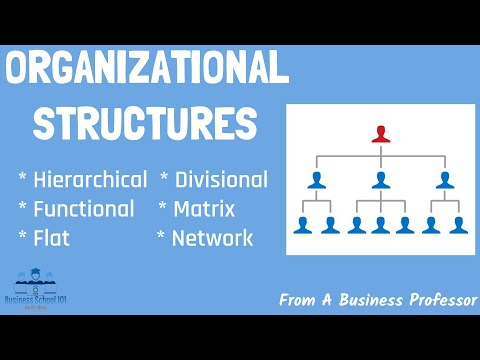
6 Most Common Types of Organizational Structures (Pros & Cons) | From A Business Professor
Organizational Structures in Business
Introduction to Organizational Structures
- The video introduces the concept of organizational structures, highlighting that traditional companies may have different structures compared to technology companies.
- Organizational structure is described as the backbone of operating procedures and workflows, determining employee roles and key for organizational development.
- The presenter outlines six common types of organizational structures: hierarchical, functional, flat, divisional, matrix, and network.
Type 1: Hierarchical Structure
- A hierarchical structure features a direct chain of command from senior management down to lower levels; decisions flow downward through management layers.
- Advantages:
- Control orientation helps employees understand leadership levels due to clearly defined roles.
- Clear career paths allow gradual advancement through management levels over time.
- Direct supervisors ease communication and clarify direction for employees.
- Disadvantages:
- Poor communication can arise due to multiple supervisory layers leading to potential misunderstandings.
- Decision-making can be slow as information must percolate through various levels, hindering responsiveness in fast-paced environments.
- High corporate overhead costs associated with maintaining numerous management layers can burden profits.
Type 2: Functional Structure
- A functional structure groups employees by specialty or related roles under designated leaders; it is effective for larger organizations with specialized skills.
- Advantages:
- Increased productivity results from specialized skills allowing quicker and more efficient work processes.
- Small teams within departments enable experienced managers to mentor team members, enhancing overall skill sets.
- Clarity in information access allows employees to know where to find expertise related to their needs.
- Disadvantages:
- Decision-making may be hindered when management is unavailable during critical projects requiring immediate feedback.
- Departments may develop a competitive mindset focused on specific goals rather than collaboration across the organization.
- Limited knowledge about how individual roles contribute to broader company objectives can restrict employee understanding.
Type 3: Divisional Structure
Organizational Structures: Advantages and Disadvantages
Divisional Structure
- Companies may have divisions focused on specific offerings, such as Cloud services or software products like Adobe's Creative Suite.
- Geographic divisional structures allow for better localization and logistics, with companies establishing satellite offices to stay close to customers.
- Advantages:
- Accountability and transparency increase due to dedicated management groups, making it easier to track actions and results.
- Competitive advantage in local markets through managerial autonomy allows quick responses to localized changes.
- Improved company culture by fostering unique perspectives at different levels of the organization.
Disadvantages of Divisional Structure
- Disadvantages:
- Higher operating costs due to the need for a centralized corporate division overseeing multiple divisions.
- Reduced economies of scale as separate divisions may not produce enough volume for cost efficiency.
- Encouragement of rivalries among divisions can lead to office politics and hinder collaboration.
Flat Organizational Structure
Overview
- A flat structure minimizes middle management levels between executives and frontline employees, promoting employee empowerment. Common in tech startups like Google and Amazon.
Advantages
- Employees enjoy more decision-making freedom without mid-level management, saving costs on wages that can be redirected elsewhere.
- Communication becomes more efficient without intermediaries, reducing distortion or misinterpretation of information.
Disadvantages
- Best suited for smaller organizations; larger ones may struggle with disproportionate employee-to-manager ratios leading to unaddressed issues among staff.
- Limited promotion opportunities can drive aspiring employees away from the organization.
Matrix Structure
Overview
- The matrix structure combines project management with functional management systems. First adopted by Phillips in the 1970s, it has since been utilized by major corporations like General Motors.
Advantages
- Promotes collaboration by bringing together skilled team members from various departments, leveraging existing resources instead of recruiting externally.
Organizational Structures: Advantages and Disadvantages
Matrix Structure
- Working in a matrix structure allows employees to gain valuable experience across different departments, but it can lead to unclear managerial roles due to undefined power dynamics between functional and project managers.
- Decision-making may be slower in a matrix organization as approvals often need to go through multiple managers, unlike traditional structures where processes are more straightforward.
- Team members may experience work overload since they juggle project responsibilities alongside their regular functional duties, potentially leading to burnout or decreased quality of work.
- Evaluating employee performance can be challenging in a matrix setup because team members often perform dual roles—both functional and project-related tasks.
Network Structure
- A network structure involves collaboration among multiple organizations to produce goods or services, either through partnerships for specific ventures or outsourcing functions like marketing.
- An example of a company using this structure is H&M, which outsources production to various Asian countries. This allows the company to focus on its core competencies while reducing costs.
- Outsourcing enables firms to lower operational costs and access specialized services that might yield better quality than if handled internally.
- The flexibility of network structures allows organizations to adapt production techniques and quantities without significant issues; however, this comes with challenges related to control over operations.
Challenges of Network Structure
- As networks expand, maintaining consistency becomes difficult; managing widespread operations can lead to complications in oversight and control.
- Relying on external firms for critical tasks increases dependency and reduces control over operations, which could pose risks if those firms also serve competitors.
- While outsourcing can reduce costs, it may also mean sacrificing potential profits that could have been earned by handling the work internally.
Conclusion on Organizational Structures