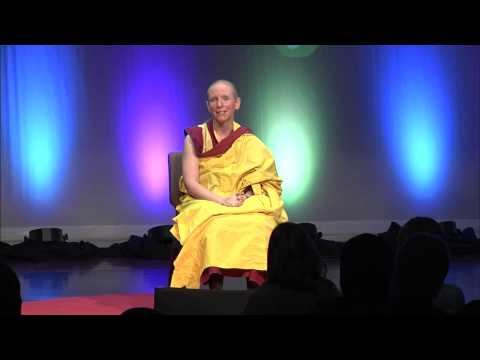
Happiness is all in your mind: Gen Kelsang Nyema at TEDxGreenville 2014
Introduction and Simple Questions
The speaker starts by asking simple questions to engage the audience.
Are you having a good day?
- The speaker asks the audience if they are having a good day.
- No need to answer out loud.
Why are you having a good or bad day?
- The speaker asks why the audience is having a good or bad day.
- Reflect on the reasons behind your emotions.
Would you rather have a good or bad day tomorrow and in the future?
- The speaker asks if the audience would prefer to have a good or bad day in the future.
- Consider your preferences for different days of the week.
Happiness Depends on Internal Factors
The speaker discusses how our happiness depends on our internal mindset rather than external circumstances.
Our mind is like a balloon in the wind
- Our mind is often influenced by external circumstances, leading to fluctuations in our happiness.
- When things go well, we feel happy, but when faced with challenges or dislikes, our happiness disappears.
External conditions should not determine our happiness
- If we attribute our happiness solely to external conditions, it will be unstable.
- Listing external factors as reasons for a good day does not lead to lasting happiness.
Take control of your own happiness
- Stop outsourcing your happiness and unhappiness to people and circumstances.
- Avoid blaming others for your unhappiness.
Two Steps Towards Having a Good Day Everyday
The speaker shares two steps towards achieving stable daily happiness.
Step 1: Stop attributing happiness to external factors
- Do not rely on external conditions for your happiness.
Step 2: Stop blaming others for unhappiness
- Avoid making others responsible for your unhappiness.
Conclusion
The speaker concludes by emphasizing the importance of taking control of our own happiness.
Our happiness is in our hands
- By not depending on others or external circumstances, we can have stable happiness.
Take responsibility for your own happiness
- We should strive to have a good day every day by focusing on our internal mindset and not relying on external factors.
Happiness and Cultivating Inner Peace
In this section, the speaker discusses the importance of cultivating inner peace and happiness from within our own minds. They emphasize that happiness and unhappiness are states of mind, and their true causes cannot be found outside the mind. The speaker also introduces the concept of meditation as a means to cultivate a peaceful positive state of mind.
Cultivating Inner Peace
- Happiness and unhappiness are states of mind; their real causes cannot be found outside the mind.
- Our state of mind determines our happiness or unhappiness.
- Meditation is a mental action that involves concentrating on a peaceful positive state of mind.
Formal Meditation vs Daily Life
- Meditation can be done formally, by sitting comfortably and focusing on a positive peaceful state of mind.
- However, meditation can also be practiced in daily life by consciously cultivating positive states of mind, such as patience.
Experiencing Inner Peace through Meditation
- During meditation, one can focus on the sensation of breath at the tip of the nose and imagine breathing out agitation and unhappiness while breathing in clear bright light representing inner peace.
- By tapping into our own potential for a peaceful positive state of mind through meditation, we can experience inner peace coming from within ourselves.
Bringing Inner Peace into Daily Life
- The goal is to bring this inner peace with us into the rest of our day to benefit ourselves and others.
This summary focuses on key points related to cultivating inner peace and happiness from within through meditation. It does not include sections unrelated to this topic or any additional information beyond what is provided in the transcript.