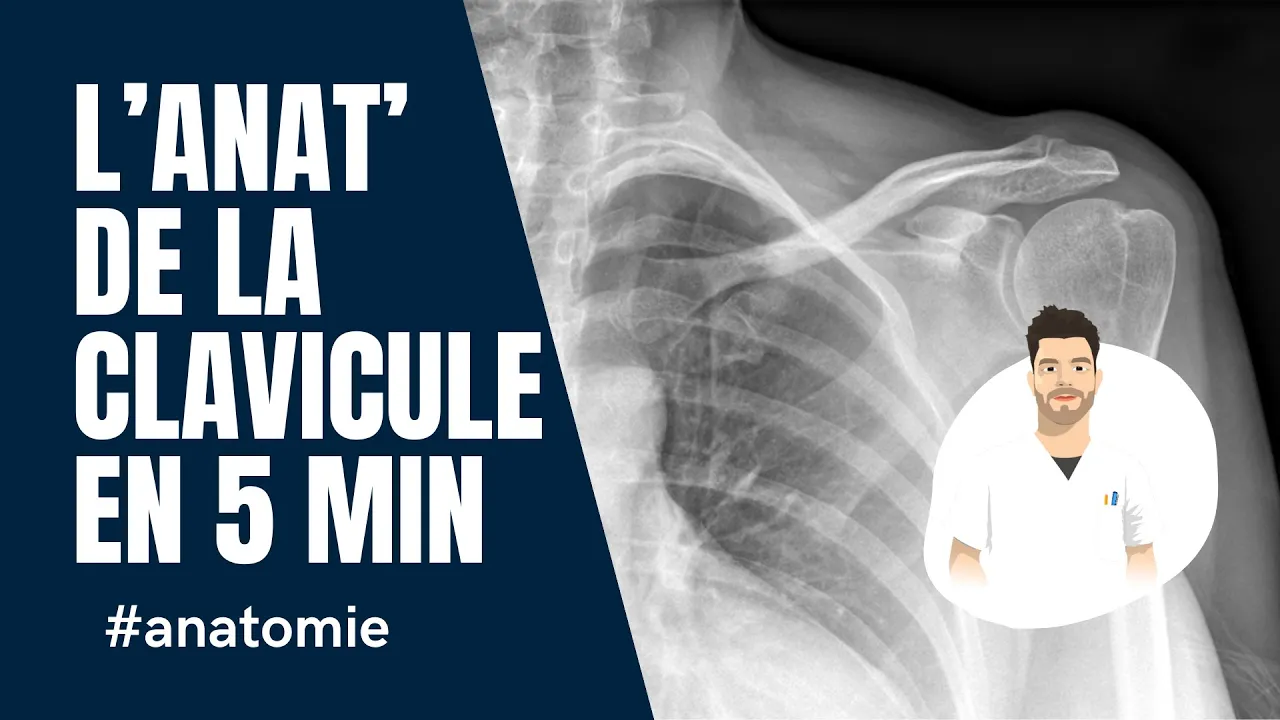
L'ANATOMIE de la CLAVICULE en 5 min !
New Section
The clavicle, also known as the collarbone, is discussed in detail, highlighting its unique features and functions within the human body.
Clavicle Structure and Function
- The clavicle is shaped like a flattened and elongated "S," lacking a medullary canal. It articulates with the manubrium sternal and acromion of the scapula to form sternoclavicular and acromioclavicular joints.
- The clavicle has superior and inferior surfaces, anterior and posterior borders, and internal and external ends. Its superior surface is subcutaneous, housing muscles like platysma. Nerves such as supraclavicular nerves innervate the shoulder area.
- The superior face of the clavicle is nearly flat externally but convex internally. Muscles like deltoid and trapezius attach to its external part while the sternocleidomastoid muscle attaches internally.
Osteology and Myology of Clavicle
- Supraclavicular nerves divide into medial, intermediate, and lateral branches to innervate the skin above the shoulder. The clavicle's internal part attaches muscles like pectoralis major while externally it connects with deltoid muscle.
- The subclavius muscle inserts below the groove on the inferior surface of the clavicle. Posteriorly lies facia posteroaxillary which receives insertion from pectoroaxillary fascia.
Detailed Anatomy of Clavicle
- The inferior face shows convexity in its middle part where subclavius muscle inserts. A rough oblique surface houses ligaments crucial for limiting clavicular rotation during upper limb movements.
- Notable structures include conoid tubercle receiving conoid ligament insertion for stability during movements. Additionally, there's a nutrient foramen under this structure aiding in vascular supply.
Articulations of Clavicle
- Costal tubercle articulates with the first rib while posteriorly sternohyoid muscle attaches. Anterior border appears convex internally but concave externally accommodating pectoralis major insertion internally and deltoid attachment externally.
- Posterior border mirrors anterior border but in reverse orientation hosting SCM internally and trapezius externally. Medial end articulates with manubrium sternal forming sternoclavicular joint while lateral end meets acromion forming acromioclavicular joint.
New Section