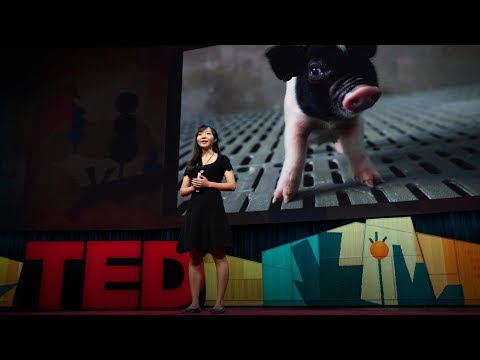
How to create a world where no one dies waiting for a transplant | Luhan Yang
Introduction to Laika
The speaker introduces Laika, a cute pig that symbolizes hope for patients in need of organ transplants.
Laika as a Symbol of Hope
- Laika is a very cute pig that represents hope for hundreds of thousands of patients in need of organ transplants.
- Organ supply has been an issue since the 1970s, and the problem has worsened over time due to increased demand.
- Currently, there are close to 115,000 patients in the US waiting for organ transplants.
- The situation is heartbreaking for patients, their families, and doctors who want to do more. In some parts of the world, it has become a disturbing social issue.
Solving the Organ Transplant Crisis with Gene Editing
The speaker discusses how gene editing technology can help solve the organ transplant crisis.
Gene Editing and Xenotransplantation
- Gene editing technology allows for the creation of human-transplantable organs that can be safely grown in pigs.
- Xenotransplantation is the process of transplanting animal organs into humans. Pigs are chosen because they have organs similar in size and physiology to human organs.
- Rejection and transmission of viruses from pigs have been major hurdles in xenotransplantation. These issues have put the field on hold for more than a decade.
- The speaker is optimistic that with gene editing technology, they are on their way to solving the organ transplant crisis.
Journey to Laika
The speaker shares their personal journey and connection to nature that led them to work towards solving the organ transplant crisis.
Personal Connection and Scientific Curiosity
- The speaker grew up in Emei Mountain in China, where they developed a strong connection with nature.
- They studied biology at Peking University and became fascinated by questions about genetic makeup and the immune system.
- After college, the speaker pursued a PhD at Harvard University, where they worked with Dr. George Church and experimented with genetic makeup.
- In 2013, they made changes in a human cell using CRISPR, a groundbreaking tool for DNA editing. This experiment brought them closer to Laika.
The transcript provided does not cover the entire video or provide timestamps for every section of the video.
Think about it as genetic scissors with a microscope
The speaker introduces the concept of using CRISPR as genetic scissors guided by a microscope to cut and repair DNA.
Using CRISPR for Medical Applications
- Physicians at Mass General Hospital reached out to the speaker after their study on CRISPR was reported.
- They saw the potential of using CRISPR to solve the organ shortage crisis.
How do we do it? It is simple, yet very complex.
The speaker explains the process they use to create pig organs that are compatible with humans.
Cloning Process
- Changes are made in a pig's cell to make it virus-free and human-immune-compatible.
- The nucleus of that cell is implanted into a pig egg, which then divides into an embryo.
- The resulting embryo is placed into the uterus of a surrogate mother and allowed to develop into a pig.
- This process essentially involves cloning.
Tackling the viral transmission problem
The speaker discusses their efforts to remove all copies of the PERV virus from the pig genome using CRISPR.
Eliminating PERV Virus
- In 2015, the team aimed to remove all 62 copies of the PERV virus from pigs' genomes.
- Initially, they could only make one or two modifications within a cell using CRISPR.
- Through careful design and hundreds of trials, they successfully removed all copies of the virus and broke previous records.
- Their studies showed that they could eliminate the possibility of transmitting this dangerous virus to humans.
Progress in creating genetically modified pigs
The speaker shares their progress in creating pigs without PERV and highlights their potential for solving organ shortage issues.
Laika - A Pig Without PERV
- In 2019, their startup eGenesis produced Laika, the first pig born without PERV.
- Laika represents a critical step in establishing safe xenotransplantation and can be further genetically modified to solve immunology problems.
- They have created more than 30 pigs without PERV, making them the most advanced geno-modified animals on Earth.
A world without organ shortage
The speaker envisions a future where organ shortages are eliminated through advancements in genetic modification.
Potential Impact
- Patients with liver failure could receive new livers without having to wait for donations or human deaths.
- People with diabetes may no longer rely on insulin after every meal if they receive pancreatic cells that can produce insulin on their own.
- Patients with kidney failure could avoid the burden of dialysis.
- The speaker's goal is to create a world without organ shortage.
Challenges and responsibility
The speaker acknowledges the challenges ahead and emphasizes the responsibility to translate cutting-edge science into medicine.
Humility and Responsibility
- Nature presents more issues to address, including immunology challenges that may arise unexpectedly.
- It is their responsibility to translate scientific advancements into medical solutions for patients in need.
Q&A: Next steps and timeline
The speaker answers questions about the next steps in their research and when successful transplants might occur.
Solving Transplant Rejection
- The next steps involve removing antigens from pig organs and learning from cancer's ability to evade the immune system. This knowledge can be applied to fooling the immune system into not attacking transplanted organs.
Timeline for Successful Transplants
- The speaker cannot provide an exact timeline but expresses hope that successful transplants will happen within one decade of their work.
Closing Remarks
The speaker concludes the talk and expresses gratitude.
Gratitude
- The speaker thanks the audience for their attention and applause.
Timestamps are approximate and may vary slightly depending on the video playback.
New Section
In this section, the speaker discusses how no one can criticize someone for eating bacon if they themselves consume it.
No Criticism for Bacon Eaters
- The speaker mentions that no one can say anything negative about eating bacon if they also enjoy consuming it.
Turn any video into a summary like this
YouTube links, meetings, lectures. With transcripts, search, and chat.