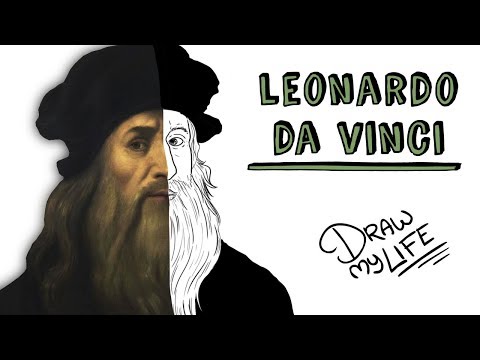
LEONARDO DA VINCI | Draw My Life
Leonardo da Vinci: A Renaissance Polymath
Early Life and Apprenticeship
- Leonardo di ser Piero da Vinci, known as Leonardo da Vinci, was born on April 15, 1452, in Vinci, Italy. He excelled in various fields during the Italian Renaissance.
- His father allowed him to apprentice with artist Verrocchio at age seventeen due to his curiosity and talent.
Artistic Development and Innovations
- While apprenticing, he learned painting and sculpture and contributed to the construction of the dome of Santa Maria dei Fiore alongside Brunelleschi.
- Da Vinci introduced oil painting techniques from the Netherlands in his first major work "La adoración de los Magos," allowing for greater control over paint thickness.
Major Works and Techniques
- In 1483, he painted "Virgen de las Rocas," utilizing a new technique called sfumato that created softer edges for depth.
- Sfumato was later used in "La Gioconda" (Mona Lisa), creating an optical effect where her smile appears to fade when viewed directly.
Contributions Beyond Painting
- In 1494, he illustrated Luca Pacioli's "La Divina Proportione," establishing himself as a pioneer of modern scientific illustration; notable works include the “Hombre de Vitruvio.”
- By 1498, he completed "La última cena," which humanized biblical figures and became iconic for its innovative composition.
Later Years and Legacy
- After political instability in Milan around 1500 led him to Venice, he pursued anatomical studies through cadaver dissections.