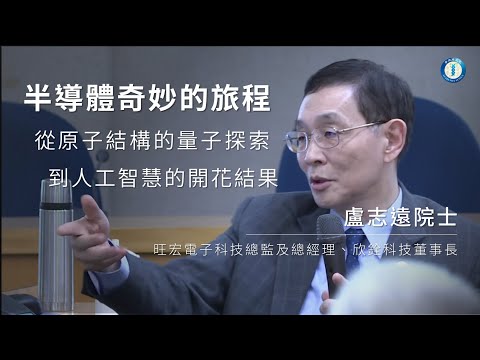
半導體奇妙的旅程—從原子結構的量子探索到人工智慧的開花結果|盧志遠院士
非常重要关键的角色
Introduction to the Semiconductor Journey
- The speaker introduces a special guest, Academician Lu Zhiyuan, to discuss the fascinating journey of semiconductors from quantum physics explorations to today's artificial intelligence.
Personal Journey and Milestones
- Academician Lu expresses gratitude for the introduction and acknowledges the gathering of guests, students, and professors.
- He shares that his own journey parallels the semiconductor evolution, beginning with his graduation in 1986 from Jianzhong High School.
- This year marks his 50th anniversary since graduating from National Taiwan University’s Physics Department.
Historical Context of Semiconductors
- Lu highlights a significant event commemorating 60 years of integrated circuits (IC), which coincides with his age.
- He presents three photos illustrating technological advancements over time.
Technological Advancements: Memory Storage Comparison
- The first photo shows an old airplane carrying a large memory box that contained only 5 Megabytes, priced at $120,000.
- By 2005, technology had advanced significantly; MicroSD cards could hold 128MB and were much cheaper than earlier memory storage solutions.
Global Connectivity Through Technology
- The second image is a world map showing satellite imagery at night. Bright areas indicate high activity levels on platforms like Facebook.
- Notably, China appears dark due to restrictions on Facebook usage while other regions show vibrant connectivity.
Evolution of Communication Devices
- The third image contrasts past gatherings where people held candles during pilgrimages with modern events where everyone uses smartphones for illumination.
科学方法与技术进步
Understanding Scientific Methodology
- Lu emphasizes that understanding history helps predict future developments in technology and science.
- He discusses how significant changes have occurred within just sixty years in semiconductor technology.
Historical Comparisons: Flight Innovations
- Comparing early flight attempts by the Wright brothers to landing on the moon illustrates rapid advancements in human innovation over six decades.
科学观察的重要性
Observational Science as Foundation
- Emphasizing scientific methodology involves rigorous observation followed by hypothesis formulation and testing through experimentation.
古典电磁学的贡献
Classical Electromagnetism's Role
- Classical electromagnetism is described as a beautiful yet powerful field of study that laid foundational principles for modern physics.
理论与实践的结合
Bridging Theory with Practical Applications
- To solve complex questions about natural phenomena like why the sky is blue requires deep theoretical understanding rooted in classical equations established by scientists like Maxwell.
从电子到现代计算机的发展历程
Discovery and Development of Electronics
- The discovery of electrons was pivotal for understanding atomic structure and led to further developments in quantum mechanics necessary for explaining electronic behavior.
This structured markdown file captures key insights from the transcript while providing timestamps for easy reference. Each section focuses on specific themes or topics discussed throughout the presentation.
Understanding Electrons and Atomic Structure
The Discovery of Electrons
- The process begins with heating metal, which produces steam that represents electrons being accelerated.
- The speaker identifies the first person to discover electrons, emphasizing their significance in atomic structure.
- A model is introduced where positive and negative charges exist within an atom, likened to raisins in a cake.
Rutherford's Experiment
- Rutherford conducts an experiment using alpha particles to probe the structure of atoms, aiming to reveal electrons.
- An unexpected phenomenon occurs: some particles bounce back instead of scattering, indicating a dense core within the atom.
- This leads to the conclusion that matter is mostly empty space with a small but heavy nucleus at its center.
Atomic Composition Insights
- The size comparison illustrates that if an atom were a stadium, its nucleus would be as small as a golf ball at its center.
- Despite atoms being mostly empty space, electromagnetic forces prevent physical penetration between objects.
Quantum Mechanics and Electron Behavior
Light Emission from Gases
- Heating gases causes them to emit light; specific wavelengths are observed rather than continuous spectra.
- Bohr proposes that electrons occupy distinct energy levels and can jump between these levels by absorbing or emitting light.
Discrete Energy Levels
- Electrons do not transition continuously between energy states but rather in discrete jumps, leading to quantized energy levels.
Schrödinger's Wave Equation
- Schrödinger describes electron behavior using wave functions, suggesting they behave like clouds rather than fixed points in orbitals.
Implications for Semiconductor Technology
Quantum Mechanics' Role in Semiconductors
- Quantum mechanics is essential for understanding semiconductor properties; without it, controlling semiconductors would be impossible.
Historical Development of Transistors
- The evolution from vacuum tubes to transistors marks significant advancements over decades in electronic technology.
Conductivity Variations Among Materials
Understanding Conductivity Differences
- Quantum mechanics explains why materials exhibit vastly different electrical conductivities based on their atomic structures and impurities present.
Semiconductor Control Mechanisms
- By manipulating impurities within semiconductors (like adding salt), conductivity can be finely tuned—this principle underlies modern electronics.
This structured summary captures key concepts discussed throughout the transcript while providing timestamps for easy reference.
Understanding Semiconductors and Their Importance
The Basics of Conductors, Insulators, and Semiconductors
- Discussion begins on controlling materials, specifically semiconductors.
- Introduction to the three types of materials: insulators, semiconductors, and conductors; highlighting their differences in size and properties.
- Inquiry into the locations where semiconductors are found.
The Significance of Carbon in Chemistry
- Mention of Group 14 from the periodic table as crucial for chemistry students.
- Question posed about what makes this group significant.
- Assertion that all life is based on carbon; emphasizing its foundational role in biology.
Properties of Carbon
- Diamonds are highlighted as a form of carbon, showcasing its versatility.
- Explanation that carbon forms the basis for integrated circuits (IC), indicating its stability and importance in technology.
Semiconductor Doping Techniques
- Introduction to energy levels within semiconductors; how adding impurities can affect conductivity.
- Explanation of how doping with different elements alters electrical properties significantly.
Electron Behavior in Doped Semiconductors
- Description of silicon's electron configuration and how it interacts with dopants like arsenic to create free electrons for conduction.
- Discussion on holes created by missing electrons and their role in conductivity.
The Creation and Functionality of PN Junction Diodes
Formation of PN Junction
- Explanation that combining P-type (positive charge carriers) and N-type (negative charge carriers) creates a fundamental semiconductor structure known as a PN junction.
Electrical Characteristics
- Overview of how current flows through a diode when voltage is applied; one direction allows flow while the other does not.
Historical Context
- Reference to Shockley’s work leading to the development of diodes which earned him a Nobel Prize in 1956.
Evolution from Transistors to Integrated Circuits (IC)
Transition from Transistor to IC Technology
- Insight into modern devices containing billions of transistors due to advancements in IC technology.
Innovations by Key Figures
- Mentioning Jack Kilby’s contributions towards integrating multiple transistors into single chips without soldering connections.
Recognizing Unsung Innovators
Contributions Beyond Fame
- Acknowledgment that true inventorship often goes unrecognized; recounting stories about lesser-known figures who contributed significantly but did not receive accolades like Nobel Prizes.
Impact vs. Recognition
- Emphasis on making real impacts over mere ideas or proposals; stressing that tangible contributions lead to historical recognition.
The Semiconductor Industry's Growth Trajectory
Historical Development
- Overview from 1940 to 1965 showing exciting discoveries yet slow industrial growth primarily supported by defense projects until civilian applications took off around 1965.
Current Landscape
- Discussion on major players evolving over time within the semiconductor industry, including shifts among companies like TI, Intel, Samsung, etc., reflecting rapid changes within just sixty years.
This structured summary captures key insights from the transcript while providing timestamps for easy reference back to specific parts of the discussion.
Exploring Competition and Market Dynamics
The Cost of Competition
- Discussion on the competitive landscape, questioning the ability to compete when products are significantly more expensive.
- Observations about consumer behavior regarding purchasing decisions, particularly with high-end products like iPhones.
- Emphasis on the lack of a viable industry if prices remain excessively high.
Technological Advancements
- Introduction of a graph illustrating technological performance over time, relating it to Moore's Law.
- Mention of 5G technology as an enabler for increased computational power and data processing capabilities.
- Importance of powerful computing in managing large datasets effectively.
Memory Technology and Its Implications
Evolution of Memory
- Recap on memory advancements, highlighting significant reductions in size and capacity over time.
- Current state where electronic components have drastically reduced in number within devices.
Reliability Concerns
- Discussion on flash memory reliability over long periods, questioning its durability after ten years.
- Explanation that even minor errors (like a single bit failure) can lead to significant issues in calculations.
Challenges Facing Moore's Law
Limitations of Scaling Down
- Acknowledgment that continuing to scale down components is becoming increasingly difficult due to physical limitations.
Alternative Approaches
- Introduction of 3D technology as a potential solution for overcoming scaling challenges without merely stacking components.
The Role of AI in Modern Computing
Requirements for AI Development
- Three critical factors necessary for AI: increased computation power, higher memory density, and cost-effectiveness.
- Highlighting that without these elements, developing effective AI solutions becomes impractical.
Data Collection Trends
- Overview of the Internet of Things (IoT), emphasizing how interconnected devices facilitate massive data collection at low costs.
Historical Context and Future Directions in AI
Past Developments in AI
- Reflection on early interest in AI during the 1970’s among physics students transitioning into computer science fields.
Breakthrough Moments
- Notable achievement by AlphaGo defeating a world champion Go player, marking a significant milestone for AI capabilities.
Energy Efficiency Strategies for AI
Reducing Power Consumption
- Discussion on strategies aimed at reducing energy consumption while enhancing computational efficiency through new architectures and materials.
Quantum Computing Potential
- Exploration into quantum computing as an avenue for solving complex problems more efficiently than classical computers.
Unique Properties of Quantum Mechanics
- Explanation of superposition and entanglement principles that could revolutionize computing paradigms if harnessed effectively.
Is Absolute Security Possible?
Theoretical Security of Passwords
- In theory, passwords can be secure, but breaking them may take longer than the lifespan of the universe.
- The difficulty in cracking a password is what defines its security; computers attempt to guess by brute force.
- A computer will keep trying combinations until it eventually finds the correct one.
Complexity of Passwords
- Password complexity increases with more characters and symbols, making it harder for computers to crack them.
- If a password requires extensive time to break, it is considered secure.
Quantum Computing Threat
- With advancements like quantum computers, traditional passwords may become insecure as they can be cracked quickly.
- The emergence of powerful computing methods poses a contradiction: if we have advanced computers, we also need stronger passwords.
Current Developments in Quantum Computing
- Various companies are exploring quantum computing using superconductors and spins; notable examples include IBM and Google with their respective bit achievements.
- Despite progress, current quantum systems face challenges such as low temperatures and instability.
Historical Context and Future Prospects
- Early developments in technology took years to stabilize; similar patience is needed for current advancements in quantum computing.
- There are multiple approaches being explored that signal hope for future breakthroughs in this field.
The Impact of Science on Technology
Evolution of MRI Technology
- Magnetic Resonance Imaging (MRI), which has saved countless lives, was recognized with Nobel Prizes over decades for its development.
Scientific Influence on Society
- The cycle from scientific discovery to technological application impacts industries and ultimately benefits society.
Distinction Between Scientists and Engineers
Roles Defined
- Scientists seek to understand the world while engineers create new solutions based on existing knowledge.
Purpose Differences
- Both roles are challenging but serve different purposes: scientists focus on discovery while engineers emphasize invention.
Key Takeaways from Scientific Inquiry
Lasting Contributions
- Understanding divine rules through academic exploration leads to significant contributions as scientists or engineers.
Innovation's Role
- Innovations derived from science can lead to new experiences and business models that benefit humanity.
Ethical Considerations in Advancing Technology
Responsibility with Power
- As technology advances, ethical considerations grow; who bears responsibility when power falls into the wrong hands?
Questions from the Audience
Discussion on M-RAM Technology
- An audience member asks about M-RAM's differences compared to current memory technologies. Taiwan's position in semiconductor advancements is highlighted.
Challenges Faced by Taiwan’s Semiconductor Industry
- While TSMC leads embedded memory efforts, standalone applications remain difficult due to complex processes involved.
Concerns Regarding MRI Machines
- Another question addresses why Taiwan cannot produce MRI machines despite purchasing them internationally.
Industry Maturity Issues
- It’s noted that mature industries tend toward oligopoly; entering these markets requires substantial investment without guaranteed success.
Huawei's Technological Positioning
- A final question discusses Huawei’s reliance on American technology amidst geopolitical tensions affecting global supply chains.