Las MEZCLAS HETEROGÉNEAS explicadas: cómo identificarlas, características y ejemplos🧪
Understanding Heterogeneous Mixtures
Definition and Characteristics of Heterogeneous Mixtures
- Heterogeneous mixtures consist of multiple distinguishable components or phases (solid, liquid, gas), each retaining its properties.
- To identify a heterogeneous mixture, look for two or more distinct material phases; examples include rice with lentils and oil mixed with water.
- Separation methods for these mixtures are primarily physical, utilizing techniques like decantation and filtration without chemical reagents.
Properties of Heterogeneous Mixtures
- A key characteristic is non-uniformity; the mixture does not appear consistent throughout due to distinguishable phases.
- They have a predominant phase that exists in greater proportion, known as the dispersing phase, while other components are termed dispersed phases.
- These mixtures can exhibit multiple states of matter simultaneously, such as solid particles in a liquid medium.
Types of Solid Heterogeneous Mixtures
- Examples include soil and fruit baskets; these mixtures are diverse and relatively easy to separate using various methods.
Suspensions vs. Colloids
- Suspensions contain small solid particles dispersed in a liquid; they settle over time due to gravity (e.g., sand in water).
- Colloids consist of smaller particles that remain stable longer than those in suspensions; they may appear homogeneous but reveal distinct phases under microscopic analysis.
Separation Methods for Heterogeneous Mixtures
Overview of Separation Techniques
- Manual separation is the simplest method for small-scale mixtures, allowing for direct removal by hand (e.g., picking chocolate from cake).
Common Separation Methods
- Decantation: Separates liquids from solids by pouring off the top layer without filters (e.g., separating water from settled sand).
- Filtration: Uses filters to separate solids from liquids effectively (e.g., filtering sand from water).
Separation Techniques in Heterogeneous Mixtures
Methods of Separation
- Low-pressure evaporation: This technique is used to separate components of mixtures, such as fat and protein from milk, by allowing the liquid with a lower boiling point to evaporate first. It is crucial for producing milk powder.
- Dissolution: Primarily applied to solid heterogeneous mixtures, this method involves bathing the mixture in water or diluted hydrochloric acid to remove impurities and achieve uniformity.
- Magnetic separation: Utilized for solid mixtures where at least one component responds to magnetic attraction. Iron particles are a classic example that can be effectively separated using this method.
Examples of Heterogeneous Mixtures
- Cupcake or cake: The cake represents a recognizable material phase while chocolate drops on its surface signify another distinct solid phase.
- Jupiter's crust: The gaseous crust exhibits multiple distinguishable phases, including a large reddish spot, illustrating the complexity and heterogeneity present on massive scales.
- Mixed salad: An everyday example where components can be manually separated, showcasing the concept of heterogeneous mixtures in culinary contexts.
Additional Examples
- Ham bread: A Venezuelan holiday dish exemplifying a heterogeneous mixture due to its varied ingredients like raisins, ham, bacon, and olives.
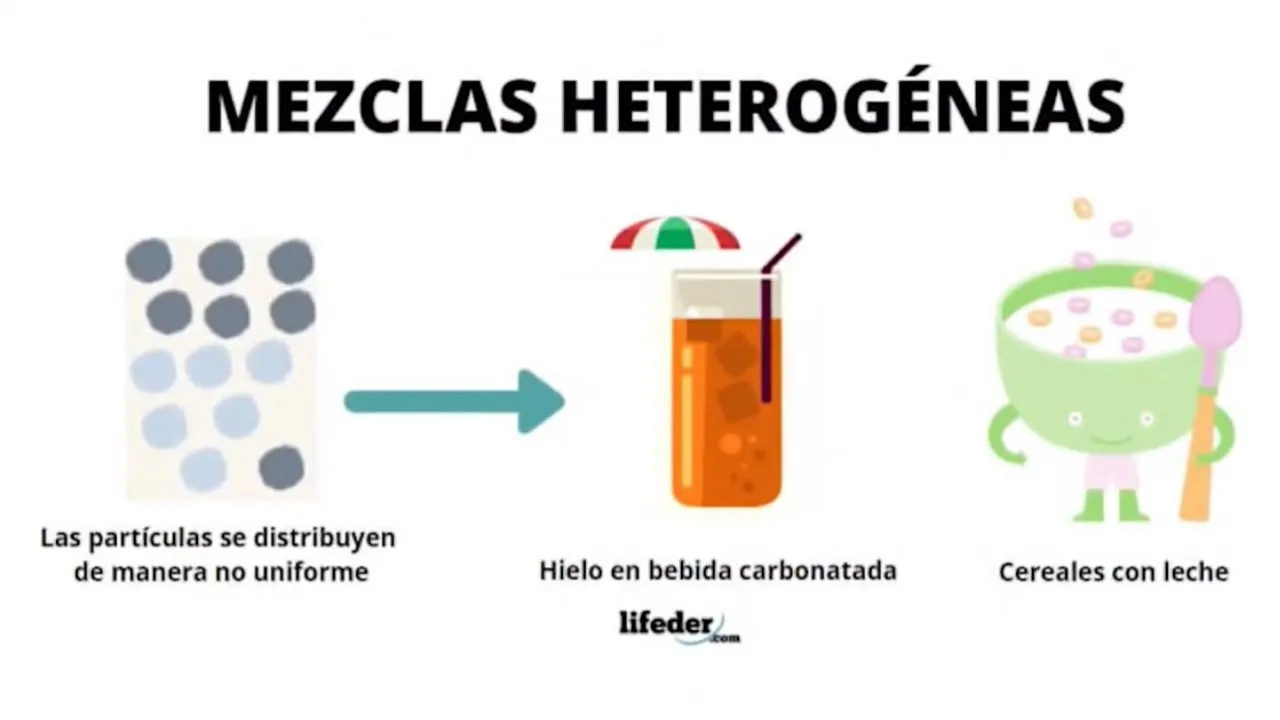
- Soda and carbonated beverages: These are considered heterogeneous because the bubbles of carbon dioxide form a distinct gaseous phase within the liquid.
- Other examples include:
- A bowl of cereal with milk
- Pizza with unevenly distributed toppings
- Nut mixtures containing different elements
- The ocean as a vast heterogeneous mixture comprising diverse biological components
- Pollution as a mix of various suspended particles in air