Pharmacology - ANTIEPILEPTIC DRUGS (MADE EASY)
Antiepileptic Drugs: Understanding Pharmacology
Overview of Seizures
- The primary use of antiepileptic drugs (AEDs) is to prevent or control epilepsy, characterized by sudden bursts of uncontrolled electrical activity in the brain.
- Seizures are classified into two major groups:
- Focal seizures: Affect a portion of the brain, typically one hemisphere, with or without awareness impairment.
- Generalized seizures: Affect both sides of the brain simultaneously and almost always result in loss of consciousness.
Mechanisms Behind Seizures
- Seizures can be viewed as an imbalance between inhibitory and excitatory processes in the brain, leading to either too little inhibition or excessive excitation.
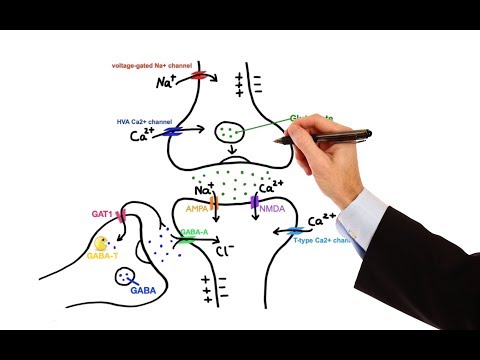
- Neurons communicate through action potentials, which are initiated by voltage-gated sodium channels opening and allowing sodium ions to enter the cell.
- Glutamate release occurs when calcium ions enter neurons; it binds to AMPA and NMDA receptors on postsynaptic neurons, facilitating further depolarization.
Role of Inhibitory Neurotransmitters
- Excessive glutamate can lead to hyperexcitability; however, inhibitory neurons release GABA that counteracts this effect by making the inside of neurons more negative.
- GABA-A receptors allow chloride ions to enter upon binding with GABA, limiting neuronal response to stimulation.
- After dissociation from GABA-A receptors, GABA is removed from the synaptic cleft via reuptake through GAT-1 and degraded by GABA-T.
Pharmacology of Antiepileptic Drugs
- The main goal of AED therapy is to lower neuronal excitability or enhance inhibition.
- Some AEDs block voltage-gated sodium channels (e.g., Carbamazepine, Lamotrigine), reducing sodium influx into neurons.
Additional Mechanisms and Drug Classes
- Many AEDs target multiple mechanisms; for instance:
- Lamotrigine & Topiramate: Block both sodium and calcium channels.
- Topiramate: Also inhibits excitatory neurotransmission via AMPA receptor blockade.
Unique Mechanisms
- Gabapentin and Pregabalin bind specifically to alpha-2-delta subunits on high-voltage calcium channels, modulating glutamate release for their antiepileptic effects.
- Levetiracetam binds SV2A proteins in vesicles containing glutamate, impairing its release and decreasing neuronal excitability.
Other Notable AED Actions
- Felbamate blocks NMDA receptors inhibiting excitatory neurotransmission.
- Benzodiazepines and Barbiturates enhance GABA-A receptor function by prolonging channel openings for increased chloride ion influx.
Antiepileptic Drugs and Their Side Effects
Mechanisms of Action and Drug Examples
- Vigabatrin: This drug irreversibly inhibits GABA-aminotransferase, the enzyme responsible for breaking down GABA. This action increases GABA concentrations in the brain, enhancing receptor binding on postsynaptic neurons.
Common Side Effects of Antiepileptic Drugs
- General Side Effects: Sedation and dizziness are common side effects associated with all antiepileptic drugs.
- Specific Drug Reactions:
- Carbamazepine & Oxcarbazepine: Can lead to hyponatremia (low sodium levels).
- Vigabatrin: Associated with visual field loss.
- Lamotrigine & Phenytoin: May cause double vision.
Additional Drug-Specific Side Effects
- Phenytoin: Known to cause gingival hyperplasia (gum overgrowth) and hirsutism (excessive hair growth).
- Cognitive Issues: Topiramate and Zonisamide can result in cognitive problems.
- Weight Changes:
- Topiramate is linked to weight loss.
- Valproic acid is more frequently associated with weight gain, though Gabapentin and Pregabalin can also contribute to this issue.