How does the INTERNET work? | ICT #2
How Does the Internet Work?
The Journey of Data
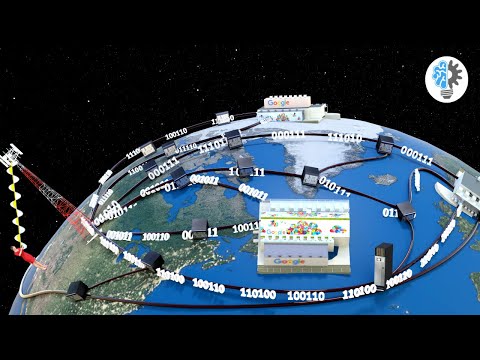
- The video you are watching has traveled from a Google Data Center to your device, illustrating the complex journey of data.
- While satellites could transmit signals, they introduce significant latency due to their distance (22,000 miles above Earth), making them unsuitable for most internet applications.
Optical Fiber Cables
- Instead of satellites, data is transmitted through a network of optical fiber cables connecting data centers to devices like mobile phones and laptops.
- Videos are stored in solid-state devices (SSDs) within servers at data centers, which act as powerful computers providing requested content.
Understanding IP Addresses
- Every internet-connected device has a unique identifier known as an IP address, similar to a home address that ensures information reaches its destination.
- Domain names (e.g., youtube.com) simplify access to websites by corresponding with IP addresses, making it easier for users to remember them.
DNS: The Internet's Phone Book
- A server can host multiple websites; thus, additional information called host headers is used for identification when accessing these sites.
- The Domain Name System (DNS) functions like a phone book for the internet, translating domain names into IP addresses upon request.
Data Transmission Process
- When you enter a domain name in your browser, it requests the corresponding IP address from the DNS server before forwarding it to the appropriate server.
- Data travels in digital format via optical fiber cables as light pulses over long distances and through challenging terrains.
Infrastructure and Signal Conversion
- Global companies maintain optical cable networks that lay cables undersea using specialized ships and plows creating trenches on the seabed.
- Routers convert light signals into electrical signals for transmission via Ethernet cables or cellular towers depending on how users connect to the internet.
Management of Internet Resources
- An organization called ICANN manages essential aspects of the internet such as IP address assignments and domain name registrations.
Efficiency of Data Transfer
Understanding Data Packet Transmission
Structure of Data Packets
- Each data packet consists of six bits, along with a sequence number and the IP addresses of both the server and the receiving device (e.g., your phone).
- Packets do not necessarily follow the same route; each packet independently selects the best available path to reach its destination.
Packet Reassembly and Loss Management
- Upon arrival at your phone, packets are reassembled based on their sequence numbers.
- If any packets fail to arrive, an acknowledgment is sent from your phone requesting those lost packets to be resent.
Comparison with Postal Systems
- The process is likened to a postal network where improper addressing can prevent letters from reaching their intended destinations.
Role of Protocols in Data Management
Turn any video into a summary like this
YouTube links, meetings, lectures — with transcripts, search, and chat.