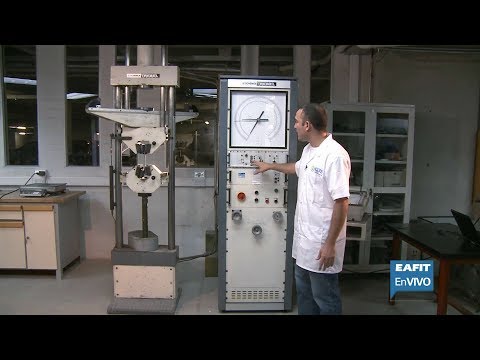
Ensayo: de tracción a probeta de acero
Universal Static Testing Machine Overview
Functionality and Capabilities
- The universal static testing machine can perform various tests including tension, compression, bending, hardness, and cutting depending on the devices used.
- It operates hydraulically through a piston mechanism, with speed measured in megapascals per second.
- The machine features a fixed head and a movable one that applies increasing pressure to the specimen during testing.
- Maximum capacity is 120 kilonewtons; scales can be adjusted for different test requirements (60, 24, or 12 kilonewtons).
Specimen Types and Materials
- Special jaws are designed for cylindrical specimens; flat specimens require different jaws. A typical specimen has about a 10 mm diameter.
- The material used in this context is ISISAE 1020 Structural steel, commonly utilized in civil engineering for seismic resistance reinforcement of concrete.
Measurement Techniques
- Mechanical strain gauges amplify small deformations (2 to 20 times) to make them more visible during testing. This is particularly useful for measuring micro-deformations in elastic zones.
- Testing speeds typically range from 2 to 10 megapascals per second depending on the type of test being conducted. Graphical representation of stress or compression can be plotted accordingly.
Test Execution Process
- During tension tests, measurements begin from the lower quadrant upwards; force is recorded in newtons while deformation is noted in millimeters on respective axes.
- An amplified test begins at a speed of 2 megapascals per second using kilonewtons as the unit of force measurement; initial deformations may not be visually apparent without specialized instruments like micrometers.
Material Behavior Observations
- As force increases towards yield point (between 25 and 30 kilonewtons), material transitions from elastic to plastic behavior where deformation becomes permanent beyond this point.